

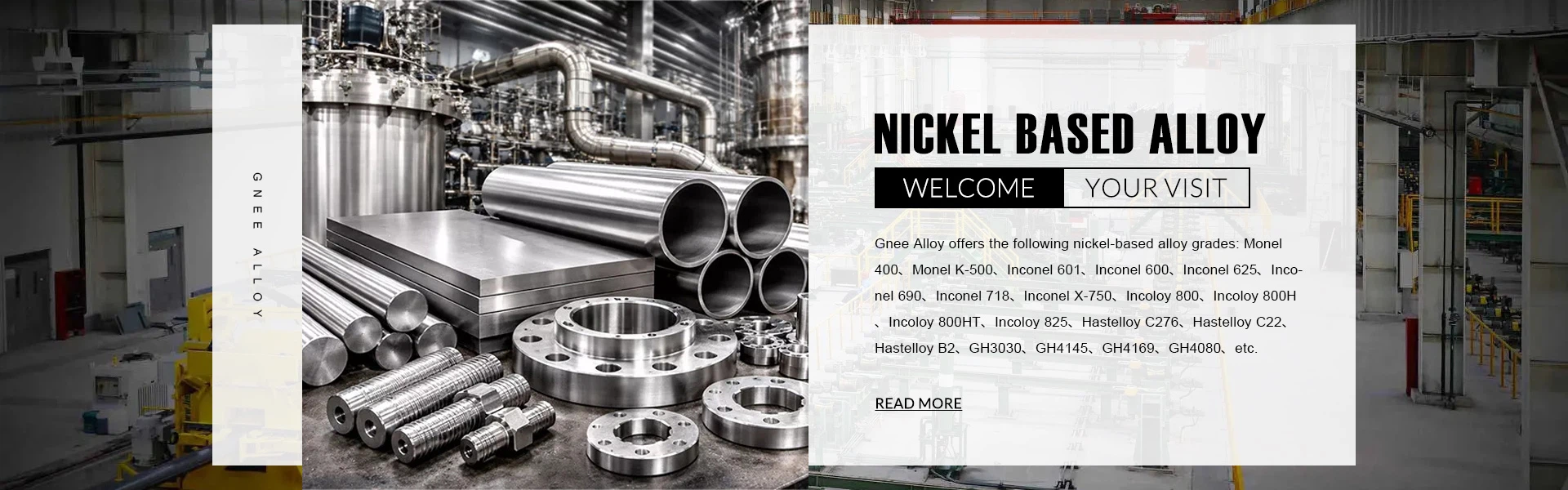
Hastelloy C4: Corrosion-resistant metal material in chemical processing
Hastelloy C4 (UNS N06455) is a wrought nickel-chromium-molybdenum alloy. It has extremely high corrosion resistance. This alloy is particularly important in industries where metal materials are exposed to harsh environments, such as chemical processing, aerospace.
Chemical Composition
The chemical composition of Hastelloy C4 is a key factor in determining its unique properties. The alloy consists primarily of nickel, chromium and molybdenum, with trace amounts of other elements to enhance its properties.
| Element | Content (%) |
|---|---|
| Chromium, Cr | 14-18 |
| Molybdenum, Mo | 14-17 |
| Iron, Fe | 3 max |
| Cobalt, Co | 2 max |
| Manganese, Mn | 1 max |
| Titanium, Ti | 0.7 max |
| Silicon, Si | 0.08 max |
| Phosphorus, P | 0.04 max |
| Sulfur, S | 0.03 max |
| Carbon, C | 0.015 max |
| Nickel, Ni | Remainder |


Physical Properties
| Properties | Metric | Imperial |
|---|---|---|
| Density | 8.64 g/cm³ | 0.312 lb/in³ |
| Melting point | 1427°C | 2600°F |
Mechanical Properties
| Properties | Metric | Imperial |
|---|---|---|
| Tensile strength | 738 MPa | 107000 psi |
| Yield strength ( @ 0.2% offset) | 492 MPa | 71400 psi |
| Elastic modulus | 211 GPa | 30600 ksi |
| Elongation at break (in 50.8 mm) | 42% | 42% |
Thermal Properties
| Properties | Metric | Imperial |
|---|---|---|
| Thermal expansion co-efficient (@ 20°C/68°F) | 10.8 µm/m°C | 6 µin/in°F |
| Thermal conductivity (@ 23°C/73°F) | 10.1 W/mK | 70.1 BTU in/hr.ft².°F |
Heat Treatment, Processing and Machining
Recommended Processing and Heat Treatment Parameters:
Forging: 1177-954°C
Soft Annealing: 1065±14°C; 30 minutes; WQ
Forging - The alloy can be hot forged within a narrow temperature range, starting at 1177°C and finishing at 954°C. Moderate reduction and frequent reheating are recommended for best results. The alloy is strain sensitive.
Cold working does not reduce its general corrosion resistance, but it will affect its resistance to stress corrosion cracking. Annealing after processing is essential to obtain the best corrosion performance.
Annealing consists of heating to 1066°C and water quenching. A hold at the annealing temperature of 10 to 30 minutes is recommended, with thicker structures requiring 30 minutes. Annealing is essential after hot forming operations and after any cold forming that results in an outer fiber elongation of 7% or more.
Post-weld heat treatment for basic applications - Heat the material to 705°C and hold at that temperature for at least 0.5 hour for every 25 mm of thickness. Determine the heating and cooling rates based on the part shape. For complex shapes with non-uniform thickness, use a heating and cooling rate of 111°C per hour. Shapes with uniform thickness may use faster heating and air cooling.
Applications
Components for wastewater treatment
Components for chemical processing
Nuclear fuel processing


