

Looking for a reliable Inconel 718 and Inconel X-750 alloy supplier in China? You've come to the right place. As a leading Inconel high-temperature alloy manufacturer and factory with over 18 years of experience, GNEE offers factory-direct prices, eliminating middlemen. This guide will provide a detailed comparison of Inconel 718 and Inconel X-750, covering composition, performance, applications, and price factors to help you choose the right material for your project.
Inconel Alloy 718 vs Inconel X-750 Alloy Comparison
Inconel Alloy 718 vs Inconel X-750 Alloy Comparison
Due to its molybdenum content, Inconel 718 alloy possesses excellent strength, weldability, and corrosion resistance (especially in reducing environments), making it ideal for high-stress aerospace components. Inconel X-750, on the other hand, offers superior high-temperature oxidation resistance and resistance to stress corrosion cracking, making it popular in power generation and spring applications. X-750 alloy is strengthened with titanium/aluminum (γ'), while 718 is hardened with γ'/γ'', but 718 generally outperforms X-750 in overall mechanical properties and under harsh conditions.
Is Inconel X-750 magnetic?
This material has excellent relaxation resistance and is non-magnetic. Its high-temperature strength reaches 1300ºF (700°C), and its oxidation resistance reaches 1800ºF (983˚C). Inconel X-750 resists corrosion from a variety of industrial corrosives under both oxidizing and reducing conditions.

1. Overview: Introduction to Inconel 718 and Inconel X-750
Both Inconel 718 and Inconel X-750 are nickel-based superalloys, renowned for their excellent high-temperature strength, oxidation resistance, and corrosion resistance. They are widely used in aerospace, energy, and chemical industries.
Inconel Alloy 718: An age-hardening alloy containing niobium and molybdenum, it maintains high strength at temperatures up to 700°C and exhibits excellent weldability.
Inconel X-750: Age-hardening with the addition of aluminum and titanium, it possesses excellent resistance to relaxation at high temperatures and is commonly used in springs and fasteners.
Despite their similar names, the two alloys differ significantly in composition, heat treatment, and primary applications.
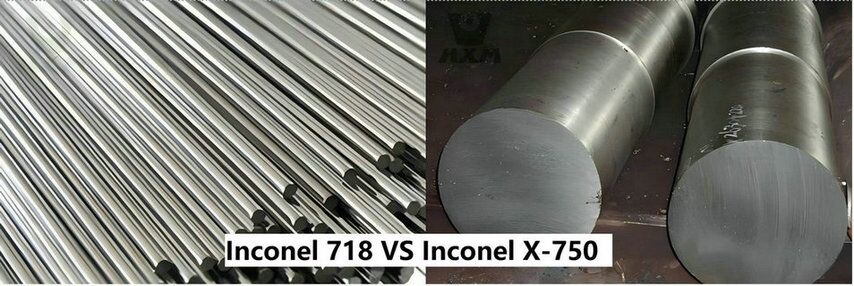
Factory product images of Inconel 718 alloy and Inconel X-750 alloy
2. Chemical Composition Comparison: Inconel 718 vs. Inconel X-750
| Element | Inconel 718 (UNS N07718) Content (%) | Inconel X-750 (UNS N07750) Content (%) |
|---|---|---|
| Nickel (Ni) | 50 – 55 | ≥ 70 |
| Chromium (Cr) | 17 – 21 | 14 – 17 |
| Iron (Fe) | Balance | 5 – 9 |
| Niobium + Tantalum (Nb+Ta) | 4.75 – 5.5 | 0.7 – 1.2 |
| Molybdenum (Mo) | 2.8 – 3.3 | – |
| Titanium (Ti) | 0.65 – 1.15 | 2.25 – 2.75 |
| Aluminum (Al) | 0.2 – 0.8 | 0.4 – 1.0 |
| Carbon (C) | ≤ 0.08 | ≤ 0.08 |
Key differences:
Inconel 718 contains significant amounts of molybdenum and niobium, enhancing its high-temperature strength and creep resistance.
Inconel X-750 has a higher nickel content and a higher aluminum-titanium content, resulting in a more pronounced age-hardening effect.
3. Inconel 718 And Alloy X-750 Mechanical Properties & Heat Treatment
The heat treatment process directly affects the final properties of the alloy.
**Inconel 718 Typical Heat Treatment and Properties**
Heat Treatment: Solution treatment (980°C) + Aging (720°C/8h → 620°C/8h, furnace cooling).
Room Temperature Tensile Strength: ≥ 1275 MPa.
High Temperature Properties: Maintains high strength and good fatigue resistance at 650°C.
Advantages: No need for re-aging after welding; good machinability.
**Inconel X-750 Typical Heat Treatment and Properties**
Heat Treatment: Solution treatment (1150°C) + Aging (845°C/24h + 705°C/20h, air cooling).
Room Temperature Tensile Strength: ≥ 1030 MPa.
High-temperature performance: Excellent resistance to relaxation below 700°C, suitable for spring manufacturing.
Advantages: Good long-term structural stability at high temperatures.
4. Application Fields Comparison: Inconel 718 vs. Inconel X-750

Inconel 718 Vs. Inconel X-750 Application
| Application Area | Inconel 718 (UNS N07718) | Inconel X‑750 (UNS N07750) |
|---|---|---|
| Aerospace – Jet Engines | Turbine discs, blades, casings, structural engine components | Springs, fasteners, sealing rings, turbine blade retaining rings |
| Gas Turbines | Hot‑section components, high‑temperature structural parts | Turbine blade retaining rings, fasteners, sealing elements |
| Oil & Gas (Downhole Tools) | High‑pressure, high‑temperature downhole tools, wellhead equipment | – |
| Nuclear Industry | Reactor structural components, core internals | Bolts, springs, fixtures for reactor and fuel assembly |
| Heat Treatment & Tooling | – | Fixtures, high‑temperature molds, furnace racks, holding tools |
| General High‑Temperature Fastening | – | Bolts, studs, nuts, washers for elevated‑temperature service |
5. Corrosion Resistance Comparison
Both perform excellently in most corrosive environments, but with slight differences in performance.
Oxidation and Carbonization: Both exhibit excellent oxidation resistance in air up to 980°C. X-750, due to its slightly lower chromium content, may be slightly inferior to 718 in extreme oxidizing environments.
Chloride Stress Corrosion Cracking: The high nickel content gives both good resistance to stress corrosion cracking.
Acidic and Alkaline Environments: Both perform well in a variety of acidic and alkaline solutions. Inconel 718, due to its molybdenum content, may have an advantage in reducing acidic media.
6. Inconel 718 and Inconel X-750 machinability and weldability
Machinability:
Both alloys can be machined in the annealed state, but they are difficult to machine, requiring carbide tools, low-speed, high-feed machining, and sufficient cooling.
Inconel 718 exhibits a more pronounced work hardening tendency.
Weldability:
Inconel 718: Excellent weldability among age-hardening alloys. It can be welded using various methods such as TIG, MIG, and electron beam welding, with a low tendency for post-weld cracking.
Inconel X-750: Decent weldability, but requires complete solution treatment and aging after welding to achieve optimal performance; otherwise, strain-aging cracks are prone to occur in the heat-affected zone.
7. Cost Analysis and Selection Guide
Price Factors:
Raw Material Costs: Inconel X-750 has a higher nickel content, typically resulting in a higher base cost than 718.
Machining Difficulty: Complex parts require higher machining costs.
Heat Treatment: X-750 has a longer heat treatment cycle, potentially increasing costs.
Market Supply and Demand: Fluctuations in aerospace demand affect prices.
Selection Recommendations:
Choose Inconel 718 if: Your needs include high-strength components, excellent weldability, and operation in the 650-700°C range, such as turbine disks and structural parts.
Choose Inconel X-750 if: Your needs include high-temperature relaxation resistance, long-term structural stability, and springs or fasteners operating below 700°C.
Contact us for the latest price list for Inconel 718 and Inconel X-750 alloys and free material selection consultation.


