


UNS N06600 (W.Nr. 2.4816 / Inconel 600) Nickel-Chromium-Iron Alloy is specifically engineered for high-temperature heat exchangers. Covering both American and European material standards, it is widely utilized in petrochemical processing, power plant high-temperature heat exchange, and alkaline corrosion service environments, setting it apart from standard stainless steels.
What is UNS N06600 W.Nr. 2.4816?
UNS N06600, also designated W.Nr. 2.4816 (NiCr15Fe), is the unified cross-reference identifier for Inconel 600 nickel-base alloy, governed by two independent material numbering systems. UNS is the unified numbering system used in the United States, while W.Nr. 2.4816 is the German Werkstoffnummer, with the chemical shorthand NiCr15Fe reflecting its core nickel‑chromium‑iron composition.
It is critical to distinguish this nickel-base alloy from conventional stainless steel. Unlike stainless grades that rely primarily on chromium for corrosion resistance, UNS N06600 features high nickel content to deliver superior resistance to chloride stress corrosion cracking and high-temperature oxidation. For heat exchanger applications, seamless tubes follow ASTM B163 specification, and plate/sheet products comply with ASTM B168. This cross-grade mapping helps global purchasers avoid material mix-up when sourcing across different regional standards.
Why UNS N06600 W.Nr.2.4816 works for high-temperature heat exchangers?
High-temperature oxidation resistance up to 1093℃
In air environments, UNS N06600 maintains reliable oxidation resistance at continuous service up to 1093℃. It forms a dense protective oxide layer to prevent scaling and spalling under repeated thermal cycles, ideal for the high-temperature side of shell-and-tube heat exchangers.
01
Resistance to caustic corrosion & chloride SCC
UNS N06600 delivers robust resistance to hot caustic corrosion and chloride stress corrosion cracking. 316L stainless steel is prone to SCC failure at temperatures exceeding 150℃ in chloride-alkali media, while Inconel 600 stays stable under these harsh exchanger conditions.
02
Stable mechanical property under thermal cycling
The alloy retains consistent yield strength during frequent thermal cycling from ambient to elevated temperatures. Low thermal fatigue tendency reduces permanent deformation and crack initiation, avoiding structural rupture under continuous heating and cooling cycles in heat exchanger service.
03
Good weldability for exchanger tube-to-tube sheet joints
It exhibits excellent weldability for tube-to-tube sheet connections, the highest-risk failure zone of heat exchangers. Properly annealed Inconel 600 welds maintain matching corrosion resistance and ductility without post-weld intergranular embrittlement.
04
Typical heat exchanger applications & product forms
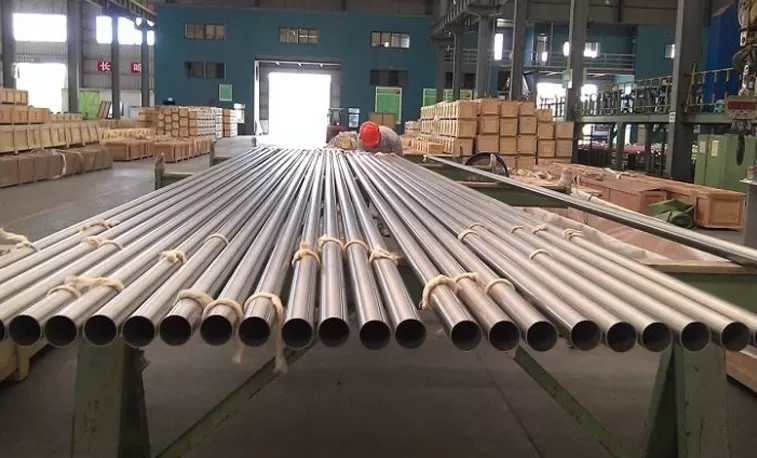
UNS N06600 (W.Nr.2.4816) is widely fabricated into plates, seamless tubes and round bars to serve different structural and heat transfer demands of heat exchangers. Each product form targets specific components in shell-and-tube, U-tube and plate heat exchangers for high-temperature corrosive service.
| Product Form | Heat Exchanger Components | Core Service Requirements |
|---|---|---|
| Seamless Tube | Heat transfer tubes, U-bend tubes, high-temperature process piping | ASTM B163, full-length eddy current test, hydrostatic test, tight dimensional tolerance |
| Plate / Sheet | Tube sheets, exchanger shell, baffle plates, lining panels | Flatness control, fine surface finish, plasma or laser cutting, PMI inspection |
| Round Bar | Stud bolts, fasteners, support shafts, fixture parts | Stable mechanical strength, good machinability, corrosion resistance in hot media |
Seamless tubes undertake core heat exchange and fluid conveyance. Tube sheets and shell plates bear pressure load and isolate corrosive medium. Round bars provide reliable fastening to prevent joint loosening under thermal cycling.
Common mistakes when sourcing UNS N06600 / W.Nr.2.4816 for heat exchangers
1.Matching only one material designation instead of both UNS and W.Nr.
Many buyers only check UNS N06600 or W.Nr.2.4816 separately on purchase orders. Suppliers may substitute similar nickel alloys if both marks are not specified. This mismatch leads to material downgrade risk and unexpected corrosion failure in high-temperature exchanger service.
2.Ignoring material heat treatment state for thermal cycling conditions.
Using non-annealed Inconel 600 with residual stress is a frequent error. Under repeated heating and cooling above 200℃, residual stress promotes caustic cracking. Fully solution-annealed condition is mandatory for heat exchanger pressure-bearing parts.
3.Skipping full-length eddy current or hydrostatic test for seamless tubes.
Some procurement plans only require PMI and mechanical tests, omitting eddy current inspection and hydrostatic pressure test. Tiny internal surface defects in seamless tubes cannot be detected by PMI alone. Hidden flaws may cause tube rupture after commissioning.
4.Confusing Inconel 600 with similar nickel alloys.
Engineers sometimes mix UNS N06600 with Incoloy 800H or 316L stainless steel. Incoloy 800H has weaker caustic corrosion resistance, while 316L suffers chloride SCC above 150℃. Wrong material selection results in short service life and costly shutdown.
5.Accepting incomplete material test certificates.
Partial MTC without furnace heat batch traceability cannot satisfy pressure vessel audit. Qualified documentation must link heat number, chemical composition, mechanical data and test records together. Non-traceable certificates often come from reworked or substitute alloy stock.
GNEE supply support for UNS N06600 W.Nr.2.4816 heat exchanger components
GNEE delivers one-stop material supply and inspection service for UNS N06600 / W.Nr.2.4816 heat exchanger parts, targeting the common sourcing pitfalls listed above. We lock both UNS and W.Nr. designations in sales contracts and material certificates to eliminate substitute alloy risks.
1.We strictly control heat treatment status for every batch. All pressure-bearing Inconel 600 materials for heat exchangers are supplied in fully solution-annealed condition, lowering residual stress and preventing caustic cracking under thermal cycling.
2.For seamless heat exchanger tubes complying with ASTM B163, we conduct 100% full-length eddy current testing and hydrostatic pressure test on our dedicated inspection benches. Digital micrometers record all dimension data to catch hidden tube defects before shipment.
3.We provide clear technical comparison between UNS N06600, Incoloy 800H and 316L, helping engineers avoid material mis-selection. Our technical team reviews project operating temperature and medium conditions to confirm suitable product forms.
4.Each order comes with complete 3.1 MTC documents tied to unique heat batch numbers, including chemical analysis, mechanical test and non-destructive inspection records. Full traceability meets pressure vessel project audit requirements.
We offer seamless tubes, plate/sheet and round bars for heat exchangers, along with custom cutting and machining services. Contact our engineering team to get technical datasheets and inspection schemes for your heat exchanger project.
UNS N06600 vs alternative alloys for high-temperature heat exchangers
Many heat exchanger purchasers weigh performance against budget and struggle to pick the right alloy. This comparison helps you evaluate trade-offs between UNS N06600, 316L stainless steel and Incoloy 800H for high-temperature corrosive heat transfer service.
| Alloy Grade | Max Continuous Service Temp | Caustic Corrosion Resistance | Chloride SCC Resistance | Thermal Cycling Stability | Relative Cost |
|---|---|---|---|---|---|
| UNS N06600 (Inconel 600 / W.Nr.2.4816) | 1093℃ | Excellent, stable in hot concentrated caustic media | Excellent, resists chloride stress cracking | Outstanding, low scaling & fatigue under repeated heat cycles | High |
| 316L Stainless Steel | 870℃ | Fair, fails in hot concentrated alkali | Poor, susceptible to SCC above 150℃ chloride environment | Moderate, prone to thermal fatigue at elevated temperature | Low |
| Incoloy 800H UNS N08810 | 980℃ | Good, limited performance under strong hot caustic | Moderate, better than 316L but inferior to Inconel 600 | Very good, high creep strength for long high-temperature hold | Medium-High |
For high-temperature heat exchangers with hot alkaline and chloride mixed media, UNS N06600 is the safest selection despite higher upfront cost. 316L works only for mild low-temperature clean service. Incoloy 800H suits high-temperature non-caustic environments with focus on creep resistance.

What Sizes and Wall Thicknesses Are Available for Inconel 600 Tubes?
GNEE supplies ASTM B163 UNS N06600 seamless heat exchanger tubes in standard and custom dimensions for shell-and-tube and U-tube heat exchangers.
| Parameter | Specification |
|---|---|
| Outer Diameter Range | 6 mm ~ 101.6 mm (0.25 in ~ 4 in) |
| Wall Thickness Range | 0.5 mm ~ 10 mm |
| Thin-wall for heat transfer | 0.5 mm – 2.0 mm, optimized for thermal efficiency |
| Heavy-wall for high pressure | Above 2.0 mm, for high-pressure heat exchanger loops |
| Standard straight length | Up to 12 m |
| Custom form | U-bend tubes with post-bend stress relief annealing |
| Dimensional inspection | Measured by digital micrometers, compliant with ASTM B163 tolerance |
Custom outer diameter, wall thickness and cut-to-length services are available on request. Reach our engineering team to verify dimension feasibility for your heat exchanger design.
Contact us for the latest export price quote for 600 Alloy
If you need to check size availability, tolerance limits or create a customized quotation for your Inconel 600 heat exchanger tube project, send your drawing, operating parameters and quantity requirements to our technical mailbox ss@gneesteel.com. Our material engineers will review your heat exchanger specification and reply with a full technical proposal, including test plan and MTC arrangement.
FAQ:
Q1: Is UNS N06600 the same as W.Nr.2.4816 Inconel 600 for heat exchangers?
A: Yes. UNS N06600 is the US UNS designation, W.Nr.2.4816 (NiCr15Fe) is the European material number, both refer to Inconel 600 nickel-chromium-iron alloy. When ordering heat exchanger components, quote both numbers on drawings and MTC to avoid substitute materials.
Q2: What is the maximum continuous service temperature of Inconel 600 heat exchanger material?
A: Continuous oxidation-resistant service up to 1093°C. Above this temperature, oxidation rate accelerates and creep strength drops. Short-term peak exposure can reach 1177°C, not recommended for long-term heat exchanger thermal cycling.
Q3: Which ASTM standard applies to Inconel 600 seamless heat exchanger tubes?
A: ASTM B163 / ASME SB163 is the dedicated standard for seamless condenser and heat exchanger tubes. ASTM B168 covers plate/sheet for exchanger shells and tube sheets. Welded exchanger tubes follow ASTM B516.
Q4: What inspections are mandatory for ASTM B163 Inconel 600 heat exchanger seamless tubes?
A: Required tests include PMI positive material identification, full-length eddy current testing, hydrostatic pressure test, dimensional check with micrometers, chemical & mechanical test. Full test data and 3.1 MTC material certificate will be issued per order.
Q5: Can Inconel 600 resist caustic corrosion and chloride stress cracking in heat exchangers?
A: Yes. It offers strong resistance to hot alkaline caustic corrosion and chloride-induced stress corrosion cracking, a common failure mode for 316L stainless steel in high-temperature heat exchanger chemical loops.
Q6: What is the difference between seamless and welded Inconel 600 tube for heat exchangers?
A: Seamless tube (ASTM B163) has no weld seam, stable under high pressure and repeated thermal cycling, preferred for critical chemical heat exchangers. Welded tube (ASTM B516) costs lower; weld seam becomes the weak point under heavy corrosion.
Q7: How does Inconel 600 compare with 316L / Incoloy 800H for high-temperature heat exchangers?
A: 316L fails easily under hot alkali and chloride SCC above 200°C. Incoloy 800H has better creep strength but weaker caustic corrosion resistance. Inconel 600 balances high-temperature oxidation and caustic corrosion performance.
Q8: Can you supply U-bend Inconel 600 tubes for shell-and-tube heat exchangers?
A: Yes. We can fabricate precision U-bend seamless tubes, with post-bend stress relief annealing. Every U-bent tube will pass eddy current and hydrostatic inspection before shipment.
Q9: What common failures may happen if I select wrong Inconel 600 heat exchanger material?
A: Improper heat treatment leads to intergranular embrittlement. Using welded tube in severe corrosive service causes seam leakage. Substitute low-grade alloy will trigger alkali cracking or oxidation peeling under thermal cycling.
Q10: What forms of Inconel 600 can be supplied for heat exchanger projects?
A: Seamless tubes for heat transfer fluid lines, plate/sheet for shell and tube sheets, round bars for fasteners, support shafts and clamping components. Custom cutting, machining and surface finishing services are available.


