

Inconel® 718 and Inconel® 625 are two of the most renowned high-performance nickel-based superalloys developed by Special Metals Corporation. They are both designed for extreme environments, including high temperatures and corrosive conditions. While they share similar elemental foundations, their unique alloying elements and heat treatment responses result in distinct mechanical and chemical properties. This article provides a detailed comparison to help engineers and materials specialists choose the best alloy for specific applications.
Chemical Composition
|
Element |
Inconel 718 (%) |
Inconel 625 (%) |
|
Nickel (Ni) |
50–55 |
≥58 |
|
Chromium (Cr) |
17–21 |
20–23 |
|
Iron (Fe) |
Balance |
≤5 |
|
Molybdenum (Mo) |
2.8–3.3 |
8–10 |
|
Niobium (Nb) + Tantalum (Ta) |
4.75–5.5 |
3.15–4.15 |
|
Cobalt (Co) |
≤1 |
≤1 |
|
Titanium (Ti) |
0.65–1.15 |
≤0.4 |
|
Aluminum (Al) |
0.2–0.8 |
≤0.4 |
|
Carbon (C) |
≤0.08 |
≤0.1 |
Key Differences
Inconel 718 contains significant amounts of niobium and titanium, enabling it to be precipitation-hardened for high strength.
Inconel 625 has higher molybdenum and chromium content, which improves corrosion resistance especially in chloride and acidic environments.
Mechanical Properties
|
Property |
Inconel 718 |
Inconel 625 |
|
Tensile Strength (MPa) |
1240–1380 |
827–930 |
|
Yield Strength (MPa)4 |
1030–1180 |
414–620 |
|
Elongation (%) |
12–23 |
30–50 |
|
Hardness (Rockwell C) |
36–44 |
20–30 |
|
Density (g/cm³) |
8.19 |
8.44 |
Key Differences
Inconel 718 has much higher strength and hardness, making it suitable for load-bearing, high-stress applications.
Inconel 625, while softer, offers greater ductility and weldability, making it easier to form and fabricate.
Corrosion Resistance
Inconel 625
Outstanding resistance to pitting, crevice corrosion, and stress corrosion cracking in chloride environments.
Performs excellently in seawater, chemical processing, and acidic environments like phosphoric or nitric acid.
Inconel 718
Good general corrosion and oxidation resistance.
Less resistant to chloride-induced corrosion compared to 625, especially in welded conditions.


Temperature Resistance
Inconel 625 remains stable up to 980°C (1800°F), maintaining corrosion resistance under prolonged exposure.
Inconel 718 can withstand temperatures up to 700°C (1300°F) for structural use, but starts to lose strength at higher temperatures due to aging mechanisms.
Typical Applications
Inconel 718
Aerospace turbine engines (discs, shafts)
Nuclear fuel element spacers
High-strength fasteners and bolts
Cryogenic tanks and structures
Inconel 625
Marine exhaust systems, heat exchangers
Chemical processing plants
Offshore oil and gas risers and flare stacks
Pollution control and waste treatment systems
Which One Should You Choose?
Need high strength and creep resistance under mechanical stress? → Choose Inconel 718
Need top-tier corrosion resistance in aggressive environments? → Choose Inconel 625
Both Inconel 718 and Inconel 625 are elite performers in harsh environments. Inconel 718 offers superior strength for load-bearing and high-pressure components, while Inconel 625 excels in corrosion-dominated scenarios. Your choice should be guided by whether mechanical strength or corrosion resistance is the priority in your application.
Our product range
| Product Form | Standard Specifications & Dimensions | Common Alloys (Examples) | Typical Standards |
|---|---|---|---|
| Bar & Rod | Round Bar: Diameter: 3mm ~ 300mm Hexagon Bar: Across Flats: 5mm ~ 100mm Square Bar: Width: 5mm ~ 150mm Length: Random, Cut-to-length, or Coils (small diameters) |
Alloy 200/201 Monel 400/K-500 Inconel 600/601/625/718 Incoloy 800/800H/825 Hastelloy C-276/C-22/B-2/B-3 |
ASTM B160, B164, B166 EN/DIN 2.4066, 2.4816, 2.4851 ASME SB-166, SB-167 |
| Wire | Diameter: 0.1mm ~ 12mm Form: Coils, spools, or straight lengths Finish: Bright, pickled, annealed |
Alloy 200/201 Inconel 600/625/X-750 Incoloy 825 |
ASTM B166, B167 EN/DIN 17752 |
| Sheet & Plate | Thickness (Sheet): 0.1mm ~ 5.0mm Thickness (Plate): 5.0mm ~ 100mm+ Width: Up to 2000mm (depending on alloy/thickness) Length: Up to 6000mm or as required |
Alloy 200/201 Monel 400 Inconel 600/625/718 Incoloy 800H/825 Hastelloy C-276 |
ASTM B162, B168, B409 EN/DIN 17742, 17744 |
| Strip & Foil | Thickness (Strip): 0.05mm ~ 2.0mm Thickness (Foil): 0.02mm ~ 0.05mm Width: Up to 600mm Condition: Cold rolled, annealed, tempered |
Alloy 200/201 Inconel 600/625 Incoloy 825 |
ASTM B162, B168 |
| Pipe & Tube | Seamless Pipe (ASTM B161/B167): - OD: 3/16" ~ 14" (6mm ~ 355mm) - Schedule: SCH 5S to XXS Welded Tube (ASTM B163/B516): - OD: 6mm ~ 300mm - Wall Thickness: 0.5mm ~ 10mm |
Alloy 200/201 Monel 400 Inconel 600/625 Incoloy 800H/825 Hastelloy C-276 |
ASTM B161, B163, B167, B516 ASME SB-163, SB-167 |
Get the complete product catalog
Our factory and testing
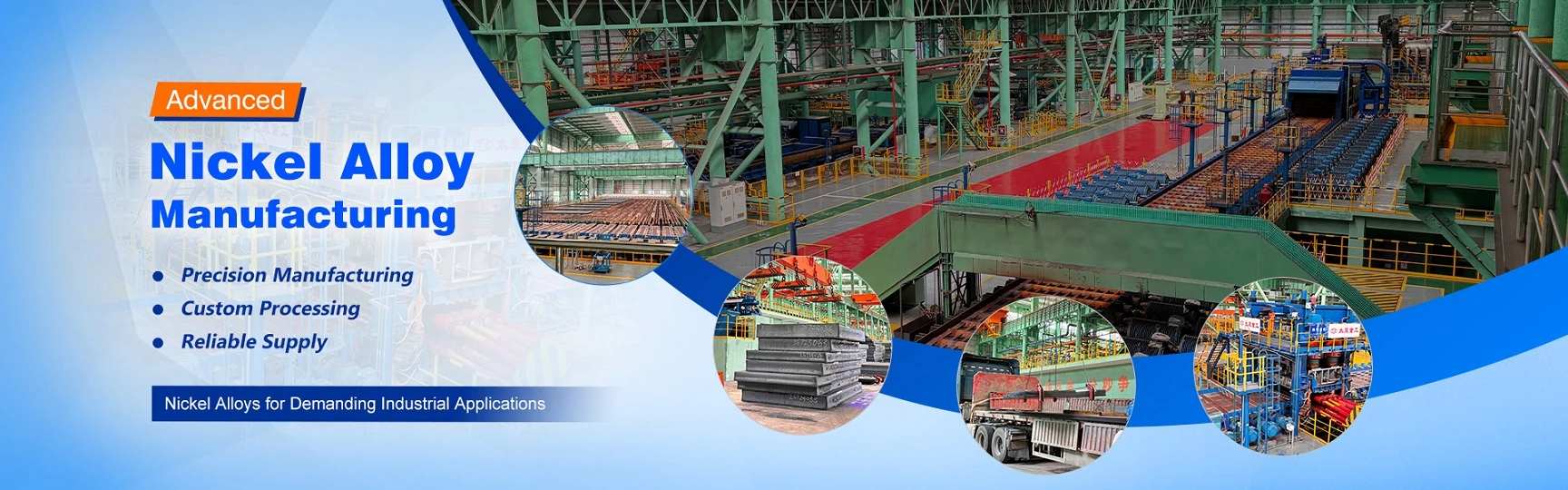
Our core factory and collaborative production system are equipped with modern precision cutting, processing, and heat treatment equipment, focusing on transforming raw materials into semi-finished and finished products that meet stringent standards. To ensure that every batch of materials meets or exceeds specifications, we have established a comprehensive end-to-end quality inspection system. From material properties analysis (PMI) upon raw material warehousing to dimensional accuracy control during production, and finally to mechanical property testing (such as tensile strength and hardness) and non-destructive testing before final shipment, every step is rigorously controlled by our professional quality inspection team. We promise to provide an authoritative, online-verifiable original manufacturer's material certificate (MTC 3.1) for every order, and can arrange for third-party certification bodies (such as SGS, BV, and TUV) to conduct on-site inspections and issue certificates upon customer request.


