

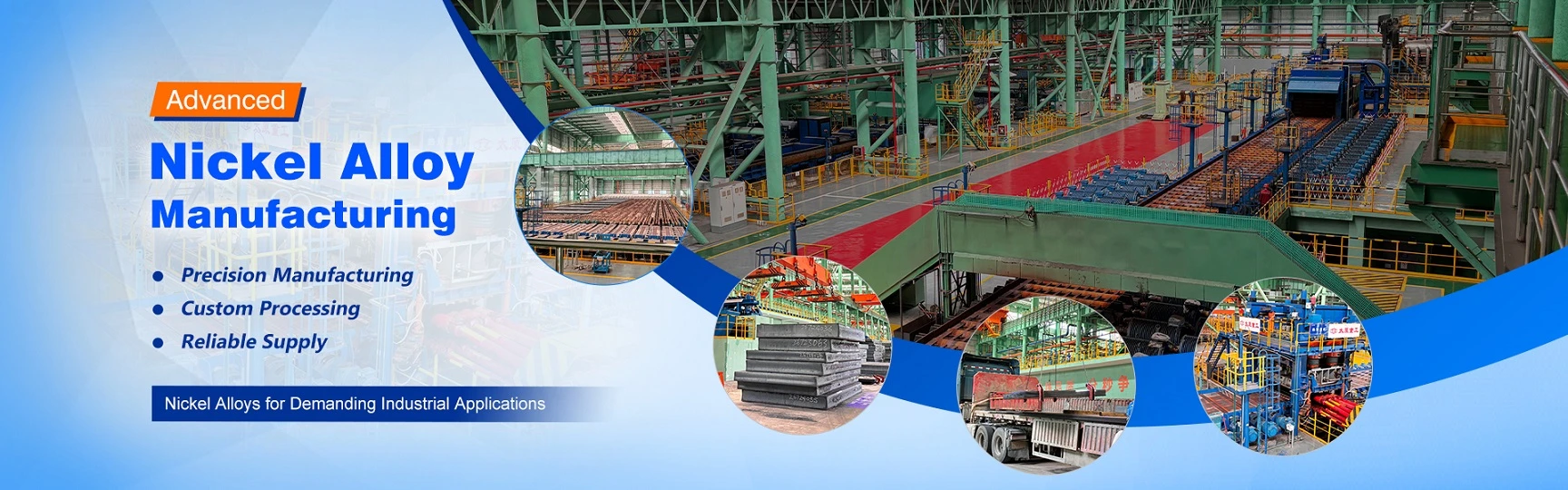
Nickel-based alloy plates are flat-rolled products with a nickel content high enough to make nickel the base element rather than an alloying addition. That distinction matters because it changes the crystal structure, the corrosion mechanism and the strengthening route available to the designer. Plates are supplied to a series of ASTM specifications that differ by alloy family, and the correct specification must be named on the purchase order because chemistry, temper and testing requirements are not interchangeable between them.
What Counts as a Nickel-Based Alloy Plate
The family covers pure nickel grades such as UNS N02200 and its low-carbon variant N02201, nickel-copper grades such as N04400, nickel-chromium grades such as N06600, nickel-chromium-molybdenum grades such as N06625, and nickel-iron-chromium grades such as N08810 with its controlled carbon content for creep service. Each of these is covered by a separate plate specification: ASTM B162 for nickel, ASTM B127 for nickel-copper, ASTM B168 for nickel-chromium, ASTM B443 for the nickel-chromium-molybdenum grade and ASTM B409 for the nickel-iron-chromium grade. Plate is normally supplied in the hot rolled, annealed and descaled condition, with the edges sheared, plasma cut or machined as ordered.
Chemistry of Common Plate Grades
| Grade | Key requirements, % | Primary reason for selection |
|---|---|---|
| N02201 | Ni 99.0 min, C 0.02 max, Fe 0.40 max | Caustic and halogen service |
| N04400 | Ni 63.0 min, Cu 28.0-34.0, Fe 2.50 max | Seawater and reducing acids |
| N06600 | Ni 72.0 min, Cr 14.0-17.0, Fe 6.0-10.0 | High temperature oxidation |
| N06625 | Ni 58.0 min, Cr 20.0-23.0, Mo 8.0-10.0, Nb+Ta 3.15-4.15 | Mixed acids and pitting |
| N08810 | Ni 30.0-35.0, Cr 19.0-23.0, C 0.05-0.10, Al 0.15-0.60, Ti 0.15-0.60 | Creep service above 600 °C |
The carbon range of N08810 is deliberately specified at the high end for this family, because the carbon combines with titanium and aluminium to form stable carbides that pin the grain boundaries and give the grade its creep strength.
High-Temperature Performance
Elevated temperature performance is governed by three separate mechanisms: oxidation, creep and phase instability. The nickel-chromium and nickel-iron-chromium plates form protective chromium oxide scales and are used in continuous service up to about 1100 °C and 900 °C respectively depending on the grade and the atmosphere. Creep becomes the design-limiting property above about 550 °C, so allowable stresses must be taken from the elevated temperature tables of the design code rather than from room-temperature tensile data. Phase instability is the third constraint: prolonged exposure to the 550 to 800 °C band allows secondary phases to form in some grades, reducing toughness and, in the worst case, ductility at the grain boundaries. Plates intended for long-term high-temperature service should therefore be ordered with a stated grain size and with a stabilised or controlled-carbon chemistry.
Corrosion Resistance
Corrosion performance follows the alloying additions. Pure nickel grades resist caustic alkalies and halogens but are attacked by oxidizing acids. Nickel-copper grades resist seawater, hydrofluoric acid and reducing acids. Nickel-chromium grades resist oxidation and chloride stress corrosion cracking but have limited pitting resistance because they contain no molybdenum. The nickel-chromium-molybdenum grade with about 9 % molybdenum and a niobium addition resists pitting and crevice corrosion in chloride solutions, mixed acids and seawater, and is the general-purpose choice where the chemistry of the process stream is uncertain. In all cases the corrosion allowance, the design temperature and the possibility of crevices under gaskets or deposits should be reviewed before the plate grade is fixed, because a plate that resists uniform corrosion may still fail by pitting or by chloride cracking in an insulated or stagnant area.
Plate Dimensions, Tolerances and Supply Condition
Plate is produced by hot rolling to thicknesses from about 3 mm to 100 mm and above, with widths commonly up to 2000 to 2500 mm and lengths up to 6000 mm. Thickness tolerance is normally expressed as a percentage of nominal thickness, and the permitted variation differs above and below the specified value. Flatness, camber and edge condition should be specified, because thin plate in the annealed condition is prone to warping during cutting and handling. Plates are supplied in the hot rolled and annealed condition, pickled or descaled, or in the as-rolled condition where the surface quality requirement permits. Where the plate will be formed into a vessel shell, the rolling direction relative to the axis of the shell affects bend performance and should be stated on the drawing.
Testing and Traceability
Each heat is tested in tension to ASTM E8/E8M, and the mill certificate should report the heat analysis, the tensile results, the heat treatment condition and the heat number stamped or stencilled on the plate. Grain size to ASTM E112 is commonly required for the high-temperature grades, and intergranular corrosion testing or hardness checks may be added for specific services. Positive material identification is a routine check at goods-in because plate grades in this family are visually indistinguishable from one another and a mix-up is both expensive and dangerous. Where the plate is to be welded to a different grade, the welding procedure should be qualified on the actual combination rather than on the filler metal alone.
Frequently Asked Questions
Q: How do I choose between the nickel-chromium and nickel-chromium-molybdenum plate grades?
A: Choose the molybdenum-bearing grade when the environment contains chlorides, mixed or reducing acids, or where pitting and crevice corrosion are credible risks; choose the simple nickel-chromium grade for high-temperature oxidation service without chlorides.
Q: Is high-temperature strength the same as room-temperature strength?
A: No. Above about 550 °C the design must be based on creep and stress rupture data, and code allowable stresses at temperature are considerably lower than the room-temperature values.
Q: What does the carbon range of a heat-resistant plate grade control?
A: Carbon, combined with titanium and niobium additions, controls the stability of the grain-boundary carbides that provide creep strength; too little carbon gives poor creep life and too much reduces toughness and weldability.
Q: Can these plates be flame cut?
A: Plasma and waterjet cutting are preferred because they leave a clean edge; thermal cutting that overheats the edge may need to be dressed back before welding, particularly on the high-temperature grades.
Q: Why is positive material identification necessary?
A: The grades in this family look identical and differ only in alloy content, so a misidentified plate can cause premature failure in service; a certificate alone is not sufficient protection against a mixed delivery.
Q: What thickness range is normally available?
A: Hot rolled plate is routinely supplied from about 3 mm to 100 mm thickness, with heavier sections available as rolled or forged product, in widths up to roughly 2000 to 2500 mm.


