

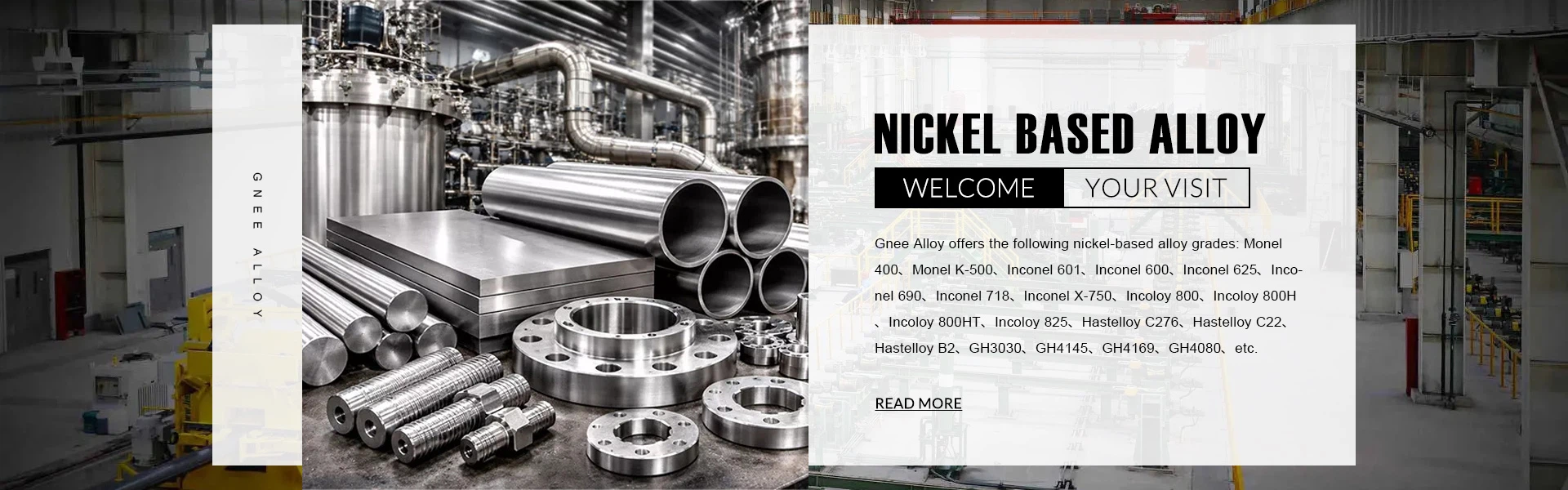
Looking for reliable Inconel 600 and Inconel 718 alloy suppliers and manufacturers in China? You've come to the right place. GNEE is a premium nickel-chromium alloy plant with over 20 years of experience in specialty metals, supplying certified materials directly from steel mills at highly competitive prices. In this guide, we'll provide a comprehensive comparison of Inconel 600 and Inconel 718 in terms of composition, mechanical properties, heat treatment, corrosion resistance, and typical applications to help you choose the most suitable material for your specific project needs.
The Difference between Inconel 600 and Inconel 718

The Difference between Inconel 600 and Inconel 718
Inconel 600 offers excellent oxidation resistance and moderate strength, making it ideal for high-temperature furnace components. Inconel 718, a precipitation-hardening alloy, maintains superior strength, tensile strength, and creep rupture properties even at temperatures up to 1300°F (700°C). Its niobium and titanium content makes it ideal for demanding aerospace and gas turbine components. The main difference lies in the fact that Inconel 718 can be heat-treated to achieve higher mechanical strength, while Inconel 600 relies on its stable nickel-chromium matrix to maintain performance stability in corrosive, high-temperature environments.
Does Inconel 718 undergo work hardening?
Inconel 718 is an extremely difficult material to process because of its high toughness, low thermal conductivity, and tendency to work harden. Furthermore, as a work-hardening material, Inconel 718 undergoes various plastic deformations during processing.

Chemical composition comparison: Inconel 600 vs. Inconel 718
| Element | Inconel 600 (UNS N06600) Content (%) | Inconel 718 (UNS N07718) Content (%) | Key Role & Difference Analysis |
|---|---|---|---|
| Nickel (Ni) | ≥ 72 | 50 – 55 | Matrix element. 600 has significantly higher Ni content, providing superior corrosion resistance in reducing media. |
| Chromium (Cr) | 14 – 17 | 17 – 21 | Provides oxidation resistance. Both have comparable Cr content, but 718 has lower high‑temperature strength due to its integrated strengthening mechanism. |
| Iron (Fe) | 6 – 10 | Balance | 718 contains a higher Fe content, which is one of its primary alloying elements. |
| Aluminum (Al) | ≤ 0.3 | 0.2 – 0.8 | Key difference. Al in 718 is one of the key elements for γ′ formation, enabling precipitation hardening. 600 has very low Al content. |
| Titanium (Ti) | ≤ 0.3 | 0.65 – 1.15 | Key difference. Works together with Al and is a core element for precipitation hardening in 718. |
| Niobium + Tantalum (Nb+Ta) | – | 4.75 – 5.5 | Key difference. Nb in 718 forms the γ″ strengthening phase, which is the main reason for its extremely high strength. 600 contains no Nb. |
| Molybdenum (Mo) | – | 2.8 – 3.3 | 718 contains Mo, which enhances solid‑solution strengthening and corrosion resistance. 600 contains no Mo. |
| Carbon (C) | ≤ 0.15 | ≤ 0.08 | 600 has slightly higher C content, requiring attention to carbide precipitation during long‑term high‑temperature service. |

The Difference between Inconel 600 and Inconel 718
Comparison of Mechanical Properties and Heat Treatment Processes
Heat treatment is crucial to the performance of Inconel 718, while its impact on Inconel 600 is relatively limited.
**Inconel 600 Typical Conditions and Properties**
Common Conditions: Annealed or Cold-Worked.
Typical Tensile Strength at Room Temperature (Annealed): ≥ 550 MPa.
High-Temperature Properties: Good oxidation resistance and moderate strength in the 600°C - 1100°C range, but its strength is significantly lower than 718 above 650°C.
Advantages: Stable microstructure, less prone to embrittlement during long-term use at high temperatures, and good processability.
**Inconel 718 Typical Heat Treatment and Properties**
Standard Heat Treatment: Solution treatment (~980°C, 1h) + Two-stage aging (720°C/8h → 620°C/8h, furnace cooling).
Typical room temperature tensile strength (aged state): ≥ 1275 MPa (approximately 2.3 times that of annealed Inconel 600).
High-temperature strength: In the 650°C - 700°C range, its yield strength and creep resistance far surpass Inconel 600, making it the preferred choice for high-temperature load-bearing structures.
Advantage: Controllable transformation from a machinable state to an ultra-high strength state can be achieved through heat treatment.
Corrosion Resistance and Oxidation Resistance Comparison
Inconel 600 has traditional advantages in high-temperature oxidation resistance and corrosion resistance in specific media.
High-Temperature Oxidation: Both exhibit excellent oxidation resistance at high temperatures. Inconel 600 is particularly well-suited for operation in high-temperature, high-purity inert or reducing atmospheres (such as carburizing and chlorination), and its high nickel content effectively resists carburizing and nitriding.
Stress Corrosion Cracking (SCC): Both have good resistance to chloride ion stress corrosion cracking. 600 exhibits particularly outstanding resistance to stress corrosion cracking in high-temperature alkaline solutions (such as NaOH).
Acid Corrosion Resistance: Inconel 600 has good resistance to a variety of organic and inorganic acids, but is not resistant to strong reducing acids (such as hydrochloric acid and sulfuric acid). Inconel 718, due to its molybdenum content, performs better than 600 in reducing acidic environments.
Aqueous Media Corrosion: Inconel 600 is widely used in heat transfer tubes of steam generators in nuclear power plants, demonstrating excellent resistance to high-temperature and high-pressure water corrosion.
Machining and Welding Properties
Machinability:
Inconel 600 (annealed state): Relatively soft, with better machinability than fully hardened 718, but still considered difficult to machine.
Inconel 718 (solution state): Machinable, but extremely hard after age hardening, making machining difficult and requiring specialized tools and processes.
Formability: Inconel 600 has better cold and hot formability, suitable for manufacturing complex-shaped parts.
Weldability:
Inconel 600: Good weldability. TIG and MIG methods can be used, with post-weld properties close to the base material. However, prolonged heating in the sensitive temperature range (700-900°C) may increase the tendency for intergranular corrosion.
Inconel 718: Excellent weldability among precipitation hardening alloys. Low tendency for post-weld cracking, but post-weld aging treatment is recommended for critical components to ensure heat-affected zone performance.

Inconel 718 Machining and Welding Properties
Inconel 600 vs 718 Industrial Applications
Both Inconel 600 and Inconel 718 are used across different sectors and industries, depending on the project type and requirements. A detailed discussion as follows:
Inconel 600 Applications: This alloy is the traditional choice for applications prioritizing broad corrosion resistance across reducing, oxidizing, and highly alkaline conditions. Its immunity to chloride-ion stress-corrosion cracking is critical in:
Chemical Processing: Heat exchangers, stills, bubble towers, and condensers.
Heat Treating: Retorts, muffles, and furnace fixtures due to oxidation resistance.
Nuclear Reactors: Core components and steam generator tubing.
Inconel 718 Applications: This alloy is the workhorse superalloy for high-stress, high-load environments where stability under heat is paramount. Its superior strength and creep resistance dominate:
Aerospace & Power Generation: Hot section turbine components (discs, blades, shafts), thrust reversers, rocket motors, and jet engine fasteners.
Oil & Gas: High-strength, high-pressure tools, packers, and mandrels for demanding down-hole applications.
Cost Considerations and Selection Guide
Cost Influencing Factors:
Material Costs: Inconel 718 contains expensive strategic elements such as niobium, resulting in a higher raw material cost compared to Inconel 600.
Processing Costs: 718's higher final hardness may lead to higher machining and forming costs. Forming and machining 600 are relatively easier to control in terms of cost.
Heat Treatment Costs: The complex aging treatment required for 718 increases both process and time costs.
Inconel 718 Decision Flowchart

Inconel 718 Decision Flowchart
Contact us for the latest price list for Inconel 600 and Inconel 718 alloys, a complete Material Testing Certificate (MTC), and free engineering consultation to determine the best alloy for your application.
Conclusion
Inconel 600 and Inconel 718 represent classic solutions for nickel-based alloys in various industrial applications. Inconel 600, a long-established and stable solid solution-strengthened alloy, excels in high-temperature oxidation resistance, carburization resistance, and certain corrosive environments (such as alkaline solutions), making it a reliable choice for the heat treatment and chemical industries.
Inconel 718, a cornerstone of modern aerospace propulsion, dominates the field of high-temperature load-bearing components with the most demanding material performance requirements, thanks to its exceptional high-temperature strength and comprehensive mechanical properties resulting from precipitation hardening.
In short, choosing 600 emphasizes environmental resistance, while choosing 718 emphasizes load-bearing capacity. As a professional Inconel alloy manufacturer with ISO 9001 certification and support for third-party inspections by SGS/BV/Lloyd's, GNEE not only ensures that material quality fully complies with ASTM/AMS standards but also provides customers with full-chain technical support from material selection to processing.
Contact us now for detailed technical information, mechanical performance reports, and competitive factory quotes for Inconel 600 or 718 to meet your project needs.


