

What Is AMS 5540 UNS N06600 Inconel 600?
AMS 5540 is SAE aerospace material specification for UNS N06600 (Inconel 600), a nickel-chromium-iron alloy. This standard governs sheet, strip and plate with max nominal thickness 50.8 mm (2 inch). It defines chemical composition, mechanical properties, heat treatment, surface condition and acceptance inspection for aerospace-grade Inconel 600 sheet.
Important note: AMS 5540 does NOT cover tube or forgings. Aerospace Inconel 600 tubing and forgings need to follow separate AMS specifications.
Material Properties of UNS N06600 for Aerospace Service
Chemical Composition of AMS 5540 UNS N06600 Inconel 600 (wt.%)
| Element | Min (wt%) | Max (wt%) |
|---|---|---|
| Nickel + Cobalt (Ni+Co) | 72.0 | - |
| Chromium (Cr) | 14.0 | 17.0 |
| Iron (Fe) | 6.0 | 10.0 |
| Carbon (C) | - | 0.15 |
| Manganese (Mn) | - | 1.00 |
| Silicon (Si) | - | 0.50 |
| Copper (Cu) | - | 0.50 |
| Sulfur (S) | - | 0.015 |
| Phosphorus (P) | - | 0.040 |
| Aluminum (Al) | - | 0.35 |
| Titanium (Ti) | - | 0.35 |
Room-Temperature Mechanical Properties for AMS 5540 Annealed Sheet (≤2 in thickness)
| Property | Unit | Minimum Requirement |
|---|---|---|
| Ultimate Tensile Strength (UTS) | ksi (MPa) | 80 (552) |
| 0.2% Offset Yield Strength | ksi (MPa) | 35 (241) |
| Elongation (Gauge >0.010 in) | % | 30 |
| Hardness | HB | ≤195 |
Elevated-Temperature Mechanical Properties (AMS 5540 Inconel 600)
| Property | 70°F (21°C) | 1000°F (538°C) | 1200°F (649°C) | 1400°F (760°C) |
|---|---|---|---|---|
| 0.2% Yield Strength (ksi) | 37 | 28.5 | 26.5 | 17.0 |
| Ultimate Tensile Strength (ksi) | 93 | 84 | 65 | 27.5 |
Notes:
AMS 5540 specification applies to annealed Inconel 600 sheet for aerospace service.
All values are specification limits, actual test results will be provided in MTR / 3.1 certification.
For forgings & seamless tube, separate AMS standards (AMS 5665 / AMS5580) govern mechanical limits.
Applicable Specifications for Inconel 600 Products
| Product Form | Specification Standard | Remarks |
|---|---|---|
| Inconel 600 Sheet / Strip / Plate | AMS 5540 | SAE aerospace specification, thickness ≤ 50.8 mm |
| Inconel 600 Aerospace Tube | AMS 5580 / ASTM B167 | AMS 5540 does not apply to tubing |
| Inconel 600 Forgings | AMS 5665 | Standalone specification for forged components |
Performance advantages for aerospace service conditions
High-temperature oxidation resistance under cyclic thermal load
AMS 5540 Inconel 600 retains stable oxidation protection up to 1095°C. Its chromium-rich oxide layer reduces material weight loss below 0.10 mg/cm² after 100-hour exposure at 980°C. It withstands repeated heating-cooling cycles during flight without rapid oxide spalling, suitable for aircraft hot-section shielding components.
Chloride and caustic stress corrosion resistance
With minimum 72% nickel content, UNS N06600 resists chloride-induced stress corrosion cracking. It maintains integrity in 20% caustic soda solution at 315°C. Unlike 316 stainless steel, it avoids spontaneous cracking in residual chloride environments from aircraft cleaning and de-icing fluids.
Consistent mechanical performance at intermediate elevated temperatures
At 538°C, the alloy still delivers minimum ultimate tensile strength of 84 ksi and 0.2% yield strength of 28.5 ksi. Property fluctuation stays within narrow AMS 5540 specification limits, preventing unexpected structural failure under sustained aerothermal load.
Reliable ductility and weldability for aerospace assembly
In annealed AMS 5540 sheet, minimum elongation reaches 30% at room temperature. No post-weld heat treatment is mandatory for many non-critical assemblies. Welded joints preserve over 90% of base metal tensile strength, lowering fabrication rejection rate for aerospace formed parts.
Differentiated usage:AMS 5540 sheet, tube and forgings in aerospace
AMS 5540 covers Inconel 600 sheet, tube and forgings, each engineered for distinct aerospace loading and corrosion requirements. The selection depends on structural load, forming method and service environment. Below table lists typical aerospace applications and core functional requirements for each product form.
| Product Form | Typical Aerospace Applications | Core Functional Requirements |
|---|---|---|
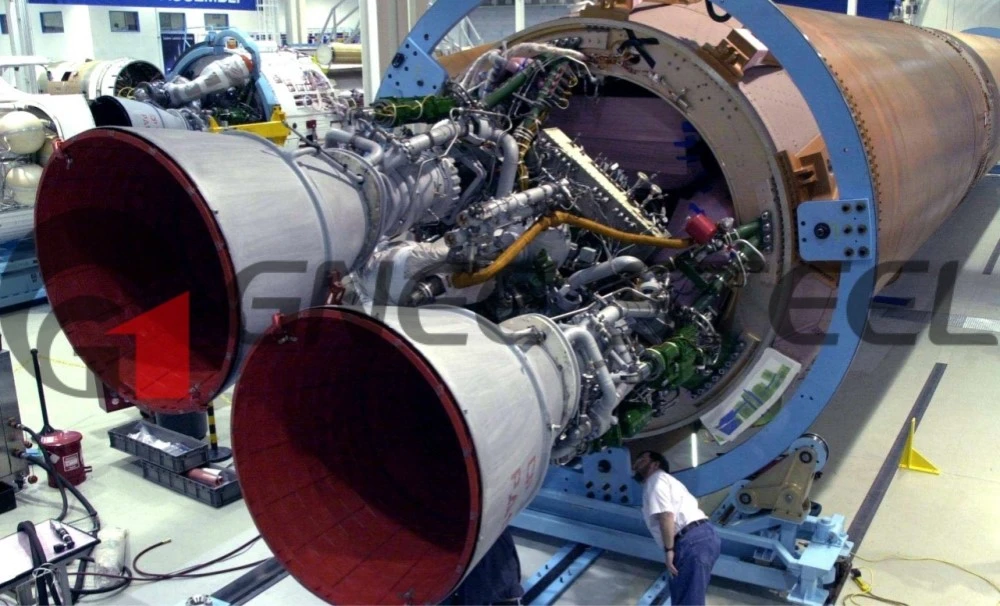
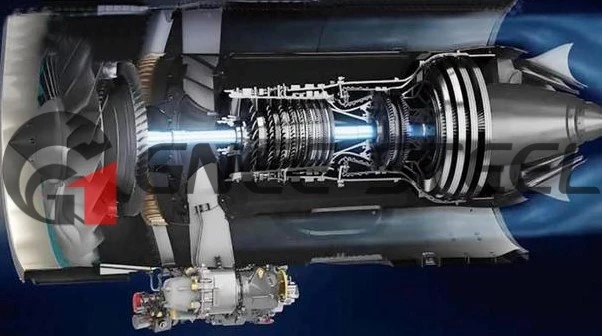
| AMS 5540 Sheet | Combustor liner shrouds, thermal shielding panels, exhaust baffles, pressure containment thin plates | High formability; stable oxidation resistance under cyclic heat load; consistent thickness tolerance; weldable for sheet assembly |
| AMS 5540 Tube | High-temperature process piping, aircraft cooling circuit, heat exchanger tubes, auxiliary fluid transfer lines | Seamless structure; strict OD & wall thickness tolerance; pass eddy current and hydrostatic test; leak-proof under thermal cycling |
| AMS 5540 Forgings | High-strength valve bodies, pump housings, fastener blanks, heavy load structural fittings | Uniform grain structure; high fatigue resistance; low segregation; capable of heavy machining for critical load-bearing parts |
AMS 5540 sheet is optimized for cold forming into complex thin-walled thermal shields, while AMS 5540 tubing prioritizes pressure tightness for continuous fluid media. Forgings are produced with controlled forging reduction and heat treatment to deliver uniform microstructure for heavy load aerospace components. Material traceability per AMS standard must be maintained across all three product forms.


Common pitfalls when sourcing AMS 5540 Inconel 600
1.Substituting ASTM-grade Inconel 600 for AMS 5540 material. Standard ASTM B168 Inconel 600 has wider composition and mechanical tolerance ranges. It does not satisfy AMS 5540's controlled melting, heat treatment and NDT rules, and will fail aerospace QA audits.
2.Incomplete heat lot traceability. AMS 5540 requires full traceability from raw melt to finished goods. Many suppliers only provide partial batch records, which cannot be tracked back to the original ingot for aerospace project documentation.
3.Using general industrial NDT instead of aerospace-compliant inspection. Ordinary eddy current or ultrasonic tests do not meet AMS acceptance criteria. Non-aerospace inspection protocols may miss tiny discontinuities critical for flight service.
4.Non-compliant heat treatment. Improper annealing temperature or cooling rate creates unstable grain structure. This leads to inconsistent high-temperature strength and oxidation performance under repeated flight thermal cycles.
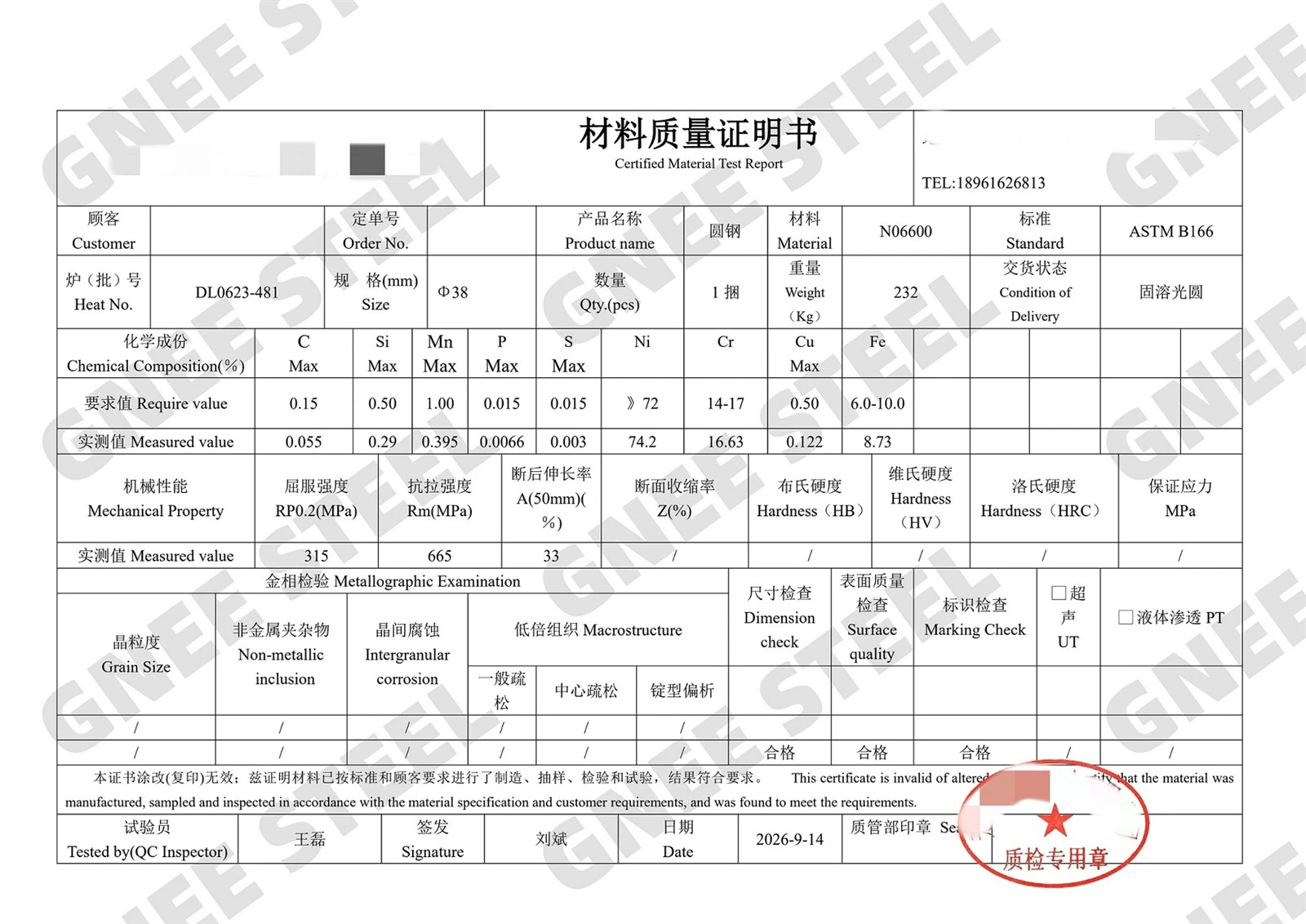
5.Incomplete certification package. Buyers often receive only basic MTRs. AMS 5540 orders require PMI records, NDT reports, heat treatment logs and dimensional check records for customer QA review.
GNEE supply support for AMS 5540 UNS N06600 aerospace components
AMS 5540 Sheet. We strictly adopt AMS-specified annealing procedures instead of general industrial heat treatment, avoiding unstable grain structure caused by improper thermal processing. We offer laser cutting, shearing and custom surface finishing. Every sheet is inspected by PMI spectrometer to confirm alloy identity, eliminating the risk of ASTM-grade material substitution.
AMS 5540 Tube. We provide seamless tubes with precision dimensional control. Each tube undergoes full-length aerospace-standard eddy current inspection and hydrostatic pressure test, rather than basic industrial NDT. Digital micrometers capture dimension records, preventing hidden discontinuities that threaten aerospace service safety.
AMS 5540 Forgings. Custom forgings and pre-machined blanks are produced with controlled forging reduction for homogeneous grain structure. Full ultrasonic testing is carried out to detect internal flaws. Complete heat-lot traceability links finished parts back to original ingot, solving incomplete batch record issues.
Full aerospace documentation package. We deliver a complete set of AMS-compliant certificates, including heat treatment logs, PMI reports, NDT records and dimensional inspection data. This fully meets customer QA audit requirements and removes the risk of incomplete documentation.


Contact us for the latest export price quote for 600 Alloy
FAQ:
What are the key differences between Inconel 600 and Inconel 718?
Inconel 600 and Inconel 718 are both nickel-chromium superalloys, but they differ significantly in strengthening mechanisms, mechanical strength, cost, and ideal operating environments.
What are the key differences between Inconel 600 and 601?
The primary difference is that.Inconel 600 is designed for general corrosion and chloride stress-corrosion resistance, while
Inconel 601 contains added aluminum and higher chromium to deliver superior high-temperature oxidation, carburization, and thermal cycling resistance.
What are the key differences between Inconel 600 and Inconel 750?
The key difference between Inconel 600 and Inconel X-750 is how they gain strength:Inconel 600 is a solid-solution strengthened alloy that cannot be hardened by heat treatment, whereas Inconel X-750 (often referred to simply as Inconel 750) contains added aluminum and titanium to allow precipitation hardening (age hardening).
What material is equivalent to Inconel 600?
Inconel 600 (also known as Alloy 600) is equivalent to several international standards and alternative commercial grade names.
What are the key differences between Inconel 600 and 625?
Inconel 600 and Inconel 625 are both nickel-based superalloys, but Inconel Alloy 600 VS Inconel Alloy 625 shows that Alloy 625 offers significantly higher mechanical strength and superior resistance to pitting, crevice corrosion, and marine environments due to the addition of molybdenum and niobium, whereas Alloy 600 excels in high-temperature oxidation and carburization resistance.


