

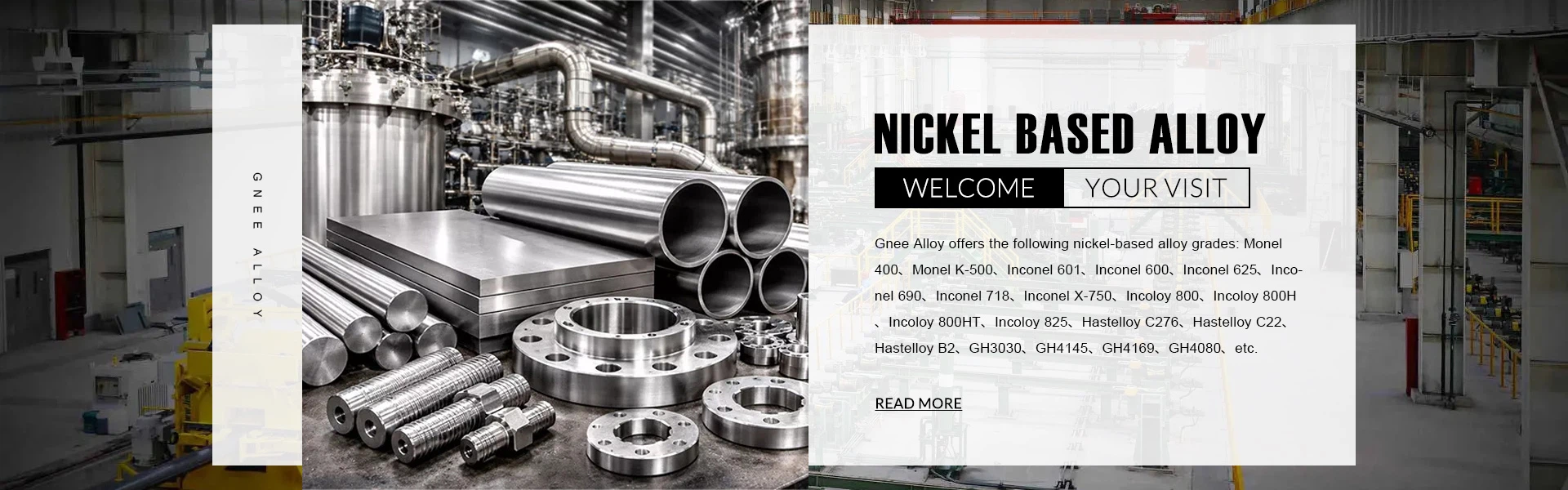
What Is Alloy 825 Nickel Based Alloy?
Alloy 825 (trade name Incoloy® 825, UNS N08825 / W.Nr. 2.4858) is a titanium‑stabilized, solid‑solution‑strengthened austenitic nickel‑iron‑chromium‑molybdenum‑copper alloy. It contains high nickel (38‑46 %) and chromium (19.5‑23.5 %) contents, supplemented by additions of molybdenum, copper and titanium.
Renowned for outstanding general corrosion resistance, excellent resistance to stress‑corrosion cracking (SCC), and favourable high‑temperature mechanical properties, the alloy's high nickel content provides superior resistance to chloride‑induced stress‑corrosion cracking. Molybdenum and copper markedly boost corrosion resistance in reducing acids such as sulfuric acid and phosphoric acid, whilst chromium imparts good oxidation resistance. Through forming stable titanium carbide (TiC), titanium additions effectively prevent intergranular sensitization during welding or high‑temperature exposure, preserving resistance to intergranular corrosion.

It delivers reliable performance in oxidising and reducing acids, alkaline solutions, and chloride‑containing environments. Maintaining favourable mechanical properties and corrosion resistance from room temperature up to approximately 550 °C, Alloy 825 holds certification for pressure‑vessel construction service up to 450 °C.
Widely deployed in chemical processing, oil & gas, marine engineering, nuclear power and pollution‑control industries, it is an ideal material for harsh corrosive media including sulfuric acid, phosphoric acid, nitric acid and chloride‑bearing fluids.
Request Alloy 825 Bar Quotation
✅️Want to verify Alloy 825 bar material performance before bulk purchase? Submit your demand, we can supply small test samples for your lab evaluation.
Alloy 825 chemical composition
The chemical composition of Alloy 825 is shown in the table below (weight percent). Its compositional design achieves an optimal balance of corrosion‑resistant properties.
| Element | Content Range (Min‑Max, wt%) | Main Function |
|---|---|---|
| Nickel (Ni) | 38.0‑46.0 | Base matrix element. Provides excellent resistance to chloride‑induced stress‑corrosion cracking and stabilizes the austenitic structure. |
| Chromium (Cr) | 19.5‑23.5 | Key alloying element. Forms dense Cr₂O₃ oxide film to deliver good oxidation resistance and pitting corrosion resistance. |
| Iron (Fe) | Balance (typically ≥ 22.0) | Reduces cost, improves hot‑workability, and serves as part of the alloy matrix. |
| Molybdenum (Mo) | 2.5‑3.5 | Core corrosion‑resistant element. Significantly improves resistance to pitting and crevice corrosion, and enhances corrosion performance in reducing‑acid environments. |
| Copper (Cu) | 1.5‑3.0 | Critical corrosion‑resistant element. Especially improves corrosion resistance in reducing acids such as sulfuric acid and phosphoric acid. |
| Titanium (Ti) | 0.6‑1.2 | Stabilizing element. Combines with carbon to form TiC, preventing intergranular corrosion caused by sensitization during welding or high‑temperature exposure. |
| Carbon (C) | ≤0.025‑0.05 | Strictly controlled to reduce carbide precipitation tendency and improve intergranular corrosion resistance. |
| Manganese (Mn) | ≤1.0 | Deoxidizer; improves hot‑workability. |
| Silicon (Si) | ≤0.5 | Deoxidizer. |
| Aluminum (Al) | ≤0.2 | Deoxidizer. |
| Cobalt (Co) | ≤1.0 | Impurity element. |
| Sulfur (S) | ≤0.015‑0.03 | Harmful impurity; strictly controlled. |
| Phosphorus (P) | ≤0.02‑0.03 | Harmful impurity; strictly controlled. |
Alloy 825 Physical Properties
| Property | Typical Value / Range | Unit | Remarks |
|---|---|---|---|
| Density | 8.10‑8.25 (typical 8.14) | g/cm³ | At room temperature |
| Melting range | 1370‑1400 (typical 1370‑1400) | °C | |
| Thermal conductivity (20 °C) | 10.8‑12.4 (typical 10.8‑12.4) | W/(m·K) | |
| Mean coefficient of thermal expansion (20‑100 °C) | 13.3‑14.1 | ×10⁻⁶/°C | |
| Specific heat capacity (20 °C) | 440 | J/(kg·K) | |
| Electrical resistivity (20 °C) | 1.12‑1.37 | μΩ·m | |
| Modulus of elasticity (Room temperature) | 195‑200 | GPa | |
| Shear modulus | 1.37 | GPa | |
| Poisson's ratio | 0.3 (typical) | - | Estimated value |
Get Your Custom Alloy 825 Bar Offer
Alloy 825 Mechanical Properties
1.Room‑Temperature Mechanical Properties (Solution‑Annealed Condition, Typical Values)
| Property | Typical Value Range (Minimum) | Unit | Condition Note |
|---|---|---|---|
| Tensile strength (Rm) | 550‑825 (typical ≥ 550‑586) | MPa | Solution‑annealed condition |
| 0.2% Proof strength (Rp0.2) | 220‑450 (typical ≥ 220‑250) | MPa | Solution‑annealed condition |
| Elongation (A) | 30‑45% (typical ≥ 30‑35%) | % | Solution‑annealed condition |
| Brinell hardness (HB) | ≤ 200 (typical 160‑200) | - | Solution‑annealed condition |
2.High‑Temperature Mechanical Properties (Short‑Term Tensile Test, Solution‑Annealed Condition)
Alloy 825 retains favourable mechanical properties at elevated temperatures up to approximately 550 °C.
| Temperature (°C) | Tensile Strength (MPa) | 0.2% Proof Strength (MPa) | Elongation (%) |
|---|---|---|---|
| 21 | 550‑586 | 220‑250 | 30‑35 |
| 200 | approx. 520 | approx. 200 | approx. 30 |
| 400 | approx. 480 | approx. 180 | approx. 30 |
| 550 | approx. 450 | approx. 170 | approx. 30 |
| 650 | Significant drop | Significant drop | Significant drop |
3.High‑Temperature Rupture / Creep Strength
Alloy 825 possesses good creep‑resistance performance and maintains stable service behaviour at temperatures up to approximately 649 °C (1200 °F).
Key Corrosion‑Resistant and High‑Temperature Properties of Alloy 825
The most prominent feature of Alloy 825 is its excellent performance under diverse severe corrosive conditions.
| Performance Category | Performance Description |
|---|---|
| Resistance to Stress‑Corrosion Cracking (SCC) | Excellent. High nickel content delivers extremely high resistance to chloride‑induced stress‑corrosion cracking, making it an ideal material for media containing chloride ions. |
| Pitting & Crevice Corrosion Resistance | Excellent. The synergistic effect of molybdenum and chromium provides outstanding resistance to pitting and crevice corrosion, especially in chloride‑containing environments. |
| Resistance to Reducing Acids | Excellent. The combination of nickel, molybdenum and copper delivers superior corrosion resistance against reducing acids such as sulfuric acid and phosphoric acid. |
| Resistance to Oxidizing Acids | Good. High chromium content enables resistance to oxidizing media including nitric acid, nitrates and oxidizing salts. |
| Resistance to Alkaline Media | Good. Offers favourable corrosion resistance to alkaline solutions such as sodium hydroxide and potassium hydroxide. |
| High‑Temperature Oxidation Resistance | Good. Suitable for short‑term service in oxidizing atmospheres up to 815 °C (1500 °F). The recommended long‑term service temperature is 550 °C. |
| Intergranular Corrosion Resistance | Good. Low carbon content plus titanium stabilization minimizes sensitization after welding or high‑temperature exposure, resulting in reliable intergranular corrosion resistance. |
Alloy 825 Welding and Heat Treatment
Heat Treatment
- Purpose: Dissolve carbides, produce a homogeneous austenitic microstructure, and achieve optimum corrosion resistance and ductility.
- Temperature: 980 – 1150 °C (1796 – 2102 °F), typical holding temperature at 1050 °C (1922 °F).
- Cooling: Rapid water quenching or air cooling.
Hot Working
Recommended temperature range: 1200 – 950 °C (2192 – 1742 °F). Solution‑annealing is recommended after hot working to achieve optimum properties.
Cold Working
Properties: Moderate work‑hardening rate. In the solution‑annealed condition, the alloy exhibits good ductility, enabling various cold‑forming operations.
Welding
- Weldability: Good. Conventional welding methods including GTAW/TIG, GMAW/MIG and SMAW can be applied.
- Filler metal selection: Matching nickel‑base filler metals such as ERNiCrMo‑3 (Inconel 625 wire) or matching‑composition consumables are recommended.
- Process control: Base material shall be in the annealed condition prior to welding, and surfaces must be thoroughly cleaned. Use low heat input and control interpass temperature. Post‑weld heat treatment is generally not required. However, for equipment intended for severe corrosive service, solution‑annealing may be advised to restore corrosion resistance.

Alloy 825 Core Material Characteristics
Excellent General Corrosion Resistance:
Delivers outstanding performance in oxidizing and reducing acids, alkaline media, and chloride‑containing environments. It is particularly suitable for service involving sulfuric acid, phosphoric acid and chloride‑bearing media.
Superior Localized Corrosion Resistance:
Provides high resistance to stress‑corrosion cracking, pitting and crevice corrosion.
Good Elevated‑Temperature Performance:
Retains stable mechanical properties and oxidation resistance up to 550 °C. It holds pressure‑vessel certification for service at 450 °C.
Excellent Weldability & Fabricability:
Readily weldable, hot‑workable, cold‑workable and machinable. Titanium stabilization minimizes sensitization risk after welding.
Titanium‑Stabilized Design:
Low‑carbon formulation with titanium addition effectively prevents intergranular corrosion induced by welding and high‑temperature exposure.
Limitations:
Relatively high material cost; performance may be limited under extreme conditions such as fluoride‑ion containing media, wet chlorine gas, and concentrated hot alkaline solutions.
Alloy 825 Application Fields
Alloy 825 is widely deployed in harsh service environments with extreme corrosion‑resistance requirements:
Chemical & Petrochemical
Sulfuric‑acid pickling equipment (heating tubes, vessels, baskets); phosphoric‑acid production equipment (evaporators, heat exchangers); organic‑acid processing equipment; chemical vessels and piping.
Oil & Gas
Offshore platform components, oil‑gas wellhead assemblies, sour‑service pipelines, acid‑gas treatment systems.
Marine Engineering
Seawater‑cooled heat exchangers, seawater desalination units, ship piping systems, offshore platform structural parts.
Nuclear Industry
Nuclear fuel reprocessing equipment, radioactive waste‑treatment vessels, piping for nuclear reactor cooling systems.
Pollution Control & Environmental Protection
Flue‑gas desulfurization (FGD) systems, wastewater‑treatment equipment, waste‑incinerator components.


Why Choose GNEE STEEL as Your Alloy 825 Nickel‑Base Bar Supplier
Alloy 825 Bar Spot Inventory
We hold 120+ tons ready stock of UNS N08825 round bars, diameter range 10‑200 mm. Achieve 7‑12‑day ex‑warehouse delivery to cut long lead‑time risks for your corrosion‑resistant project orders.

Alloy 825 Bar Precision Processing Capacity
Equipped with heavy‑duty CNC bar sawing machines, tolerance controlled within ±0.04 mm. Perform straightening, peeling & chamfering for Alloy 825 bars with minimal surface alteration.
Workshop & Bar‑Oriented Production Equipment 35,000 ㎡ special‑alloy workshop fitted with bar annealing furnaces (850‑1050 ℃ adjustable) and straightening presses. Annual nickel‑alloy bar output reaches 6000 tons for stable large‑volume supply.

Complete Certification & In‑house Bar Inspection
Provide EN 10204 3.1/3.2, NACE MR0175, ISO 9001 certificates. Our lab owns tensile tester and hardness tester; every Alloy 825 bar batch finishes full mechanical‑chemical testing pre‑shipment.


Bar‑Specific Packaging & Global Shipment
Alloy 825 bars adopt anti‑scratch PE wrapping plus reinforced wooden bar racks. Support FCL/LCL sea‑air shipping, prevent bar surface abrasion and oxidation in long‑haul international transit.


Real customer feedback on Gnee Alloy products

✅️Whether you require small trial orders or bulk‑volume Alloy 825 round bars, send us your diameter, length and quantity. We will issue formal quotation with complete MTR documents quickly.
Beyond Alloy 825 round bar covered on this page, GNEE STEEL also provides complementary UNS N08825 product forms to support your one‑stop project procurement requirement. Please click below links for further details:


FAQ:
Is Inconel 825 the same as alloy 825?
Incoloy 825 alos known as Inconel 825. Its is an alloy formulated of Nickel, Chromium and Iron with extension of Molybdenum, Copper and Titanium. The alloy 825 invented to contribute exceptional resistance to many corrosive environments and reducing environments that acquire sulphuric acid and phosphoric acid.
What is the difference between alloy 825 and 925?
Alloy 825 (Incoloy 825, UNS N08825, 2.4858) and Alloy 925 (Incoloy 925, UNS N09925) are nearly identical in composition, and therefore provide very similar corrosion resistance and physical properties. However, Alloy 925 provides significantly higher levels of strength as it benefits from precipitation strengthening.
Does Inconel 825 rust?
The outstanding attribute of INCOLOY alloy 825 is its high level of corrosion resistance. In both reducing and oxidize environments, the alloy resists general corrosion, pitting, crevice corrosion, intergranular corrosion, and stress-corrosion cracking.
What is the difference between 625 and 825 alloy?
Alloy 625 and Alloy 825 are high-performance nickel-based alloys with major differences in chemical makeup, strength, and cost. Alloy 625 offers superior high-temperature strength and chloride corrosion resistance, while Alloy 825 provides better resistance to specific reducing acids at a lower price.
What is the difference between alloy 825 and 316?
INCOLOY 825 excels in high corrosion resistance, particularly in reducing environments, while SS316 offers superior corrosion resistance in marine and chemical environments. The choice between these two alloys ultimately depends on the specific requirements of the application and the overall cost-benefit analysis.


