

When sourcing Inconel 713C (UNS N07713) alloy for turbine impellers or aerospace blades, your profit margin depends on two factors: casting yield and sourcing costs. As a Tier 1 manufacturer of high-temperature alloys, we focus on providing VIM-melted 713C master alloy bars that meet the stringent AMS 5391 standard-shipped directly from our factory to your foundry.
By choosing our factory-direct model, you can eliminate intermediary markups and obtain wholesale prices, giving you a competitive edge in the global market.
Click to get a quote for Inconel 713C alloy bars now
High-temperature AMS 5391 Inconel 713C: Factory direct sales alloy rod

High-temperature AMS 5391 Inconel 713C: Factory direct sales alloy rod
Inconel 713C (UNS N07713) is a precipitation-hardening nickel-chromium-based cast superalloy, primarily defined according to AMS 5391 precision casting specifications. It is highly regarded for its excellent creep rupture strength and structural stability at temperatures up to 1800°F (982°C).
What are the differences between Inconel 718 and 713C?
Inconel 713C is a precipitation-hardening nickel-chromium alloy. Inconel 718 is an age-hardening nickel-chromium alloy. Inconel 713C has superior mechanical properties at high temperatures compared to Inconel 718. Inconel 713C also has better corrosion resistance than Inconel 718.

1. AMS 5391 Inconel 713C Alloy Bar Technical Specification
| Element | Requirement (%) | Our Factory Standard |
| Nickel (Ni) | Balance | MTC 3.1 Certified |
| Chromium (Cr) | 12.0 - 14.0 | Optimized for Oxidation Resistance |
| Aluminum (Al) | 5.5 - 6.5 | Precise
γ′γ′ Precipitation |
| Molybdenum (Mo) | 4.0 - 5.0 | Superior Mechanical Strength |
| Gases (O, N) | - | Ultra-Low (<10 ppm) |
2. Chemical composition of AMS 5391 Inconel 713C alloy rods (wt%)
| Element | Content (%) | AMS 5391 Requirement | Function |
|---|---|---|---|
| Nickel (Ni) | Balance (~70-75) | Balance | Matrix element; high-temperature stability |
| Chromium (Cr) | 11.0 – 14.0 | 11.0 – 14.0 | Oxidation resistance |
| Aluminum (Al) | 5.5 – 6.5 | 5.5 – 6.5 | Primary γ′ former |
| Molybdenum (Mo) | 3.5 – 5.0 | 3.5 – 5.0 | Solid-solution strengthening; creep resistance |
| Niobium (Nb) | 1.5 – 2.5 | 1.5 – 2.5 | Supplementary strengthening |
| Titanium (Ti) | 0.4 – 1.0 | 0.4 – 1.0 | γ′ strengthening |
| Iron (Fe) | ≤ 2.0 | ≤ 2.0 | Residual element |
| Cobalt (Co) | ≤ 1.0 | ≤ 1.0 | Residual element |
| Carbon (C) | 0.05 – 0.15 | 0.05 – 0.15 | Carbide former; grain boundary strength |
| Boron (B) | 0.005 – 0.015 | 0.005 – 0.015 | Grain boundary strengthener |
| Zirconium (Zr) | 0.05 – 0.15 | 0.05 – 0.15 | Grain boundary strengthener |
| Manganese (Mn) | ≤ 0.20 | ≤ 0.20 | Deoxidizer |
| Silicon (Si) | ≤ 0.50 | ≤ 0.50 | Deoxidizer |
Click to download the Inconel 713C alloy PDF file now
3. AMS 5391 Inconel 713C Alloy Bars: Room Temperature Mechanical Properties
| Property | AMS 5391 Requirement | Typical Value | Test Standard |
|---|---|---|---|
| Tensile Strength, Ultimate | ≥ 830 MPa (120 ksi) | 830 – 950 MPa | ASTM E8 / ASTM E21 |
| Tensile Strength, Yield (0.2% Offset) | ≥ 650 MPa (94 ksi) | 650 – 760 MPa | ASTM E8 / ASTM E21 |
| Elongation at Break | ≥ 2% | 2 – 5% | ASTM E8 / ASTM E21 |
| Reduction of Area | - | 2 – 5% | ASTM E8 |
| Hardness (Rockwell C) | Report value | 35 – 40 HRC | ASTM E18 |
| Modulus of Elasticity | - | ~205 GPa | ASTM E111 |
| Density | - | 7.91 g/cm³ | - |
4. Stress fracture properties of AMS 5391 Inconel 713C alloy bars
| Temperature | Stress | Minimum Rupture Life | Typical Value |
|---|---|---|---|
| 800°C (1472°F) | 250 MPa (36 ksi) | ≥ 100 hours | ~100 hours |
| 870°C (1600°F) | 140 MPa (20 ksi) | ≥ 100 hours | ~100 hours |
| 950°C (1742°F) | 100 MPa (14.5 ksi) | ≥ 100 hours | ~100 hours |
5. Commonly Used Dimensions of AMS 5391 Inconel 713C Alloy Bars
| Diameter (mm) | Diameter (in) | Max Length (mm) | Length Tolerance | Diameter Tolerance | Typical Application |
|---|---|---|---|---|---|
| 10 – 20 | 0.375 – 0.750 | 150 | ±0.5 mm | ±0.2 mm | Small castings, test specimens |
| 20 – 40 | 0.750 – 1.500 | 250 | ±0.8 mm | ±0.3 mm | Medium castings |
| 40 – 60 | 1.500 – 2.250 | 300 | ±1.0 mm | ±0.4 mm | Larger castings |
| 60 – 80 | 2.250 – 3.000 | 300 | ±1.2 mm | ±0.5 mm | Large castings |
| 80 – 100 | 3.000 – 4.000 | 300 | ±1.5 mm | ±0.5 mm | Large castings |
Dimensional Tolerances
| Parameter | Grade / Value |
|---|---|
| Dimensional Tolerance Grade | CT7 – CT9 (ISO 8062) |
| Surface Roughness (As-Cast) | Ra 3.2 – 6.3 µm |
| Surface Roughness (After Machining) | Ra 0.8 – 1.6 µm |
Contact us to customize Inconel 713C products to fit your project dimensions
6. AMS 5391 Inconel 713C Alloy Rod Manufacturing Process
| Equipment | Purpose |
|---|---|
| Vacuum Induction Melting (VIM) | Master alloy melting |
| Vacuum Casting Furnace | Investment casting pouring |
| Vacuum Heat Treatment Furnace | Solution + Aging treatment |
| CNC Lathe / Centerless Grinder | Precision finishing of castings |


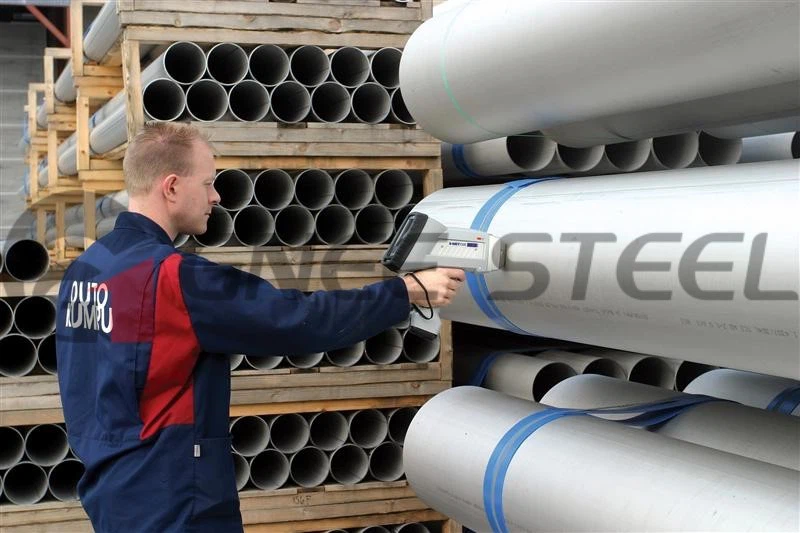
7. AMS 5391 Inconel 713C Alloy Rod Testing Method
| Inspection Method | Test Item |
|---|---|
| Optical Emission Spectrometer (OES) | Chemical composition |
| Universal Testing Machine (UTM) | Tensile, yield, elongation |
| Rockwell Hardness Tester | Hardness (HRC) |
| Fluorescent Penetrant Inspection (FPI) | Surface cracks, porosity |
| Radiographic Testing (RT) | Internal porosity, voids |
| Metallurgical Microscope | Grain size, microstructure |


8. Common Applications of AMS 5391 Inconel 713C Bars
Aerospace & Defense: Turbine blades, guide vanes, and complex airfoils in aircraft engines and military drones.
Automotive: High-performance turbocharger components.
Industrial: Marine and industrial gas turbine applications.


9. Why Choose Gnee as Your Nickel-Based Alloy Supplier
✅️Full Traceability: Every shipment is accompanied by a comprehensive MTC 3.1 and lab reports verifying chemical and gas analysis.
✅️Global Logistics Network: We ship to over 60 countries, providing optimized sea and air freight solutions to minimize your landed cost.
✅️Flexible Packaging: Standardized bundles or custom palletizing to fit your foundry's handling requirements.

Gnee Steel Alloy 713C Certificate
📦 Packaging and Shipping
All Nickel Based Alloy products are packaged using the following methods:
Wooden pallets or crates
Moisture-proof packaging
Labels with furnace number, standard, and size labels
Shipped worldwide by sea, air, or express

Gnee Steel 713C Product Packing
Contact us for the latest export price quote for 713C Alloy
FAQ
Q1. What is Inconel 713C mainly used for?
A:It is primarily used in aerospace turbines, industrial gas turbines, and automotive turbocharger wheels where high strength and oxidation resistance are required.
Q2. What is the maximum service temperature of Inconel 713C?
A:It is recommended for applications up to 950 °C. Beyond this, alloys like 738LC or 939 are preferred.
Q3. Is Inconel 713C weldable?
A:No, this alloy is not weldable and is processed through investment casting.
Q4. How does Inconel 713C compare to Inconel 738LC?
A:While Inconel 713C offers excellent strength and cost advantages, 738LC provides better oxidation and creep resistance for applications above 1000 °C.
Q5. Can Gnee Alloy provide custom castings made of Inconel 713C material?
A:Yes, we supply OEM standard cast turbine parts and turbocharger wheels manufactured from Inconel 713C.


