

When manufacturing a new part, one important question is what metal to use. Although the choice can be easy, such as selecting a plain carbon steel because it's cheap, other applications may not have such clear cut answers. When deciding on a material to use and a method to produce that part, a few questions need to be answered:
1. What are the conditions this part is going to be in?
2. What kind of strength do I need?
3. What price point do I need this part to be at?
If a part needs to have superior strength and corrosion resistance at high temperatures, Inconel alloys are best. On the other hand, a part for handling medical supplies may be better suited for an alloy of stainless steel. The rest of this post documents what kind of other applications you can use for inconel metal or stainless steel.
What is Inconel Metal
Inconels metals are a class of nickel-chrome-based super alloys characterized by high corrosion resistance, oxidation resistance, strength at high temperatures, and creep resistance. Inconel is able to withstand elevated temperatures and extremely corrosive environments due to two factors.
First, the intermetallic compound Ni3Nb is formed in the gamma double prime (ɣ'') phase. This intermetallic phase acts as a 'glue' on the grain boundaries. This 'glue' prevents the grains from increasing in size when heated to high temperatures (for the most part, smaller grains means a high strength and larger grains lends itself to a higher ductility). Second, Inconel metal has a high corrosion resistance due to the passivation layer that forms when heated. Both of these factors make Inconel ideal alloys for applications from hot section gas turbines to deep sea well drilling. So what is the downside of these alloys? They are expensive, hard to machine, and hard to work.
Stainless Steel
Stainless steels are characterized by a chromium content higher than 10.5% by weight. There are five classes of stainless steels:
Austenitic
Ferritic
Martensitic
Duplex
Precipitation Hardenable
These stainless steels are named after the microstructure that forms in those alloys. Duplex stainless steel is a mix of austenitic and ferritic microstructures, and precipitation hardening means that precipitates can form to increase the strength of those class of stainless steels. The strength and the corrosion resistance of the stainless steel is dependent on these microstructures. For example, austenitic stainless steels are going to be the most ductile class of stainless steel, but also the most corrosion resistant. On the other hand, the martensitic class has typically much higher strength, but less corrosion resistance. Austenitic stainless steels have a larger more equiaxed grain structure which is what gives it these properties compared to the smaller lathe structure found in martensitic stainless steels.
All stainless steels have a higher corrosion resistance than traditional steels and can be found in everything from kitchen cutlery and structural building applications to biomedical and food preparation applications.


Inconel Metal vs Stainless Steel: What's the Difference?
For one thing, Inconel is much more expensive than stainless steel alloys. Inconel also has much better corrosion resistance and strength at high temperatures. However, at lower temperatures, steels like 17-4PH stainless will have a higher strength than Inconel. When deciding between the two different alloys, the main deciding factor is cost, temperature, and strength. If a lower cost, but relatively strong part is required, stainless steel is probably the way to go. If an air-critical component is required with high temperature needs, then Inconel is a much better alloy for that application.
Our product range
| Product Form | Standard Specifications & Dimensions | Common Alloys (Examples) | Typical Standards |
|---|---|---|---|
| Bar & Rod | Round Bar: Diameter: 3mm ~ 300mm Hexagon Bar: Across Flats: 5mm ~ 100mm Square Bar: Width: 5mm ~ 150mm Length: Random, Cut-to-length, or Coils (small diameters) |
Alloy 200/201 Monel 400/K-500 Inconel 600/601/625/718 Incoloy 800/800H/825 Hastelloy C-276/C-22/B-2/B-3 |
ASTM B160, B164, B166 EN/DIN 2.4066, 2.4816, 2.4851 ASME SB-166, SB-167 |
| Wire | Diameter: 0.1mm ~ 12mm Form: Coils, spools, or straight lengths Finish: Bright, pickled, annealed |
Alloy 200/201 Inconel 600/625/X-750 Incoloy 825 |
ASTM B166, B167 EN/DIN 17752 |
| Sheet & Plate | Thickness (Sheet): 0.1mm ~ 5.0mm Thickness (Plate): 5.0mm ~ 100mm+ Width: Up to 2000mm (depending on alloy/thickness) Length: Up to 6000mm or as required |
Alloy 200/201 Monel 400 Inconel 600/625/718 Incoloy 800H/825 Hastelloy C-276 |
ASTM B162, B168, B409 EN/DIN 17742, 17744 |
| Strip & Foil | Thickness (Strip): 0.05mm ~ 2.0mm Thickness (Foil): 0.02mm ~ 0.05mm Width: Up to 600mm Condition: Cold rolled, annealed, tempered |
Alloy 200/201 Inconel 600/625 Incoloy 825 |
ASTM B162, B168 |
| Pipe & Tube | Seamless Pipe (ASTM B161/B167): - OD: 3/16" ~ 14" (6mm ~ 355mm) - Schedule: SCH 5S to XXS Welded Tube (ASTM B163/B516): - OD: 6mm ~ 300mm - Wall Thickness: 0.5mm ~ 10mm |
Alloy 200/201 Monel 400 Inconel 600/625 Incoloy 800H/825 Hastelloy C-276 |
ASTM B161, B163, B167, B516 ASME SB-163, SB-167 |
Get the complete product catalog
Our factory and testing
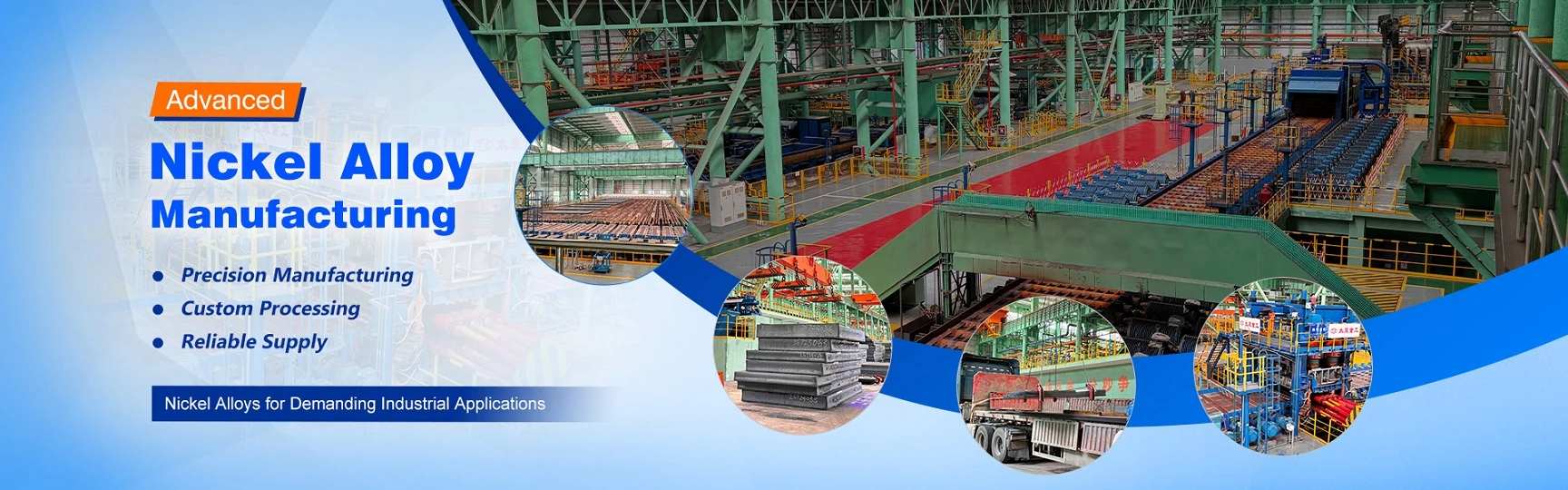
Our core factory and collaborative production system are equipped with modern precision cutting, processing, and heat treatment equipment, focusing on transforming raw materials into semi-finished and finished products that meet stringent standards. To ensure that every batch of materials meets or exceeds specifications, we have established a comprehensive end-to-end quality inspection system. From material properties analysis (PMI) upon raw material warehousing to dimensional accuracy control during production, and finally to mechanical property testing (such as tensile strength and hardness) and non-destructive testing before final shipment, every step is rigorously controlled by our professional quality inspection team. We promise to provide an authoritative, online-verifiable original manufacturer's material certificate (MTC 3.1) for every order, and can arrange for third-party certification bodies (such as SGS, BV, and TUV) to conduct on-site inspections and issue certificates upon customer request.


