


GNEE STEEL supplies Inconel 718 in different product forms, including forged rings, forged discs, bars, plates, and tubes, subject to confirmed specifications and availability.
Inconel 718 nickel alloy for gas turbine hot components
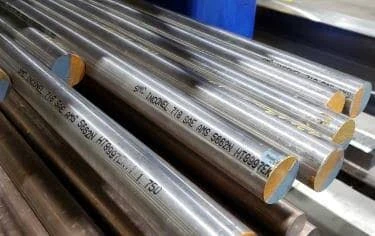
What is Inconel 718 nickel alloy?
Inconel 718 nickel alloy (UNS N07718, W.Nr. 2.4668) is a precipitation-hardenable nickel-based superalloy used in selected gas turbine hot components and other high-stress parts. Its combination of high-temperature strength, fatigue resistance, and oxidation resistance makes it suitable for components such as turbine discs, compressor discs, turbine shafts, rotor components, and forged rings.
Explore Inconel 718 Forged Rings, Discs and Bars for Gas Turbine Components
What Is Inconel 718 in Gas Turbine Applications?
A gas turbine converts energy from hot, expanding gases into mechanical power. It is widely used in industrial power generation, mechanical drive systems, and aerospace-related applications.
A typical gas turbine engine includes three main sections:
- Compressor: Compresses incoming air.
- Combustor: Mixes fuel with compressed air and produces high-temperature gas.
- Turbine: Extracts energy from the expanding gas to drive the compressor and external equipment.
Different sections experience different temperatures, stresses, and operating conditions. Materials must therefore be selected according to their specific service environment.
Inconel 718 is a nickel-based precipitation-hardened alloy strengthened primarily by gamma double-prime (γ″) precipitates, with a contribution from gamma-prime (γ′). It is used in selected high-strength rotating and structural components where mechanical strength, fatigue performance, and elevated-temperature properties are important.
It is relevant to both industrial gas turbines and aero-derivative gas turbines, although component designs and material specifications vary between equipment types.
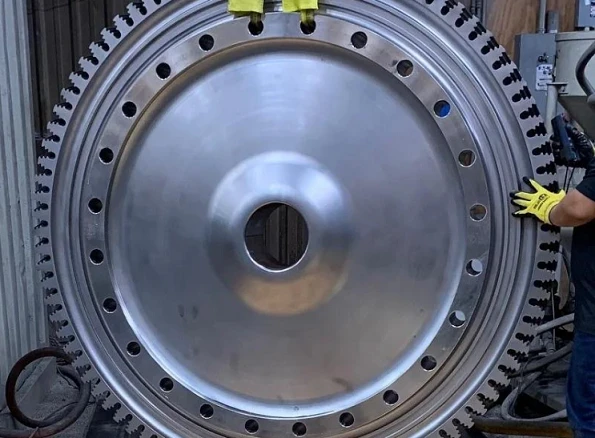
Inconel 718 Alloy Forgings in Gas Turbine Manufacturing
Which Gas Turbine Components Use Inconel 718?
Gas turbine components experience different combinations of temperature, centrifugal stress, vibration, and mechanical loading. Inconel 718 is particularly relevant to components that require high strength and dimensional integrity under demanding operating conditions.
| Component | Function | Potential Inconel 718 Product Form |
|---|---|---|
| Turbine Disc | Supports rotating turbine blades and withstands centrifugal loading | Forged disc |
| Compressor Disc | Supports compressor blades and transfers rotational loads | Forged disc |
| Turbine Shaft | Transfers rotational torque | Forged bar or forging |
| Rotor Components | Connect and support rotating assemblies | Forged bar, ring or custom forging |
| Turbine Ring | Provides structural support in selected turbine assemblies | Forged ring |
| Turbine Casing | Encloses and supports turbine components | Application-specific forging or plate stock |
| High-Temperature Bolts | Fasten components exposed to elevated temperatures | Bar stock or machined fasteners |
| Turbine Flange | Connects structural or mechanical assemblies | Forged ring or bar |
Why Is Inconel 718 Used in Gas Turbines?
The operating environment of a gas turbine hot section combines elevated temperatures, mechanical loads, and repeated operating cycles. Several material properties make Inconel 718 relevant to selected components.
High-Temperature Strength
High-temperature strength is important for rotating components that must maintain their load-bearing capability during operation. Inconel 718 retains useful mechanical strength at elevated temperatures, making it suitable for selected turbine and compressor structures.
However, allowable stress and service temperature must be determined using the applicable material specification, heat-treatment condition, component dimensions, and design requirements.
Creep and Stress Rupture Resistance
Creep resistance describes a material's ability to resist gradual deformation under sustained stress at elevated temperatures.
Stress rupture strength relates to the stress a material can withstand over a specified period before rupture. These properties are relevant when evaluating components exposed to long-term mechanical loading and elevated temperatures.
Fatigue and Thermal Cycling
Gas turbines undergo starting, shutdown, load changes, and other operating cycles. These conditions can create repeated mechanical and thermal stresses.
Important considerations include:
- Fatigue resistance under repeated mechanical loading.
- Low-cycle fatigue during repeated start-stop cycles.
- Thermal fatigue caused by temperature fluctuations.
- Resistance to crack initiation and propagation under the applicable service conditions.
Oxidation and Corrosion Resistance
Oxidation resistance is important when alloy surfaces are exposed to elevated temperatures and oxygen-containing gases. High-temperature corrosion and hot corrosion may also occur depending on fuel composition, contaminants, deposits, and operating conditions.
Inconel 718 offers oxidation and corrosion resistance, but it should not automatically be considered suitable for every combustion-gas environment. The actual service conditions must be evaluated.
How Is Inconel 718 Processed for Turbine Components?
Manufacturing quality affects the performance of Inconel 718 gas turbine components. Forging, heat treatment, machining, and inspection must be controlled according to the applicable product specification and component requirements.
Hot Forging and Deformation Control
Hot forging Inconel 718 requires controlled heating and deformation. The alloy's resistance to deformation makes forging process control important.
Inadequate processing may contribute to cracking, non-uniform deformation, or unsuitable grain structures. Forging temperature, reduction, reheating, and cooling procedures should follow qualified manufacturing practices.
Solution Treatment and Aging
Solution treatment and aging treatment are important stages in developing the required mechanical properties of Inconel 718.
The precipitation-hardening process produces strengthening phases, particularly γ″, with a contribution from γ′. The exact heat-treatment cycle depends on the applicable specification, product form, size, and required properties.
Grain Structure and Machining
Grain structure and grain size control are important for forged components subjected to mechanical loading. Buyers may specify grain-size requirements or additional metallurgical examinations.
Machining Inconel 718 also requires appropriate cutting parameters and tooling. Its strength and work-hardening behavior can increase machining difficulty, tool wear, and production time.
Other Industrial Applications of Inconel 718 nickel alloy
Although this article focuses on gas turbine hot components, Inconel 718 is also used in other industries that require high strength and resistance to demanding service conditions.
| Industry | Typical Components | Relevant Product Forms |
|---|---|---|
| Aerospace Engines | Turbine discs, compressor discs, shafts, fasteners | Forgings, bars |
| Oil and Gas | Selected wellhead, downhole, valve, and high-strength components | Bars, forgings, tubes |
| Power Generation | Gas turbine rotating parts, rings, and shaft components | Forgings, bars |
| Rocket and Spacecraft | Rocket engine components and high-strength fasteners | Forgings, bars |
| Turbocharger Systems | Selected rotor and high-temperature components | Bars, forgings |
| Nuclear Industry | Selected fasteners, valves, and engineered components | Bars, forgings |
The material selection for each application must consider operating temperature, stress, corrosion environment, applicable codes, and component qualification. For sour oil and gas service, for example, the relevant requirements under NACE MR0175 / ISO 15156 and the actual service conditions must be evaluated rather than assuming that an alloy designation alone establishes suitability.
Beyond gas turbine hot-section components, Inconel 718 serves demanding environments across multiple high-value industries.
If your project targets downhole production with high pressure and corrosive formation brine, check our article: Inconel 718(UNS N07718 GH4169)in Oil and Gas Industry.
For ultra-fine precision tubing used in aerospace instrumentation and control systems, view our dedicated guide: Inconel 718 UNS N07718 capillary tube for aerospace. Contact our engineering team to match the right 718 product form to your design limits.
Inconel 718 Alloy Chemical Composition
Typical chemical analysis of Inconel 718.
|
Element
|
Percentage |
| Carbon |
0.08 max |
| Manganese |
0.35 max |
| Phosphorus |
0.015 max |
| Sulfur |
0.015 max |
| Silicon |
0.35 max |
| Chromium |
17-21 |
| Nickel |
50-55 |
| Molybdenum |
2.80-3.30 |
| Columbium |
4.75-5.50 |
| Titanium |
0.65-1.15 |
| Aluminum |
0.20-0.80 |
| Cobalt |
1.00 max |
| Boron |
0.006 max |
| Copper |
0.30 max |
| Tantalum |
0.05 max |
| Iron |
Balance |
Inconel 718 Alloy mechanical properties
| Property | Value | Description |
|---|---|---|
|
Ultimate Tensile Strength |
185 ksi (1276 MPa) |
Peak load bearing capacity before fracture ranks among the highest of any weldable nickel superalloy. |
|
0.2% Yield Strength |
150 ksi (1034 MPa) |
The onset of permanent deformation defines design limits, where turbine discs operate at stresses below the yield threshold. |
|
Elastic Modulus |
29.0 Msi (200 GPa) |
Defines rigidity under elastic load, with values comparable to low alloy steels and higher than those of titanium alloys. |
|
Elongation at Break |
12% |
Confirms adequate ductility for complex formed shapes and impact-loaded structures. |
|
Fatigue Strength (10⁸ cycles) |
100 ksi (690 MPa) |
Endurance limit under cyclic loading supports jet engine rotating parts with required values above 80 ksi. |
|
Creep Rupture Life (1200°F, 100 ksi) |
23+ hours |
Time to failure under constant elevated temperature load serves as the governing design criterion for turbine components. |
|
Charpy Impact Energy |
20 ft·lbf (27 J) |
Energy absorbed during fracture reflects notch toughness at ambient temperature. |
|
Fracture Toughness (K₁c) |
88 ksi·√in (97 MPa·√m) |
Resistance to crack propagation limits failure growth from pre-existing flaws. |
Inconel 718 Alloy Physical Properties
Typical physical properties of Inconel 718 are summarized in the table below.
|
|
Solution Treated and Aged |
|
| Density |
0.296 lb/in3 (8.192 g/cm3) |
0.297 lb/in3 (8.22 g/cm3) |
| Specific Gravity |
8.19 |
8.22 |
| Melting Range |
2500-2600°F |
1370-1430°C |
Inconel 718 Alloy Thermal Conductivity
The thermal conductivity at various temperatures for Inconel 718 are given in the following table.
|
Temperature Range |
Co-Efficients |
||
|
°C |
°F |
W/m.K |
Btu.ft/ft2.hr.°F |
|
0-100 |
532-212 |
6.5 |
11.2 |
Inconel 718 Product Forms for Gas Turbines
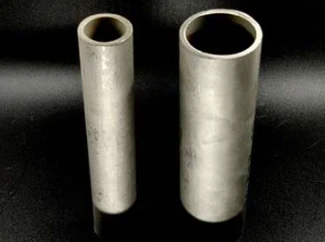
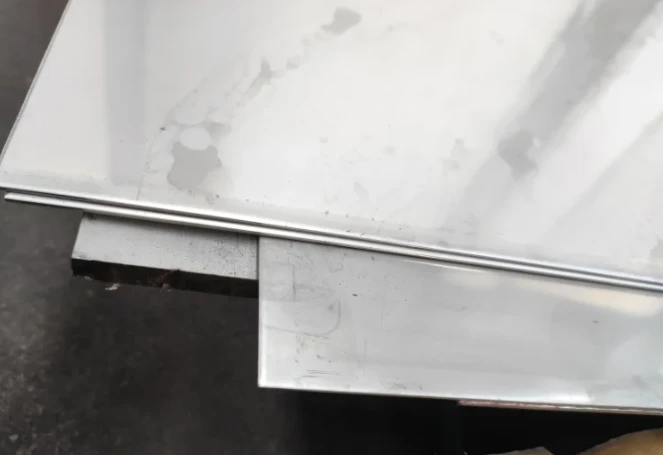
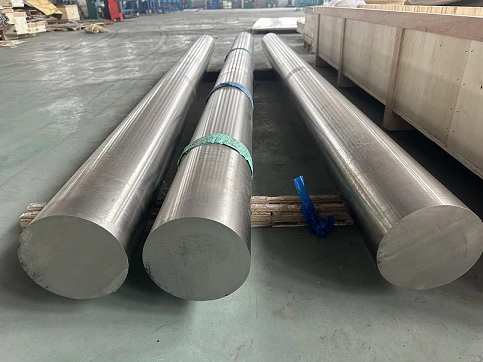
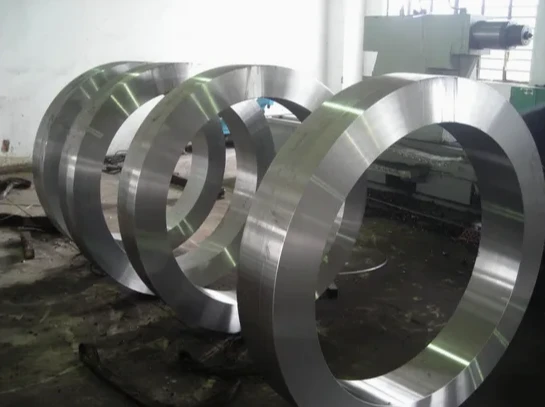
The required component geometry and manufacturing route determine which Inconel 718 product form is appropriate. GNEE STEEL can discuss the following product categories according to the required specification, dimensions, and delivery condition.
Why Choose GNEE STEEL as Your Inconel 718 Alloy Supplier?
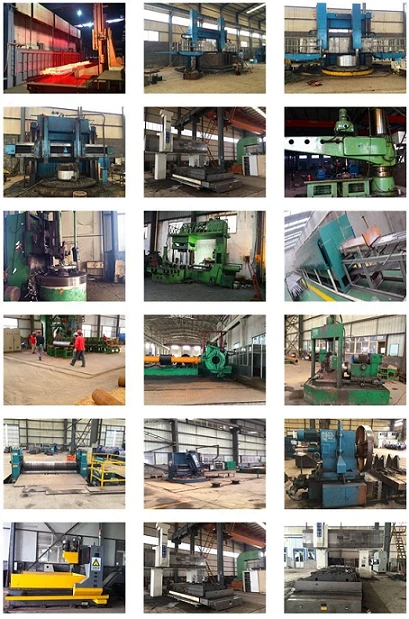
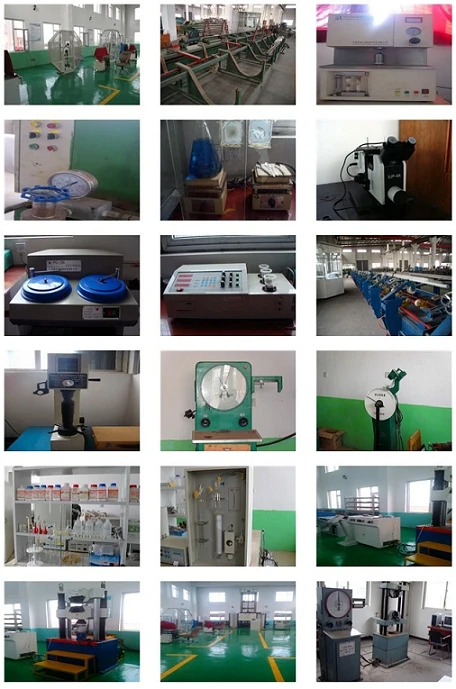
Selecting an Inconel 718 alloy supplier for gas turbine applications requires clear communication about material specifications, product forms, inspection, and delivery requirements.
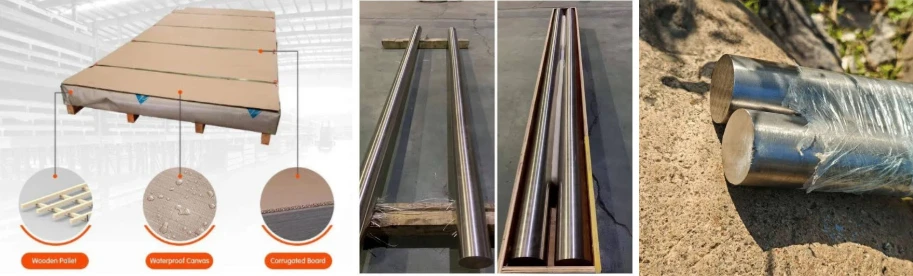
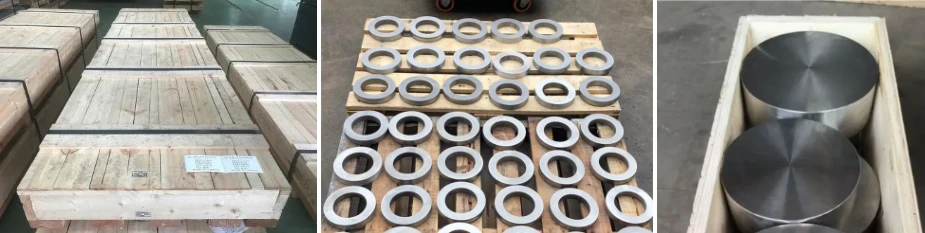
GNEE STEEL supports international buyers sourcing Inconel 718 forged rings, forged discs, forged bars, round bars, plates, and tubes. We can discuss the required product form, dimensions, applicable standards, heat-treatment condition, and inspection documentation according to each inquiry.
Packaging and Shipping
FAQ:
Q1: Is Inconel 718 suitable for gas turbine applications?
Yes. Inconel 718 is used in selected gas turbine components requiring high strength, fatigue resistance, and elevated-temperature performance. Suitability depends on the component's design and operating conditions.
Q2: What gas turbine components use Inconel 718?
Potential applications include turbine discs, compressor discs, shafts, rotor components, rings, selected casings, and high-temperature fasteners.
Q3: Is Inconel 718 used for turbine blades?
It can be used in certain turbine-related applications, but it should not be assumed to be the standard material for first-stage or other extremely high-temperature turbine blades. Specialized blade alloys and cooling designs may be required.
Q4: What is the maximum operating temperature of Inconel 718?
There is no single universal maximum service temperature for every component. Allowable use depends on stress, exposure time, heat treatment, product form, and design requirements. Material data and component design criteria should be reviewed together.
Q5: Which Inconel 718 product form is used for turbine discs?
Forged discs or suitable forged blanks are commonly considered for turbine-disc manufacturing. Final selection depends on component geometry, material specification, forging quality, and machining requirements.
Q6: Which standards apply to Inconel 718 forgings?
ASTM B637 and applicable AMS specifications, such as AMS 5662 and AMS 5663, may be relevant. Buyers should confirm the exact specification, revision, product form, size, and delivery condition.


