

What is Inconel 625 UNS N06625 & P265GH seamless tube?

Inconel 625 (UNS N06625) seamless tube
Inconel 625 UNS N06625 seamless tube is a nickel-chromium-molybdenum-niobium alloy pipe manufactured to ASTM B444, widely used for demanding steam boiler and waste heat boiler service. It maintains stable mechanical strength and excellent creep resistance at temperatures up to 980℃. The alloy provides reliable protection against chloride pitting, stress corrosion cracking and weak acid corrosion, even in contaminated steam media. It can be fabricated into straight tubes or U-bend tubes, and requires PMI, UT and hydrostatic testing to meet strict boiler safety requirements, ideal for high-risk corrosive boiler operating conditions.
P265GH seamless tube
P265GH seamless tube is a carbon-manganese pressure vessel steel pipe conforming to EN 10216-2, designed for conventional industrial steam boilers. It features good ductility, simple weldability and high thermal conductivity, suitable for clean demineralized steam environments below 450℃. Its yield strength drops significantly at elevated temperatures, and it is susceptible to pitting and stress corrosion once chloride or acidic impurities exist in steam. It is a cost-effective base material for medium-temperature boilers with stable water treatment, supplied as seamless straight tubes with mandatory hydrostatic test and 3.1 material certificate.

Inconel 625 vs P265GH:Material Standards and Scope of Application
| Standard | Scope | Product form | Suitability for this superheater |
|---|---|---|---|
| ASTM B444 / ASME SB444 | Ni-Cr-Mo-Cb alloy, UNS N06625 only; Grade 1 and Grade 2 | Seamless pipe and tube | Correct call; Grade 2 for corrosive elevated-temperature service |
| ASTM B167 | Ni-Cr-Fe alloys incl. N06625, N06600 | Seamless pipe and tube | Acceptable alternative; less grade-specific |
| ASTM B163 | Nickel and nickel alloy condenser and heat-exchanger tubes | Seamless tube | Not for pressure-retaining superheater duty |
| ASTM B622 / ASME SB622 | Ni and Ni-Co alloys incl. N10276 | Seamless pipe and tube | Wrong alloy family for this specification |
| ASTM B619 / B626 | Welded nickel and nickel-cobalt alloy pipe | Welded pipe | Not acceptable where seamless is specified |
| EN 10216-2 P265GH (1.0425) | Non-alloy and alloy steel tubes with specified elevated temperature properties | Seamless steel tube | Adequate for low-temperature, non-chlorinating zones only |
Inconel 625 vs P265GH:Mechanical Properties Comparison
Alloying elements strengthen Inconel 625 matrix, retaining high yield strength and creep resistance under sustained high temperature and pressure. P265GH loses most strength above 450℃ and tends to creep deformation under long-term boiler loading.
| Property | P265GH | Inconel 625 (UNS N06625) |
|---|---|---|
| RT Tensile Strength | 410–530 MPa | ≥827 MPa |
| RT Yield Strength Rp0.2 | ≥265 MPa | ≥414 MPa |
| Elongation A | ≥21% | ≥30% |
| Yield Strength @450℃ | ~140 MPa | ~380 MPa |
Inconel 625 vs P265GH:Chemical Composition Comparison
High nickel, chromium, molybdenum and niobium in Inconel 625 form dense protective oxide films, resisting chloride pitting and SCC. P265GH lacks sufficient alloying elements; once steam contains corrosive impurities, rapid metal corrosion and wall thinning will occur.
| Item | P265GH | Inconel 625 (UNS N06625) |
|---|---|---|
| Base matrix | Iron base (Fe balance) | Nickel base (Ni ≥58 wt%) |
| Cr | ≤0.30 wt% | 20.0 ~ 23.0 wt% |
| Mo | Trace | 8.0 ~ 10.0 wt% |
| Nb+Ta | - | 3.15 ~ 4.15 wt% |
| C | ≤0.20 wt% | ≤0.10 wt% |
| Mn | 0.80 ~ 1.40 wt% | ≤0.50 wt% |
Inconel 625 vs P265GH for Steam Boiler:Core Performance Comparison
This comparison table contrasts P265GH carbon steel and Inconel 625 (UNS N06625 / EN 2.4856) for high-temperature pressure component selection. Key advantages of Inconel 625 are listed below:
| Dimension | P265GH (EN 10216-2) | Inconel 625 (UNS N06625 / EN 2.4856) | What it means in service |
|---|---|---|---|
| Maximum continuous service temperature | Oxidation in air to about 550 °C; pressure design practice normally stops at 450 – 480 °C | Inconel 625 oxidation resistant to about 980 °C in air; pressure design with published allowable stress extends well past 650 °C | At 530 – 550 °C metal temperature, P265GH is outside its normal design band |
| Creep resistance | Creep governs above about 450 °C; 200,000 h design strength not normally assigned at 550 °C | Inconel 625 creep resistance: indicative stress to rupture at 550 °C is about 190 MPa at 200,000 h, about 145 MPa at 600 °C | This is the dimension that decides the 200,000 hour target |
| Thermal fatigue resistance | Ferritic matrix, scale spalling at cycling; fatigue strength falls steeply with temperature | Inconel 625 fatigue resistance: austenitic fcc matrix, adherent scale, retains a higher fraction of its strength at 500 – 600 °C | Load-following WtE boilers cycle daily |
| Metallography and oxidation | Ferritic-pearlitic; spheroidisation and graphitisation above 450 °C; Fe3O4 / Fe2O3 scale is non-protective once chlorine reaches the interface | Austenitic Ni-Cr-Mo matrix with NbC and a stable grain structure; forms Cr2O3 and NiCr2O4 that re-heals after damage | Scale re-healing is what turns a linear corrosion rate into a parabolic one |
Inconel 625 vs P265GH:Corrosion Resistance Comparison
This table quantifies corrosion performance of P265GH carbon steel and Inconel 625 under typical boiler and heat exchanger service environments.
1.In clean demineralized steam, P265GH corrosion accelerates once temperature exceeds 450℃, while Inconel 625 keeps metal loss below 0.005 mm/year over a much wider temperature window.
2.In chloride-containing media, P265GH readily develops pitting and stress corrosion cracking at low chloride levels. Inconel 625's high PREN value delivers strong pitting resistance and immunity to chloride SCC.
3.For weak organic acid and concentrated salt service, P265GH suffers severe uniform corrosion. Inconel 625 maintains a corrosion rate under 0.01 mm/year.
4.At high temperature, P265GH forms loose iron oxide scale above 450℃. Inconel 625 generates adherent, self-healing chromium oxide scale up to ~980℃.

Inconel 625 vs Mild Steel Corrosion Test Specimens
| Corrosion Condition | P265GH | Inconel 625 (UNS N06625) |
|---|---|---|
| Clean demineralized steam | Corrosion rate: 0.02–0.08 mm/year at ≤420℃; rate rises sharply above 450℃ | Corrosion rate: <0.005 mm/year up to 900℃; stable passive film maintains low metal loss |
| Chloride pitting corrosion | Pitting potential low; pits initiate at Cl⁻ >20 ppm under elevated temperature | High pitting resistance; PREN >40, resists pitting in Cl⁻ concentrations up to several thousand ppm |
| Chloride stress corrosion cracking (SCC) | Susceptible to SCC at Cl⁻ >10 ppm + tensile stress, crack propagation rapid | Immune to chloride SCC under typical boiler & heat exchanger operating tensile stress |
| Weak organic acid / salt concentrated medium | Uniform corrosion rate ≥0.3 mm/year in concentrated organic acid-salt solution | Corrosion rate <0.01 mm/year; alloy matrix resists uniform & localized corrosion attack |
| High temperature oxidation | Continuous oxidation above 450℃, Fe-oxide scale thickness increases rapidly, scale spalls under thermal cycling | Forms dense Cr₂O₃ protective scale; oxidation limit ~980℃, oxide layer self-repairs after minor damage |
Inconel 625 vs P265GH:Economic Cost & Service Life Comparison Table
| Index | P265GH | Inconel 625 (UNS N06625) |
|---|---|---|
| Upfront material cost | Low (Baseline =1) | Much higher (15~25 × P265GH) |
| Expected service life (clean steam) | 8–12 years | 15–25 years |
| Expected service life (corrosive steam) | 2–4 years | 12–20 years |
| Maintenance & replacement cost | High for corrosive service | Minimal maintenance |
| Unplanned shutdown risk | High under corrosive medium | Very low |
Although Inconel 625 has higher initial purchase cost, its long service life greatly cuts maintenance, replacement and shutdown losses in corrosive boiler conditions. P265GH brings much higher total lifecycle cost for aggressive steam media.
Contact us for the latest export price quote for 625 Alloy

Share your boiler medium and operating parameters with GNEE, we evaluate the total lifecycle cost for you. Send your project details to ss@gneesteel.com.
Inconel 625 vs P265GH:Weldability Comparison Table
Inconel 625 weldment maintains the same high corrosion resistance and mechanical properties as parent metal. Though its welding procedure is stricter, weld joints will not fail prematurely under corrosive steam, unlike P265GH welds prone to localized corrosion.
| Welding Item | P265GH | Inconel 625 (UNS N06625) |
|---|---|---|
| Welding difficulty | Low | Medium, strict welding procedure specification (WPS) required |
| Filler metal requirement | Ordinary carbon steel welding wire | Matching nickel-based filler metal |
| Preheat requirement | Optional, low preheat | Preheating is generally not required |
| Post-weld heat treatment (PWHT) | Usually required | Not required for most boiler service |
| Weld joint corrosion risk | Weld zone vulnerable to local corrosion in corrosive medium | Weld retains equivalent corrosion resistance as base metal |
 Inconel 625 Seamless Pipe Welding

Inconel 625 Welding Process Flow Chart
Inconel 625 vs P265GH:How to Choose?
Boiler Working Conditions: When you need to upgrade to Inconel 625 UNS N06625 tube
-
Waste heat recovery boiler, where steam medium contains chloride ions, organic acids or dissolved salts that cause corrosion.
-
Long-term operating temperature approaching or exceeding 450℃, requiring sustained high strength and anti-creep performance under high pressure.
-
Boiler with frequent thermal cycling, prone to thermal fatigue and stress corrosion cracking for ordinary carbon steel.
-
Projects requiring long design service life, minimizing unplanned shutdown, maintenance and tube replacement cost.
-
Historical tube failure cases: carbon steel pipes suffered pitting, SCC or burst due to corrosive steam medium.

When to choose P265GH seamless tube?
- Clean demineralized steam system with strictly controlled water quality, no chloride, acid or salt contaminants in the medium.
- Operating temperature below 450℃ and medium pressure, conventional industrial steam boiler without waste gas/liquid impurity entrainment.
- Stable water treatment system, regular water quality monitoring, low risk of medium contamination.
- Project with budget constraints and design life without frequent shutdown requirements.
- Risk reminder: Any failure of water treatment will cause rapid corrosion and wall thinning of P265GH tubes.
Real Project Case
Inconel 625 Superheater Tube Replacement for RDF Waste-to-Energy Boiler
This case comes from an industrial steam boiler and thermal energy system manufacturer. The customer operates an RDF/CDR-fired waste-to-energy boiler and faced severe premature failure on existing P265GH superheater seamless tubes.
Project Background & Operating Conditions:
The original P265GH carbon steel superheater tubes suffered heavy material degradation after only 8 months of service. Aggressive flue gas and chloride contaminants from RDF combustion caused rapid high-temperature corrosion, forcing the customer to seek upgraded corrosion-resistant tube alternatives.
Boiler parameters:
- Steam output: 60 ton/hour
- Operating steam pressure: 60 bar
- Superheated steam outlet temperature: 500°C
- Fuel: RDF / CDR refuse derived fuel
- Target design service life: 200,000 hours (subject to technical validation)
Field Operation Results after Installation
After installation of our ASTM B444 Inconel 625 seamless superheater tubes, the boiler has been running continuously. Periodic thickness inspection after long-term service shows negligible wall thinning. No pitting, cracking or high-temperature oxidation damage has been detected on tube surfaces.
Compared to the P265GH tubes that failed in merely 8 months, Inconel 625 maintains stable mechanical strength and creep resistance under 500°C high-temperature chloride-containing flue gas, progressing steadily toward the target 200,000-hour design lifespan. Unplanned shutdowns caused by tube failure have been eliminated, cutting maintenance and replacement costs greatly.
Nickel Alloy Tube Supply and Quality Control Capability
| Capability | Description |
|---|---|
| Stock availability | In-stock availability of nickel alloy seamless tube in common superheater sizes, with scheduled production for non-standard walls |
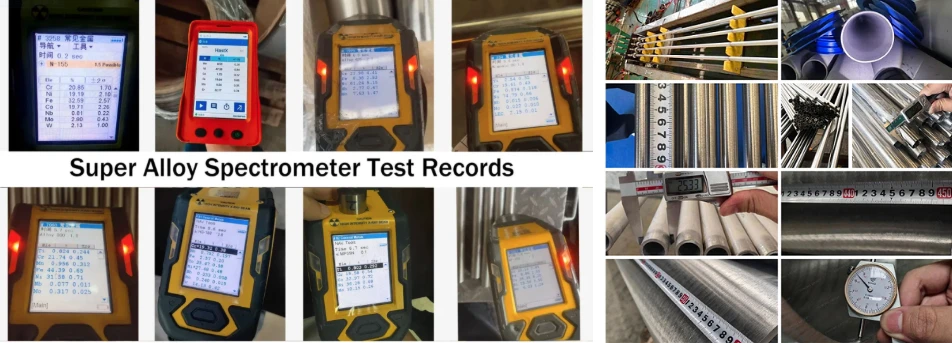
| Full NDT capability | UT, ET, PMI and OES in-house, to ASTM B444 requirements and to the purchaser's supplementary requirements |
| Material certification | EN 10204 3.1 and 3.2 mill test certificates, heat treatment records, and NACE MR0175 documentation where the duty requires it |
| Custom processing | Cut-to-length, beveling, bending, heat treatment, and Alloy 625 weld overlay to qualified WPS / PQR |
| Export packaging | VCI corrosion-inhibitor paper, end caps, steel-strapped bundles on wooden pallets, for sea, air and road freight |
| Technical support | Metallurgical engineers available for alloy selection, creep and corrosion-allowance review, and code documentation support |

Contact us for the latest export price quote for 625 Alloy
FAQ:
What is the material equivalent of UNS N06625?
UNS N06625 is primarily known by its brand name INCONEL alloy 625 and has several international material equivalents across different standards.
What are the key differences between Inconel 625 and Inconel 718?
Inconel 625 and Inconel 718 are high-performance nickel-based superalloys, but they differ fundamentally in how they gain strength. Inconel 625 is a solid-solution-strengthened alloy built for superior corrosion resistance and high-temperature oxidation limits (up to 2,000°F). Inconel 718 is a precipitation-hardened (age-hardened) alloy engineered for maximum mechanical strength and load-bearing toughness.
What is the core difference between Inconel 625 and P265GH seamless tube for steam boiler service?
P265GH is carbon steel for low-to-medium pressure steam boilers, max operating temp ~450°C, low cost. Inconel 625 (UNS N06625) is nickel-chromium-molybdenum alloy, resistant to high temperature, oxidation and corrosion, suitable for high-temperature, corrosive steam conditions with far higher material cost.
What pressure and temperature limits apply to Inconel 625 boiler seamless tubes?
Inconel 625 maintains high tensile and creep strength up to 980°C. It can serve high-pressure steam boilers with corrosive media, resisting pitting, crevice corrosion and stress corrosion cracking from chlorides.


