

For design engineers and FEA specialists in aerospace and nuclear, nothing kills confidence faster than data inconsistency. Relying on generic internet values for Inconel 625 (UNS N06625) can trigger three real risks:
Over-engineering – adding unnecessary weight and cost because safety factors are guesswork.
Structural failure – underestimating thermal softening above 600°C.
Audit rejection – your 3D models don't match actual material certs.
At Gnee Alloy, our Inconel 625 properties are verified by independent labs-so you get high-fidelity, traceable data for accurate FEA and zero-surprise execution. No guesswork. No red flags. Just structural integrity you can simulate and defend.
Click here for an Inconel 625 product quote
Inconel 625 (UNS N06625) Performance Guide
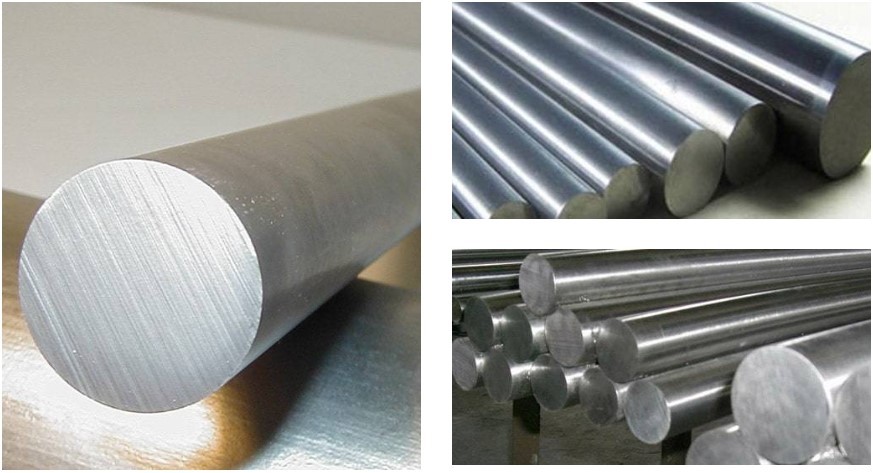
Inconel 625 (UNS N06625) Performance Guide
Inconel 625 (UNS N06625) is a premium nickel-chromium-molybdenum alloy renowned for its exceptional strength, excellent corrosion resistance, and reliable performance from low temperatures up to 982°C (1800°F). It is widely used in aerospace, chemical, and marine engineering fields.
Can Inconel 625 be hardened?
Hardening treatment helps improve the strength and hardness of the material. The precipitation hardening temperature of Inconel 625 is typically between 540°C and 620°C, lasting approximately eight hours.

1. Inconel 625 (UNS N06625) Chemical Analysis
| Element | Content (%) | Function |
|---|---|---|
| Nickel (Ni) | ≥ 58.0 (Balance) | Matrix element; corrosion resistance and high-temperature stability |
| Chromium (Cr) | 20.0 – 23.0 | Oxidation and corrosion resistance |
| Molybdenum (Mo) | 8.0 – 10.0 | Core solid-solution strengthening; pitting and crevice corrosion resistance |
| Niobium (Nb) | 3.15 – 4.15 | Solid-solution strengthening; carbide stabilizer |
| Iron (Fe) | ≤ 5.0 | Residual element |
| Titanium (Ti) | ≤ 0.40 | Supplementary strengthening |
| Aluminum (Al) | ≤ 0.40 | Supplementary strengthening |
| Carbon (C) | ≤ 0.10 | Low carbon for weldability and toughness |
| Manganese (Mn) | ≤ 0.50 | Deoxidizer |
| Silicon (Si) | ≤ 0.50 | Deoxidizer |
| Phosphorus (P) | ≤ 0.015 | Ensures toughness |
| Sulfur (S) | ≤ 0.015 | Ensures hot workability |
| Cobalt (Co) | ≤ 1.0 | Residual element |
2. Mechanical properties of Inconel 625 (UNS N06625) (typical annealed state)
| Property | Value at 20°C | Value at 650°C (1200°F) | Industrial Verdict |
| Yield Strength (0.2%) | ≥ 415 MPa | ≥ 300 MPa | Elite structural load capacity. |
| Tensile Strength (σb) | ≥ 827 MPa | ≥ 600 MPa | Prevents pressure bursting. |
| Elongation (δ5 %) | ≥ 30% | ≥ 35% | High ductility for bellows/coils. |
| Hardness (Aged) | 175 - 240 HB | - | Superior wear & erosion resistance. |
Click here to download the Inconel 625 alloy PDF file
3. Physical Properties Of inconel 625 alloy
| Property | Value |
|---|---|
| Density | 8.44 g/cm³ (0.305 lb/in³) |
| Melting Range | 1290°C – 1350°C (2350°F – 2460°F) |
| Specific Heat | 410 J/kg·°C (at 20°C) |
| Thermal Expansion | 12.8 × 10⁻⁶/°C (at 20 – 100°C) |
| Modulus of Elasticity | 205 GPa (at 20°C) |
4. Inconel 625 Alloy Corrosion Resistance
This alloy delivers proven performance across a wide range of corrosive service conditions:
Marine & seawater environments – Excellent resistance to pitting, crevice corrosion, and chloride-induced stress corrosion cracking (SCC).
Acids – Handles both mineral acids (nitric, phosphoric, sulfuric, and hydrochloric) and organic acids with minimal attack.
Oil & gas – Qualified per NACE MR0175/ISO 15156-3 for sour service environments containing H₂S.
PREN rating – >45, indicating high resistance to localized corrosion. No ambiguity. No false confidence. Just data you can spec to.
5. Inconel 625 Alloy Heat Treatment
| Treatment | Temperature | Time | Cooling | Purpose |
|---|---|---|---|---|
| Solution Treatment (Annealing) | 940 – 1040°C | Per thickness | Rapid cool (water or air) | Softening, carbide dissolution |
6. Industry Specs – What You Actually Need to Know
Inconel 625 isn't a one-size-fits-all material. The applicable specs depend entirely on form:
Bar & Forging – AMS 5666
Sheet & Plate – AMS 5599, AMS 5869, AMS 5879
Tube & Pipe – AMS 5581
7. Inconel 625 Nondestructive Testing (NDT)
| Test Method | Requirement | Standard | Acceptance Criteria |
|---|---|---|---|
| Ultrasonic Testing (UT) | As specified (100% for aviation) | ASTM E2375 | No defects exceeding 0.8mm |
| Eddy Current Testing (ET) | As specified (100% for tubes) | ASTM E426 | No relevant indications |
| Hydrostatic Test | 100% (tubes/pressure parts) | ASTM B444 | No leakage |
| Liquid Penetrant Inspection (LPI) | As specified | ASTM E1417 | No relevant indications |
| Visual Inspection | 100% | - | No surface defects |
Why Choose Gnee as Your Nickel-Based Alloy Supplier
✅️Direct Factory Pricing: Skip the middleman markups and secure the best rates for bulk procurement.
✅️Cut-to-Size Service: We offer precision laser, waterjet, and centerless grinding to deliver blanks ready for your assembly line.
✅️MTC 3.1 Traceability: Every kg of material is delivered with a full EN 10204 3.1 certificate documenting the exact heat analysis.
✅️Global Logistics Support: Fast and secure shipping to Europe, USA, and Southeast Asia within 5-7 business days for stock items.
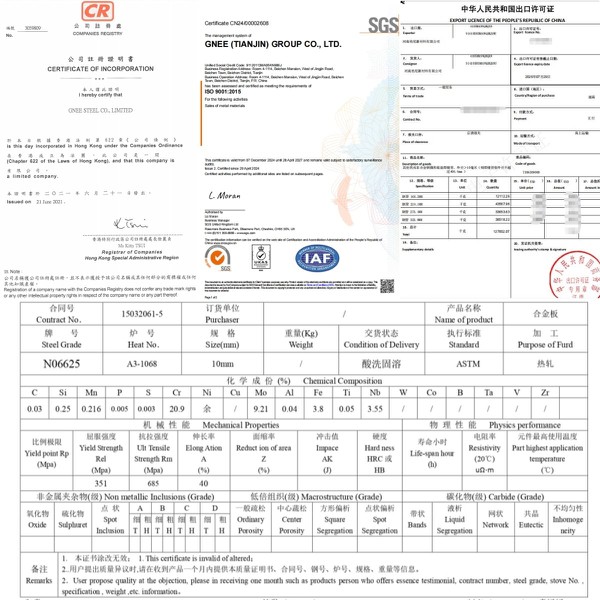
Gnee Alloy inconel 625 Certificate
📦 Packaging and Shipping
All Nickel Based Alloy products are packaged using the following methods:
Wooden pallets or crates
Moisture-proof packaging
Labels with furnace number, standard, and size labels
Shipped worldwide by sea, air, or express
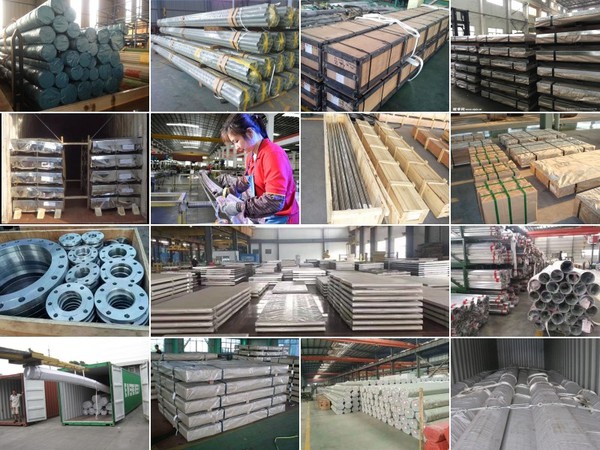
Gnee Alloy 625 Alloy Product Packing
Contact us for the latest export price quote for 625 Alloy
FAQ
Q1: How does the grain size affect the yield strength at high temperatures?
A: Grain size is critical for Industrial Durability. We guarantee a grain size of ASTM E112 Level 5 or finer for Grade 1 and Level 2 or coarser for Grade 2 (Solution Annealed) to maximize creep-rupture life at heat.
Q2: Is Inconel 625 interchangeable with 2.4856?
A: Yes. 2.4856 is the Werkstoff number used in the German/DIN system for the exact same metallurgical system as UNS N06625. We provide materials that comply with both standards.
Q3: Does the hardness change after long-term service?
A: Because Inconel 625 is a solid-solution alloy, its hardness is very stable. Unlike precipitation-hardened alloys (like Inconel 718), it does not suffer from "over-aging" softening at temperatures below 900°C.
Q4: Can you provide customized physical testing for my project?
A: Absolutely. Our in-house lab can perform custom elevated-temperature tensile, fatigue, and Charpy impact testing to verify our material against your specific FEA parameters.


