

Selecting the right Inconel alloy is critical for engineers, procurement managers, and decision-makers in aerospace, marine, energy, and industrial applications. High-performance alloys such as Inconel 600, 625, and 718 are nickel-based superalloys engineered for extreme environments, including high temperature, corrosive conditions, and high-stress operations. Making the wrong choice can lead to material failure, downtime, or regulatory non-compliance.
This guide provides a comprehensive technical comparison of Inconel grades, covering chemical composition, mechanical properties, density, hardness, yield strength, thermal performance, machining challenges, surface treatment, industry applications, technical standards, and supplier considerations. It addresses common customer pain points, helping you make informed decisions backed by ISO 9001, IATF 16949, AS9100, and NADCAP certifications.
Understanding Inconel 600, 625, and 718
Inconel 600 – Chemical Composition, Properties, and Fabrication vs Stainless Steel
Composition: Approximately 72% nickel, 14–17% chromium, with minor iron, manganese, silicon, and carbon.
Properties: Excellent oxidation and corrosion resistance up to 1093°C. Mechanical properties include:
Hardness: 160–220 HB
Tensile strength: 515–827 MPa
Yield strength: 180–310 MPa
Applications: Metal stampings, heat exchangers, chemical processing components, industrial ducting.
Fabrication & Machining: Inconel 600 supports metal stamping, CNC machining, and moderate welding. Surface finishing such as electropolishing or passivation improves corrosion resistance. For stamping, typical sheet thicknesses range 0.5–3 mm, with feed rates adjusted to minimize work hardening.
Inconel 625 – Mechanical Performance, Machining Challenges, and Corrosion Resistance
Composition: Nickel (58%), chromium (20–23%), molybdenum (8–10%), niobium (3–4%).
Properties:
Hardness: 200–300 HB
Yield strength: 414–827 MPa
Tensile strength: 827–1,034 MPa
Excellent fatigue and corrosion resistance, especially in seawater and chemically aggressive environments
Machining & Fabrication: Compared to 600, Inconel 625 is more challenging to machine, requiring:
Specialized tooling (carbide or coated tools)
Controlled cutting speed and feed rates (recommended 30–60 m/min for roughing, 15–25 m/min for finishing)
Low heat input during welding; preheating generally not required, but post-weld stress relief may be applied
Slow feed rates in CNC milling to reduce work hardening
Surface Treatment: Passivation or electropolishing improves corrosion resistance for marine and chemical applications.
Applications: Offshore platforms, chemical plants, marine structures, aerospace components.
Inconel 718 – Precipitation-Hardened Superalloy for High-Load Applications
Composition: Nickel-based, strengthened with chromium, niobium, molybdenum, and titanium.
Properties:
Hardness: 330–410 HB after aging
Yield strength: up to 1,270 MPa
Tensile strength: 1,380–1,510 MPa
Density: 8.19 g/cm³
Applications: Aerospace turbine disks, high-pressure valves, fasteners in high-load and high-temperature environments.
Machining & Fabrication:
Requires precision CNC machining, carbide tooling, and post-machining stress-relief heat treatment
Welding feasible but demands strict pre- and post-heat treatment to maintain mechanical properties
Recommended cutting speeds: 10–30 m/min; feed rates: 0.05–0.2 mm/rev for turning; lower for finishing
Supplier & Certification Notes: Components from NADCAP-approved suppliers meet AS9100/IATF 16949 standards.
Technical Comparison of Inconel Grades – Mechanical and Corrosion Properties
| Eigentum | Inconel 600 | Inconel 625 | Inconel 718 | Notes / Supply Info |
|---|---|---|---|---|
| Hardness (HB) | 160–220 | 200–300 | 330–410 | 625/718 hardness certification; labs in USA, Singapore |
| Yield Strength (MPa) | 180–310 | 414–827 | 1,270 | Tested for aerospace/energy applications |
| Tensile Strength (MPa) | 515–827 | 827–1,034 | 1,380–1,510 | Critical for high-temp marine/chemical/aerospace |
| Density (g/cm³) | 8.47 | 8.44 | 8.19 | Relevant for weight-sensitive applications |
| Korrosionsbeständigkeit | Good | Excellent | Excellent | 625 for seawater; 718 for high-temp oxidative conditions |
| Max Service Temp (°C) | 1093 | 982 | 704 | 600 tolerates higher continuous temp; 718 ideal for structural stress <704°C |
| Bearbeitbarkeit | Moderate | Challenging | Difficult | CNC machining services: Germany/UAE; OEM stamping: China/USA |
| Price per kg | $25–30 | $40–45 | $55–65 | Prices vary by region: USA, UK, India; bulk orders |
| Typische Anwendungen | Heat exchangers, ducting, metal stampings | Marine, aerospace, oil & gas components | Aerospace turbine disks, high-stress fasteners, valves | Certified suppliers, NADCAP-approved components |
Inconel vs Stainless Steel: Inconel alloys maintain strength and corrosion resistance at high temperatures; stainless steel may fail in marine or chemical environments.
625 vs 718: Use 625 for marine or chemically aggressive conditions; choose 718 for high-load and high-temperature structural components.
Cost Considerations: 718 is most expensive due to complex processing; 600 and 625 allow cost-efficient bulk production.


Fabrication and Surface Treatment – CNC, Stamping, Welding, and Finishing
Inconel 600: Metal stamping, CNC machining, moderate welding; electropolishing reduces corrosion points.
Inconel 625: Controlled machining, slow feed rates, heat input management; passivation or coatings enhance seawater durability.
Inconel 718: Precision CNC, carbide tooling, post-aging heat treatment; surface finishing improves fatigue resistance.
Selecting the right combination of alloy, machining parameters, heat treatment, and surface finishing is essential for meeting aerospace, marine, and energy technical standards
FAQ
Is Inconel stronger than stainless steel?
Yes, Inconel alloys like 718 and 625 offer higher yield strength and corrosion resistance at elevated temperatures.
Which Inconel grade is best for marine applications?
Inconel 625 resists seawater; 718 is suitable for high-load structural applications.
Can Inconel 718 be welded easily?
Welding 718 requires controlled pre- and post-heat treatment to maintain strength and fatigue resistance.
How hard is Inconel 625 compared to stainless steel?
Brinell hardness: 200–300 HB, generally higher than most stainless steels.
What industries use Inconel 600 metal stampings?
Aerospace, marine, chemical processing, and high-temperature industrial applications.
Our product range
| Product Form | Standard Specifications & Dimensions | Common Alloys (Examples) | Typical Standards |
|---|---|---|---|
| Bar & Rod | Round Bar: Diameter: 3mm ~ 300mm Hexagon Bar: Across Flats: 5mm ~ 100mm Square Bar: Width: 5mm ~ 150mm Length: Random, Cut-to-length, or Coils (small diameters) |
Alloy 200/201 Monel 400/K-500 Inconel 600/601/625/718 Incoloy 800/800H/825 Hastelloy C-276/C-22/B-2/B-3 |
ASTM B160, B164, B166 EN/DIN 2.4066, 2.4816, 2.4851 ASME SB-166, SB-167 |
| Wire | Diameter: 0.1mm ~ 12mm Form: Coils, spools, or straight lengths Finish: Bright, pickled, annealed |
Alloy 200/201 Inconel 600/625/X-750 Incoloy 825 |
ASTM B166, B167 EN/DIN 17752 |
| Sheet & Plate | Thickness (Sheet): 0.1mm ~ 5.0mm Thickness (Plate): 5.0mm ~ 100mm+ Width: Up to 2000mm (depending on alloy/thickness) Length: Up to 6000mm or as required |
Alloy 200/201 Monel 400 Inconel 600/625/718 Incoloy 800H/825 Hastelloy C-276 |
ASTM B162, B168, B409 EN/DIN 17742, 17744 |
| Strip & Foil | Thickness (Strip): 0.05mm ~ 2.0mm Thickness (Foil): 0.02mm ~ 0.05mm Width: Up to 600mm Condition: Cold rolled, annealed, tempered |
Alloy 200/201 Inconel 600/625 Incoloy 825 |
ASTM B162, B168 |
| Pipe & Tube | Seamless Pipe (ASTM B161/B167): - OD: 3/16" ~ 14" (6mm ~ 355mm) - Schedule: SCH 5S to XXS Welded Tube (ASTM B163/B516): - OD: 6mm ~ 300mm - Wall Thickness: 0.5mm ~ 10mm |
Alloy 200/201 Monel 400 Inconel 600/625 Incoloy 800H/825 Hastelloy C-276 |
ASTM B161, B163, B167, B516 ASME SB-163, SB-167 |
Get the complete product catalog
Our factory and testing
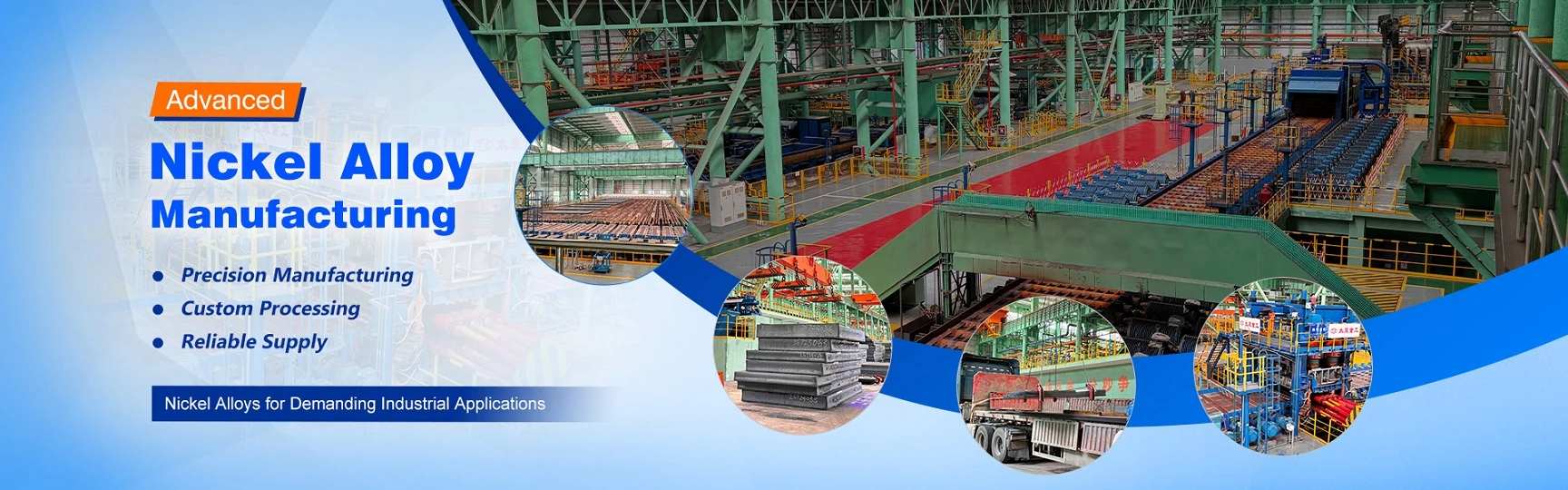
Our core factory and collaborative production system are equipped with modern precision cutting, processing, and heat treatment equipment, focusing on transforming raw materials into semi-finished and finished products that meet stringent standards. To ensure that every batch of materials meets or exceeds specifications, we have established a comprehensive end-to-end quality inspection system. From material properties analysis (PMI) upon raw material warehousing to dimensional accuracy control during production, and finally to mechanical property testing (such as tensile strength and hardness) and non-destructive testing before final shipment, every step is rigorously controlled by our professional quality inspection team. We promise to provide an authoritative, online-verifiable original manufacturer's material certificate (MTC 3.1) for every order, and can arrange for third-party certification bodies (such as SGS, BV, and TUV) to conduct on-site inspections and issue certificates upon customer request.


