

In extreme service environments such as heat-treatment furnaces, petrochemical plants, aero engines, and offshore engineering, ordinary stainless steel often fails quickly when faced with high-temperature oxidation, carburization, chloride pitting, or long-term creep.
Nickel-based superalloys (the Inconel series), built on a high-nickel matrix alloyed with chromium, aluminum, molybdenum, and niobium, have become the material of first choice for these applications.
But although they all carry the "Inconel" brand, 600, 601, and 625 differ considerably in design philosophy and applicable boundaries:
600 is the high-nickel, economical "general-purpose oxidation-resistant workhorse"; 601, with aluminum addition, specializes in carburizing and thermal-cycling service; and 625 combines high strength with broad-spectrum corrosion resistance through molybdenum plus niobium.
This article compares the three systematically across five dimensions - chemical composition, physical properties, mechanical properties, application fields, and welding - to help purchasing and design engineers select by service condition rather than by brand name alone.
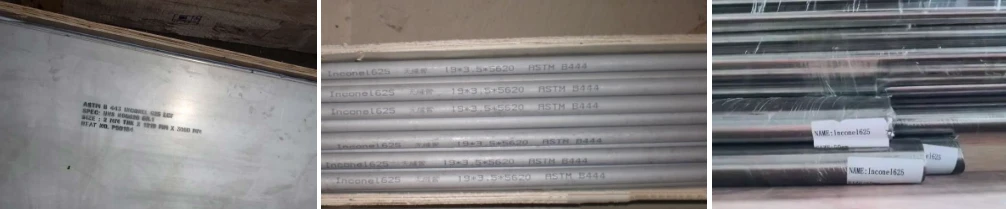
Inconel 600 vs 601 vs 625:What is the difference?
| Item | Inconel 600 | Inconel 601 | Inconel 625 |
|---|---|---|---|
| UNS number | N06600 | N06601 | N06625 |
| Alloy system | Ni-Cr-Fe | Ni-Cr-Fe-Al | Ni-Cr-Mo-Nb |
| Core strengths | High-temperature oxidation resistance, chloride stress corrosion cracking (SCC) resistance | Oxidation resistance + carburization resistance, scaling resistance under thermal cycling | High strength, creep resistance + broad-spectrum corrosion resistance |
| Maximum service temperature (reference) | ≈ 1150 °C | ≈ 1250 °C (oxidizing atmosphere) | ≈ 1000 °C |
| Strengthening mechanism | Solid-solution strengthening | Solid-solution strengthening | Solid solution + niobium-stabilized precipitation strengthening (γ″ phase) |
| Relative material cost | Baseline 1.0× | ≈ 1.3× | ≈ 1.8× |
| Typical positioning | Furnace components, chemical & nuclear heat exchange | Heat-treatment fixtures, carburizing equipment | Aerospace, marine, and pressure-bearing corrosion-resistant parts |
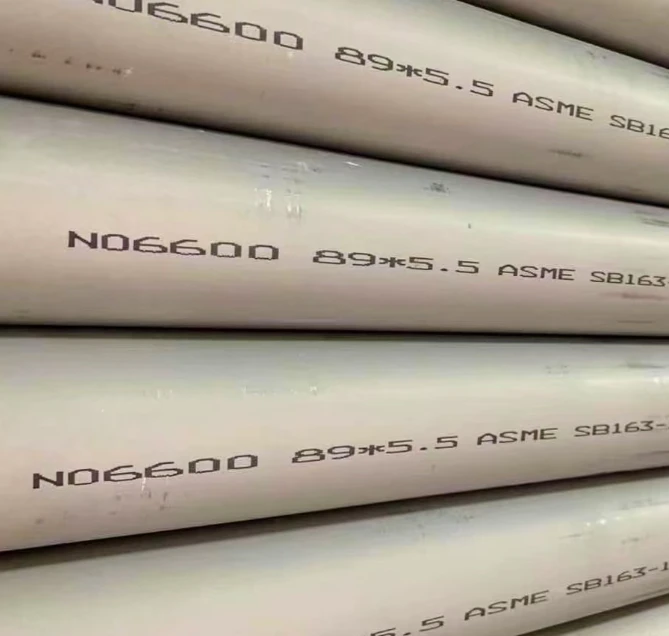
Inconel 600 vs 601 vs 625:Chemical Composition Comparison (wt%)
Composition determines performance. The most critical differences among the three grades lie in the nickel-to-chromium ratio, plus aluminum in 601 and molybdenum and niobium in 625.
| Element | Inconel 600 | Inconel 601 | Inconel 625 |
|---|---|---|---|
| Ni (Nickel) | ≥ 72.0 | 58.0 – 63.0 | ≥ 58.0 |
| Cr (Chromium) | 14.0 – 17.0 | 21.0 – 25.0 | 20.0 – 23.0 |
| Fe (Iron) | 6.0 – 10.0 | Balance (≤ 15) | ≤ 5.0 |
| Al (Aluminum) | - | 1.0 – 1.7 | ≤ 0.4 |
| Mo (Molybdenum) | - | - | 8.0 – 10.0 |
| Nb (Niobium) | - | - | 3.15 – 4.15 |
| Ti (Titanium) | - | - | ≤ 0.4 |
| C (Carbon) | ≤ 0.15 | ≤ 0.10 | ≤ 0.10 |
| Mn (Manganese) | ≤ 1.0 | ≤ 1.0 | ≤ 0.5 |
| Si (Silicon) | ≤ 0.5 | ≤ 0.5 | ≤ 0.5 |
Inconel 600 vs 601 vs 625:Composition Interpretation
- 600 (high nickel, low alloying): Nickel content ≥ 72%, supported by 14–17% chromium and a small amount of iron. The high-nickel matrix gives it excellent oxidation resistance and resistance to chloride stress corrosion cracking (SCC); with few alloying additions, cost is controllable - the "plainest" of the three.
- 601 (high chromium + aluminum): Chromium is raised to 21–25%, with 1.0–1.7% aluminum added. Aluminum forms a dense, tightly adherent Al₂O₃ protective film on the surface that resists spalling through repeated thermal cycles; the high chromium simultaneously strengthens oxidation and carburization resistance.
- 625 (chromium–molybdenum–niobium synergy): On a base of 20–23% chromium, 8–10% molybdenum and 3.15–4.15% niobium are added. Molybdenum markedly improves pitting and crevice corrosion resistance; niobium provides strengthening through the γ″ (Ni₃Nb) precipitate phase, keeping the alloy high-strength and creep-resistant across a wide temperature range.
| Trade designation | UNS (US) | W-Nr. (German) | DIN/EN material name | JIS (Japan) | China GB (GH / NS) |
|---|---|---|---|---|---|
| Inconel 600 | N06600 | 2.4816 | NiCr15Fe | NCF 600 | GH3600; NS3102 (former NS312) |
| Inconel 601 | N06601 | 2.4851 | NiCr23Fe (with Al) | NCF 601 | NS3103 (former NS313) |
| Inconel 625 | N06625 | 2.4856 | NiCr22Mo9Nb | NCF 625 | GH3625; NS3306 (former NS336) |
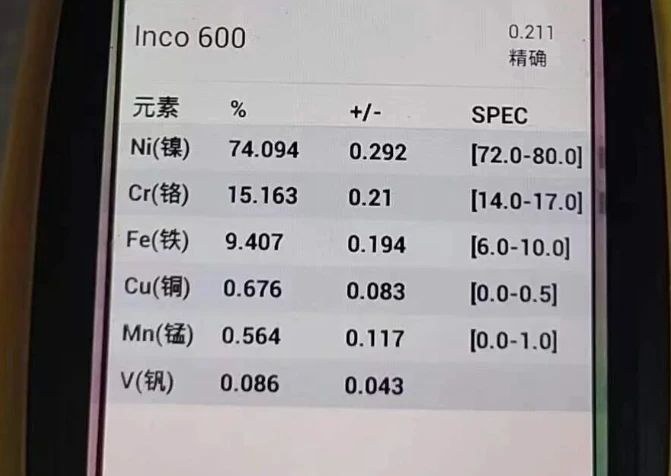
Inconel 600 vs 601 vs 625:Physical Properties Comparison
| Physical property | Inconel 600 | Inconel 601 | Inconel 625 |
|---|---|---|---|
| Density (g/cm³) | 8.47 | 8.11 | 8.44 |
| Melting range (°C) | 1354 – 1413 | 1320 – 1370 | 1290 – 1350 |
| Magnetism | Austenitic, non-magnetic | Austenitic, non-magnetic | Austenitic, non-magnetic |
| Thermal conductivity | ≈ 14.8 W/(m·K) (23 °C) | ≈ 13.3 W/(m·K) (100 °C) | Lower (solid-solution-strengthened nickel alloy) |
| Elastic modulus | ≈ 200–210 GPa (RT) | ≈ 200–210 GPa (RT) | ≈ 200–210 GPa (RT) |
Key points:
The three densities are close (8.1–8.5 g/cm³); 601 is slightly lower due to its relatively higher iron content and the aluminum addition, while 625 is essentially the same as 600. The melting range is highest for 600 and lowest for 625, but all are far above stainless steel, suiting long-term high-temperature service.
All three are austenitic and non-magnetic, with no ductile-to-brittle transition at low temperature, making them usable across a wide window from cryogenic to high temperature. The thermal conductivity of nickel alloys is generally lower than carbon steel, so heat-transfer component design requires an integrated evaluation of heat-transfer area.
Inconel 600 vs 601 vs 625:Mechanical Properties Comparison
Typical/minimum mechanical properties at room temperature (annealed or solution-treated)
| Mechanical property | Inconel 600 | Inconel 601 | Inconel 625 |
|---|---|---|---|
| Tensile strength Rm (MPa) | ≥ 550 | ≥ 550 | ≥ 830 |
| Yield strength Rp0.2 (MPa) | ≥ 240 | ≥ 205 | ≥ 415 |
| Elongation A (%) | ≥ 30 | ≥ 30 | ≥ 30 |
| Hardness (HB) | 109 – 163 | 109 – 163 | 170 – 240 |
High-temperature strength and creep resistance
600 and 601: Strengthened mainly by solid solution, their room- and high-temperature strengths are of the same order of magnitude; the design intent is "temperature and oxidation resistance" rather than "load bearing". Their strength drops markedly with rising temperature, so they are unsuitable as long-term pressure-bearing structural members.
625: The niobium-stabilized γ″ precipitate gives it a room-temperature yield strength about 1.7× that of 600, with a significant advantage maintained across 650–1000 °C; the combined solid-solution/precipitation strengthening from Mo + Nb yields superior creep resistance. Under long-term load at 650–900 °C, the creep rupture strength of 625 is clearly higher than 600/601.
Note: the γ″ phase gradually re-dissolves above roughly 650–700 °C, so 625's strengthening advantage is mainly in the medium-to-high-temperature load-bearing range; beyond that temperature, verify separately against specific creep data.
Inconel 600 vs 601 vs 625:Application Fields Comparison
| Industry / scenario | Inconel 600 | Inconel 601 | Inconel 625 |
|---|---|---|---|
| Aerospace | Exhaust system components | Combustion chamber parts | Turbine components, seals, exhaust parts |
| Petrochemical | Reactors, heat exchangers, piping | Carburizing equipment, furnace internals | Process piping, valves, pump bodies |
| Power & energy | Steam generator heat-transfer tubes | Burner nozzles | Turbine blades, seals |
| Heat treatment | Furnace hearth plates, muffles, baskets | Baskets, fixtures, retorts | High-stress fixtures and tooling |
| Nuclear power | Steam generator tubes, reactor components | Rarely used | Waste-processing related equipment |
| Marine / offshore | Rarely used | Rarely used | Seawater piping, risers, corrosion-resistant connectors |
Typical applications interpreted:
- 600: Its most classic use is nuclear steam generator heat-transfer tubes, plus furnace liners, trays, and wire-mesh components in heat-treatment furnaces; in chemical service it is used for heat exchange and reaction equipment in nitric acid, organic acids, and chloride-containing atmospheres. Its high nickel content is especially critical for SCC resistance.
- 601: Focused on heat-treatment fixtures and carburizing-atmosphere equipment - baskets, fixtures, annealing retorts, roller rails, etc. The Al₂O₃ film formed by aluminum resists scaling through repeated heating and cooling cycles, giving service life markedly longer than ordinary heat-resistant steel; it is also used for burner nozzles and high-temperature furnace internals.
- 625: Aimed at demanding scenarios requiring "both strength and corrosion resistance": aero-engine turbine and exhaust components, seawater piping and risers in offshore engineering, valves and piping in sour gas fields, pressure-bearing corrosion-resistant chemical equipment, and welded structural parts requiring fatigue and creep resistance.
Welding Processes and Consumables Comparison
All three grades are weldable nickel alloys, but their alloy systems differ, so matching consumables and heat-input control also differ. Consumable classifications below follow AWS A5.14 (filler wires/rods) and AWS A5.11 (covered electrodes).
Recommended consumables comparison
| Base metal / UNS | Filler wire (GTAW·GMAW, AWS A5.14) | Electrode (SMAW, AWS A5.11) | Weldability |
|---|---|---|---|
| Inconel 600 / N06600 | ERNiCr-3 (FM 82) | ENiCrFe-3 (FM 182) | Good |
| Inconel 601 / N06601 | ERNiCrCoMo-1 | ENiCrCoMo-1 | Good |
| Inconel 625 / N06625 | ERNiCrMo-3 (FM 625) | ENiCrMo-3 | Excellent (heat input must be strictly controlled) |
Note: for dissimilar-metal welding (between nickel alloys and carbon steel or stainless steel), ERNiCr-3 / ENiCrFe-3 are commonly chosen as transition consumables; final consumable selection should be confirmed per joint type, standard, and welding procedure qualification (WPS/PQR).
General welding process essentials
Welding method: GTAW (TIG) offers controllable heat input and a stable arc, and is the preferred choice; GMAW (MIG), SMAW (stick), and SAW (submerged arc) may be selected according to component thickness and production volume.
Shielding gas: Use argon of 99.99% purity; both the weld pool and the back side of the weld must be effectively gas-shielded to prevent high-temperature oxidation.
Preheating: Generally not required; only when the base metal has condensation or ambient temperature is below about 5 °C, apply a 40–50 °C moisture-removal preheat.
Interpass temperature: Generally controlled at ≤ 150 °C, stricter for sensitive joints; interpass overheating reduces weld corrosion resistance and toughness.
Heat input and beads: Use low heat input, stringer beads, and multi-layer multi-pass technique; avoid wide weaving. Nickel alloys have shallow penetration and poor fluidity, so groove angles and assembly gaps should be increased accordingly.
Pre-weld cleaning: Thoroughly remove oil, oxide scale, and low-melting-point impurities such as sulfur and lead to prevent solidification (hot) cracking.
Post-weld heat treatment: Generally no PWHT is needed; for critical load-bearing or corrosion-resistant components in 625, solution annealing may be performed as required to restore microstructure and corrosion resistance.
Welding precautions by grade
- 600: Niobium in the consumable can tie up impurities such as sulfur and phosphorus, reducing hot-cracking tendency; excessive heat input easily causes microcracking in the joint, so linear energy should be controlled.
- 601: The aluminum in the alloy may cause slight porosity during welding; trailing-gas shielding and interpass cleaning should be reinforced.
- 625: Niobium segregates during solidification, and joints with high restraint are prone to microcracking; use narrow-bead, low-heat-input procedures; for critical parts, solution treatment may be arranged after welding per design requirements.
Selection Recommendations: Match the Alloy to the Service Condition
1. High-temperature oxidation dominant, low load bearing, cost-sensitive → choose 600. For furnace components, ordinary heat exchange, and general chemical corrosion service, 600 offers the best balance between cost and life.
2. Carburizing atmospheres, repeated thermal cycling, long fixture life required → choose 601. Its aluminum-oxide protective film significantly extends service life on heat-treatment baskets and carburizing equipment.
3. High-temperature pressure bearing, creep resistance required, or strong localized corrosion such as seawater or acidic media → choose 625. Its combined strength and corrosion resistance are the strongest of the three; unit material cost is higher, but full life-cycle cost can be amortized through thinner sections and longer replacement intervals.
Common misconceptions to avoid:
1. Do not substitute 600 for 625 in load-bearing service: the gap in yield and creep performance is significant, and unqualified substitution may cause early failure. Conversely, specifying 625 for a purely oxidizing, stress-free furnace condition is over-specification.
2. For seawater and chloride-containing media, look at molybdenum first: 600/601 contain no molybdenum and have limited pitting and crevice corrosion resistance; 625 should be preferred in such scenarios.
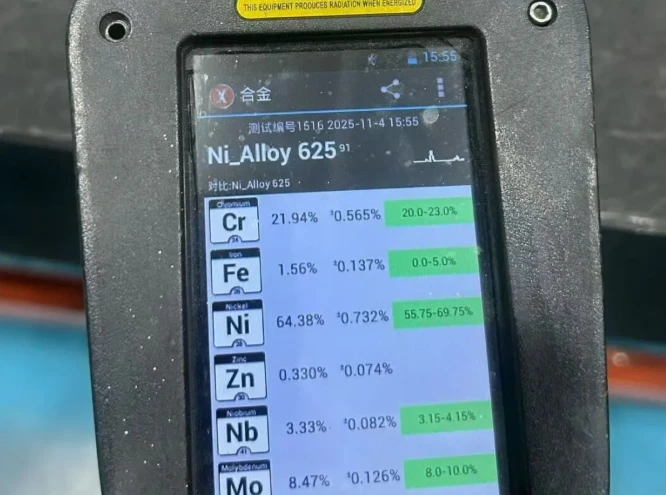
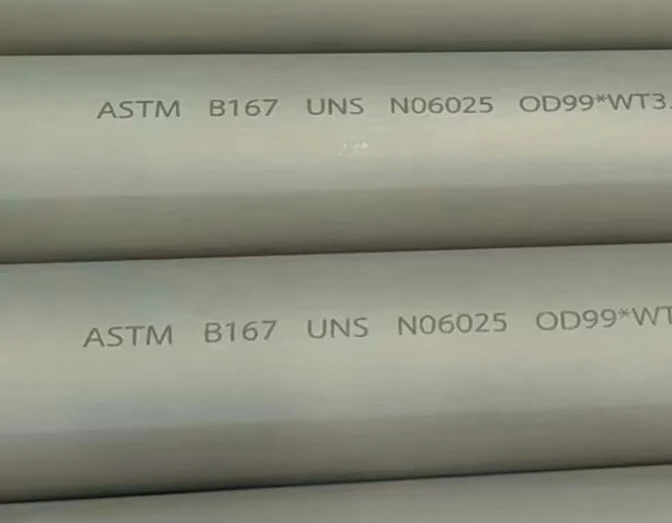
3. When quoting or ordering, specify the UNS number (N06600 / N06601 / N06625), the applicable standard (e.g., ASTM B168 plate, B444 seamless pipe & tube), and delivery condition, and request an EN 10204 3.1 material certificate; for critical components, composition can be re-verified by PMI (positive material identification) after receipt. Welded structural parts should also be accompanied by a welding procedure specification (WPS) and procedure qualification record (PQR), with consumables re-tested.
Conclusion
600, 601, and 625 are not about "which is better" but "which matches the service condition": 600 wins on high-nickel oxidation resistance and cost-effectiveness; 601 wins on carburization resistance and thermal-cycling stability; 625 wins on high strength, creep resistance, and broad-spectrum corrosion resistance. Clarify the medium, temperature, loading mode, and life requirement first, then select against the composition and property tables - only then can you strike the optimal balance between cost and reliability.
Disclaimer: The data in this article are compiled from public grade standards and manufacturers' technical literature; mechanical properties are typical/reference room-temperature values and may vary slightly with product form, delivery condition, and applicable standard. For engineering design, the corresponding standards and the supplier's TDS/mill certificate shall prevail.


