

Inconel 600: Properties, Applications & Buying Guide

Inconel 600: Properties, Applications & Buying Guide
Inconel 600 (UNS N06600) is a nickel-chromium-iron alloy favored for its excellent corrosion resistance, high-temperature oxidation resistance up to 2,000°F (1,093°C), and outstanding creep strength. It is non-magnetic, easy to machine, and widely used in chemical processing, nuclear energy, and aerospace industries.
What temperatures can Inconel 600 withstand?
The hot working temperature range for Inconel 600 alloy is 1600 – 2250°F (870 – 1230°C). Heavy-duty working requires temperatures between 1900 – 2250°F (1040 – 1230°C), while light-duty working can be performed at temperatures as low as 1600°F (870°C).

2.4816 Alloy 600 Seamless Pipe Chemical Composition
| Grade | C | Mn | Si | Fe | S | Cr | Cu | Ni | |
| Inconel 600 Pipe | min. | – | – | – | 6.0 | – | 14.0 | – | 72.0 |
| max. | 0.15 | 1.0 | 0.5 | 10.0 | 0.015 | 17.0 | 0.5 | – | |
Inconel 600 Din 2.4816 Pipe Mechanical Properties
| Grade | Tensile Strength (MPa) min | Yield Strength 0.2% Proof (MPa) min | Elongation (% in 50mm) min | Hardness | |
| Rockwell B (HR B) max | Brinell (HB) max | ||||
| Inconel 600 Pipe | Psi – 95,000 , MPa -655 | Psi – 45,000 , MPa – 310 | 40 | – | – |
2.4816 Inconel Equivalent Material
| Grade | UNS No | Old British | Euronorm | GOST | Japanese JIS | ||
| BS | En | No | AFNOR | ||||
| Inconel 600 Pipe | N06600 | NA 13 | NiCr15Fe | 2.4816 | NC15FE11M | МНЖМц 28-2,5-1,5 | NCF 600 |
International Standards for Inconel 600
|
Form |
Standard |
|---|---|
|
Metal Type |
UNS N06600 |
|
Bar |
ASTM B166 AMS 5665 Din 17752 |
|
Plate |
ASTM B168 AMS 5540 Din 17750 |
|
Pipe |
ASTM B167 |
|
Fitting |
ASTM B366 |
|
Forging |
ASTM B564 Din 17754 |
|
Din |
2.4816 |
Other Regional and Industry Standards:
AMS 5540: Aerospace Materials Specification (Aerospace Grade Inconel 600).
DIN 17750: German Nickel-Based Alloy Industrial Standard.
EN 10095: European standard for heat-resistant alloys.
GB/T 15007: Chinese national standard for nickel-based superalloys.
Material Testing Certificate (MTC/COA) Requirements
When purchasing Inconel 600, always request a Material Testing Certificate (MTC) or Certificate of Analysis (COA) from the supplier. This document should include:
Chemical composition test results (verified by XRF or wet chemical analysis).
Mechanical property test results (tensile strength, yield strength, elongation, hardness).
Conformity to specified standards (e.g., ASTM B166).
Production batch number and product dimensions.
A valid material inspection certificate/analysis certificate serves as proof of the alloy's quality and compliance, helping buyers avoid purchasing counterfeit or substandard products.
Inconel 600 Applications in Industrial Sector
Aerospace Industry
In the aerospace industry, Inconel 600 is used to manufacture components that must withstand extreme temperatures and harsh environments. Key applications include:
* Engine Components: Exhaust manifolds, combustion chamber liners, and afterburner components-these components can reach temperatures exceeding 900°C (1650°F).
* Aircraft Structural Components: Heat shields and thermal management components.
* Heat Exchangers: Used in aircraft cooling systems to effectively transfer heat while resisting oxidation.

600 alloy for aerospace industry
Petrochemical and Chemical Industries
In the petrochemical and chemical processing industry, Inconel 600 is used in equipment that handles high-temperature, alkaline, and corrosive media. Common applications include:
* Reactors and Vessels: Used in processes such as ethylene production, ammonia synthesis, and alkaline solution handling.
* Heat Exchangers and Piping: Used to transfer heat between corrosive fluids while resisting corrosion.
* Valves and Fittings: Critical components that must maintain integrity under high pressure and high temperature environments.
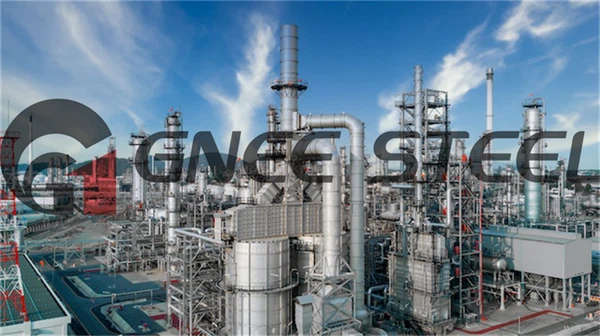
inconel 600 for Petrochemical and Chemical Industries
Nuclear Industry
The nuclear industry relies on Inconel 600's superior radiation resistance, corrosion resistance, and thermal stability. Key applications include:
* **Reactor Heat Exchangers:** Transferring heat from the reactor core to the steam generator while resisting radiation-induced corrosion.
* **Steam Generators:** Piping and components used to handle high-temperature, high-pressure steam.
* **Fuel Cladding:** Protecting nuclear fuel rods from corrosion and radiation.

inconel 600 for Nuclear Industry
Other Industries
Besides aerospace, petrochemical, and nuclear power, Inconel 600 is used in numerous other industries, including:
* **Automotive:** High-performance exhaust systems for racing cars and heavy vehicles.
* **Power Generation:** Boiler superheaters and heat exchangers in coal-fired and gas-fired power plants.
* **Marine:** Components such as valves, pumps, and heat exchangers resistant to seawater corrosion.

inconel 600 for Automotive
**Case Study:A large petrochemical plant in the Middle East replaced its existing stainless steel heat exchanger tubes with Inconel 600 alloy tubing to address corrosion and oxidation issues. The plant operates at temperatures up to 950°C (1742°F) and handles alkaline process fluids. Compared to the mere two-year lifespan of stainless steel tubing, installing Inconel 600 tubing extended the heat exchanger's lifespan to 10 years. This significantly reduced downtime and maintenance costs, resulting in substantial savings.
Inconel 600 vs. Other Nickel-Based Alloys Comparison Table
| Comparison Aspect | Inconel 600vs. Inconel 718 | Inconel 600 vs. Inconel 625 | Inconel 600 vs. Hastelloy C276 |
|---|---|---|---|
| Temperature Resistance | Inconel 600 performs better at high temperatures (1100°C short-term) vs. Inconel 718 (650°C short-term). | Inconel 600 has a higher maximum operating temperature (1100°C vs. 980°C). | Inconel 600 has superior high-temperature oxidation resistance (1100°C vs. 900°C). |
| Strength | Inconel 718 has significantly higher tensile strength (≥1100 MPa vs. 550 MPa) due to precipitation hardening. | ||
| Corrosion Resistance | Inconel 625 is more resistant to strong acids (e.g., hydrochloric) and chloride-rich environments. | Hastelloy C276 outperforms Inconel 600 in strong acids, chlorides, and mixed chemical environments. | |
| Cost | Inconel 600 is more cost-effective due to simpler composition and manufacturing process. | Inconel 600 is more economical than Inconel 625. | Hastelloy C276 is significantly more expensive than Inconel 600. |
| Applications | Inconel 600: high-temperature/oxidation resistance applications. Inconel 718: high-strength/load-bearing applications. | Inconel 625: strong acid/corrosive environments. Inconel 600: high-temperature oxidation resistance environments. | Hastelloy C276: extreme chemical corrosion environments. Inconel 600: high-temperature applications. |
How to Choose the Right Alloy
When choosing Inconel 600 and similar alloys, follow this decision-making process:
Q: What is the maximum operating temperature?
A: If ≥ 980°C, choose Inconel 600.
Q: Is the environment corrosive (strong acid/chloride)?
A: If yes, choose Inconel 625 or Hastelloy C276.
Q: Does the application require high strength/high load-bearing capacity?
A: If yes, choose Inconel 718.
Q: What is your budget?
A: For high-temperature/alkaline applications, Inconel 600 is the most cost-effective choice.
Inconel 600 Purchasing Guide
Purchasing Inconel 600 requires careful consideration to ensure you receive a high-quality, compliant product that meets your application needs. Here are the key considerations for purchasing personnel.
Key Considerations for Purchasing Personnel
Choose a reputable supplier: Select a supplier with ISO certification, a proven track record in nickel alloys, and the ability to provide a Material Testing Certificate (MTC)/Certificate of Analysis (COA). Avoid choosing unknown suppliers whose product quality cannot be verified.
Confirm product shape and size: Inconel 600 is available in various forms, including bars, plates, tubes, and forgings. Ensure the supplier can provide the exact shape and size you require.
Define standards: Clearly specify the required standards in your purchase order (e.g., plates must conform to ASTM B167) to avoid purchasing substandard products.
Understand cost factors: Costs are affected by alloy grade, product form (tubes are more expensive than plates), quantity, and delivery time. Bulk orders often qualify for discounts.
Common Quality Issues and Precautions
When purchasing Inconel 600, be aware of the following common quality issues:
Incorrect composition: Some suppliers reduce the nickel or chromium content to cut costs, which compromises corrosion resistance and temperature stability. Always verify the composition with a Material Testing Certificate (MTC) or Certificate of Analysis (COA).
Poor surface quality: Surface scratches, oxidation, or defects reduce corrosion resistance and mechanical strength. Inspect the product before acceptance.
Lack of Material Certification: Suppliers unable to provide an MTC/COA are likely selling substandard or counterfeit products.
Inspection and Testing
For critical applications, third-party inspection and testing are recommended to verify product quality:
Compositional Testing: X-ray fluorescence (XRF) or wet chemical analysis to confirm elemental composition.
Mechanical Property Testing: Tensile testing, hardness testing, and elongation testing to verify mechanical properties.
Corrosion Testing: Salt spray testing or immersion testing to confirm corrosion resistance (suitable for marine/chemical applications).
Third-party testing provides additional assurance that the product meets your requirements.
Why Choose Gnee as Your Nickel-Based Alloy Supplier
✅ Over 18 years of export experience, products sold to more than 80 countries
✅ Certified by ISO, SGS, and BV
✅ Global inventory of Inconel, Hastelloy, Incoloy, and Monel alloy tubing, plates, and bars
✅ Custom processing services available – including cutting, polishing, CNC machining, and packaging
✅ Fast delivery within 7-15 days, supported by global logistics partners
📦 Packaging and Shipping
All Nickel Based Alloy products are packaged using the following methods:
Wooden pallets or crates
Moisture-proof packaging
Labels with furnace number, standard, and size labels
Shipped worldwide by sea, air, or express

About Gnee Steel
Gnee Steel is a professional manufacturer of nickel-based alloys, including Nickel 201, Nickel 202, Hastelloy C-276, Hastelloy C-22, Hastelloy B, Hastelloy C-4, Inconel 600, Inconel 625, Inconel 718, Inconel X-750, Incoloy 800, Incoloy 800H/HT, Incoloy 825, Monel 400, Monel K500, and other high-temperature alloy materials. We specialize in the production and sales of alloy materials. Gnee Steel's products are widely used in aerospace, chemical, power generation, automotive, nuclear energy, and other fields, and we can provide customized alloy material solutions according to customer needs. For inquiries about alloy material prices or customized alloy material solutions, please feel free to contact us via email at ss@gneemetal.com for a quote.
Square Meters Built
Enterprise Employees
Years Experience
Partner countries
Contact us for the latest export price quote for Inconel 600 metal
FAQ
Q: What is the maximum operating temperature of Inconel 600?
A: Inconel 600 can withstand short-term high temperatures up to 1100°C (2012°F) and long-term continuous operating temperatures up to 980°C (1800°F). This makes it ideal for high-temperature applications such as aerospace engine components and power generation boilers.
Q: Is Inconel 600 resistant to seawater corrosion?
A: Yes, due to its high nickel and chromium content, Inconel 600 has good resistance to seawater corrosion. However, its resistance to chloride corrosion is not as good as Inconel 625 or Hastelloy C276. For extreme marine applications, consider these alternatives.
Q: Can Inconel 600 be welded?
A: Yes, Inconel 600 can be welded using common welding methods such as TIG welding, MIG welding, and SMAW welding. No post-weld heat treatment is required, simplifying the manufacturing process. The welded joint maintains excellent corrosion resistance and mechanical strength.
Q: How does Inconel 600 compare to stainless steel?
A: Inconel 600 has a higher nickel content (72%, while stainless steel has approximately 8-10%), giving it superior high-temperature stability and corrosion resistance. Stainless steel is more economical, but its performance degrades in extreme temperatures and corrosive environments, while Inconel 600 performs exceptionally well under these conditions.
Q: Are the compositions of Inconel 600 supplied by different suppliers consistent?
A: Reputable suppliers provide Inconel 600 core materials with consistent compositions because they must conform to international standards (such as ASTM B166), which have strict regulations on the content of nickel, chromium, and iron. Trace element contents may vary slightly within the standard range, but this will not affect the performance of the core material. Please always refer to the material testing/analysis certificate for verification.
Q: What is the hardness of Inconel 600?
A: Inconel 600 has a Brinell hardness of ≤200 HB at room temperature, which is relatively low for an ultra-hard alloy. Therefore, it is easier to machine and form compared to harder alloys such as Inconel 718.


