

For designers of aero-engine nozzles, high-pressure reactors, and heat treatment equipment, one of the most challenging problems is microstructure degradation.
The GH4169 Pitfalls: Many engineers believe that the exceptional strength of GH4169 (equivalent to Inconel 718) can be maintained indefinitely. However, at temperatures above 700°C, the reinforcing phase γ″ begins to dissolve. By 850°C, GH4169 undergoes rapid overaging, leading to a sharp drop in yield strength and component sagging.
The GH3128 Solution: When your application temperatures reach 950°C (1742°F), you need a different metallurgical material. GH3128 is specifically fortified with tungsten (W) and molybdenum (Mo), allowing it to maintain stability at high temperatures where other materials would soften.
At Gnee Steel, we offer seamless high-pressure alloys to ensure your systems maintain complete structural integrity.
Contact our professionals to recommend the right alloy for your project
Comparison of 700°C strength and 950°C thermal stability of GH4169 and GH3128 pipes

Comparison of 700°C strength and 950°C thermal stability of GH4169 and GH3128 pipes
GH4169 and GH3128 are both nickel-based superalloys used in high-temperature applications, but they are optimized for different temperature ranges and strengthening mechanisms. GH4169 performs better in high-strength applications below 650°C–700°C, while GH3128 has better thermal stability, oxidation resistance, and strength at higher temperatures (especially around 950°C).
What is GH4169 equivalent to?
Inconel 718
GH4169 (equivalent to the American brand Inconel 718) is a precipitation-hardening nickel-based superalloy widely used in the aerospace industry due to its excellent mechanical properties (Lu et al., 2014).

1. Chemical composition (wt%) of GH4169 and GH3128 seamless pipe
| Element | GH4169 | GH3128 | Key Difference |
|---|---|---|---|
| Nickel (Ni) | 50.0 – 55.0 | Balance (≥ 60.0) | GH3128 has higher Ni content |
| Chromium (Cr) | 17.0 – 21.0 | 19.0 – 22.0 | Similar |
| Iron (Fe) | Balance (~18-20) | ≤ 1.5 | GH4169 has much higher Fe |
| Molybdenum (Mo) | 2.80 – 3.30 | 7.5 – 9.0 | GH3128 has ~2.5x more Mo |
| Tungsten (W) | – | 7.5 – 9.0 | GH3128 unique |
| Niobium (Nb) | 4.75 – 5.50 | – | GH4169 unique |
| Titanium (Ti) | 0.65 – 1.15 | 0.15 – 0.35 | GH4169 higher |
| Aluminum (Al) | 0.20 – 0.80 | 0.10 – 0.50 | GH4169 higher |
| Carbon (C) | ≤ 0.08 | ≤ 0.05 | GH3128 lower |
| Manganese (Mn) | ≤ 0.35 | ≤ 0.50 | Similar |
| Silicon (Si) | ≤ 0.35 | ≤ 0.80 | GH4169 lower |
| Phosphorus (P) | ≤ 0.015 | ≤ 0.013 | Similar |
| Sulfur (S) | ≤ 0.015 | ≤ 0.013 | Similar |
| Boron (B) | ≤ 0.006 | ≤ 0.012 | GH3128 has more B |
| Cerium (Ce) | – | ≤ 0.050 | GH3128 unique |
| Cobalt (Co) | ≤ 1.00 | – | GH4169 may contain |
2. Comparison of room temperature and extreme high temperature for GH4169 and GH3128 seamless tubes
| Feature | GH4169 (The 700°C King) | GH3128 (The 950°C Workhorse) |
| Strengthening Method | Precipitation (Nb, Ti, Al) | Solid Solution (W, Mo) |
| Max Continuous Load | 650°C - 700°C | 950°C - 1000°C |
| Over-aging Risk | High above 750°C | Near Zero (Stable Matrix) |
| Oxidation Resistance | Good | Exceptional at 950°C |
| Yield Strength at 800°C | ~ 250 MPa (Softens) | **~ 450 - 500 MPa (Stable)** |
| Fabrication | Challenging (Requires Aging) | Excellent (Superior Weldability) |
Click to download the GH4169 alloy PDF file now
3. Key Comparison Table of GH4169 and GH3128 Tubes
| Feature | GH4169 (Inconel 718) | GH3128 (GH128) |
|---|---|---|
| Strengthening Method | Precipitation Strengthening (γ'' + γ') | Solid Solution Strengthening (W, Mo) |
| 700°C Strength | Very High (Maximum yield ~1000 MPa at 650°C) | Moderate (Lower than GH4169) |
| 950°C Stability | Poor (γ'' transforms to δ phase, softens) | Excellent (Stable microstructure, high oxidation resistance) |
| Primary Use | Turbine disks, blades (sub-700°C) | Combustion chambers, afterburners (950°C+) |
4. Strength at 700°C
GH4169: This alloy is designed to achieve maximum strength at medium to high temperatures, making it ideal for 700°C. It relies on a high volume fraction of coherent nickel-niobium (Ni3Nb) precipitates, which provide excellent yield strength in the 650°C–700°C range.
GH3128: As a solid solution-strengthened alloy, its high-temperature strength at 700°C is generally lower than that of precipitation-strengthened alloys like GH4169. However, it maintains stable strength at 700°C, while GH4169 begins to show a decrease in strength.
Conclusion: GH4169 has higher strength at 700°C.
5. Thermal Stability and Strength at 950°C
GH4169: Poor thermal stability at 950°C. The "phase" begins to coarsen and transform into an incoherent phase above 650-700°C, leading to severe softening of the material. Not suitable for long-term use at 950°C.
GH3128: This alloy is specifically designed for an operating temperature range of 900-1150°C. Its solid solution matrix is reinforced with tungsten (W) and molybdenum (Mo), maintaining stability. It exhibits excellent high-temperature oxidation resistance and maintains high creep rupture strength during long-term use at 950°C.
Conclusion: GH3128 is more stable and reliable at 950°C.
6. Choosing Between GH4169 and GH3128 Piping
As a reliable supplier, we advise on specific "switchover" points for our customers' piping systems:
GH4169 piping is suitable for: high-speed rotating components, turbine disks, and high-pressure fuel lines operating at temperatures strictly below 700°C. In these applications, GH4169 piping offers the highest yield strength, meeting high-pressure sealing requirements.


GH3128 piping is suitable for: combustion chamber linings, nozzle baffles, furnace radiant tubes, and structural components exposed to high-temperature environments of 900°C to 1000°C. GH3128 piping offers industrial durability and oxidation resistance unmatched by GH4169 piping.


7. Why choose to source GH4169 and GH3128 from Gnee Steel?
As a Tier-1 Manufacturer of high-temperature nickel alloy pipes, we offer:
✅️VIM + VAR melting: Ensuring ultra-low impurities for both grades to maximize thermal fatigue resistance.
✅️Dual Inventory: We maintain a massive Wholesale Inventory of both GH4169 and GH3128 seamless pipes for immediate project dispatch.
✅️MTC 3.1 Traceability: Full heat-analysis and mechanical verification certificates included with every shipment.
✅️Custom Fabrication: Precision cutting, centerless grinding (h8-h11), and specialized heat treatment tailored to your environment.

Gnee Steel GH4169(inconel 718) Certificate
📦 Packaging and Shipping
All Nickel Based Alloy products are packaged using the following methods:
Wooden pallets or crates
Moisture-proof packaging
Labels with furnace number, standard, and size labels
Shipped worldwide by sea, air, or express
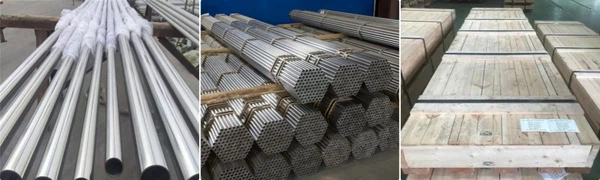
Gnee Steel GH4169 Product Packing
Contact us for the latest export price quote for GH4169 Alloy
FAQ
Q1: What exactly is "Over-aging" in GH4169?
A: GH4169 relies on tiny γ′′ particles for its strength. At temperatures above 750°C, these particles grow too large or dissolve back into the metal matrix. This "softens" the alloy, causing parts to stretch and warp under load. GH3128 avoids this because its strength comes from solid solution elements (W, Mo) that don't dissolve.
Q2: Can I weld GH3128 to GH4169?
A: Yes. Both have excellent weldability. We recommend using specialized filler metals like ERNiCrMo-3 to ensure the joint remains stable across the different thermal expansion zones.
Q3: Which alloy is more cost-effective?
A: GH4169 is generally more expensive due to higher Niobium content and complex heat treatment. GH3128 is an extremely Cost-effective Solution for pure high-temperature oxidation service where elite tensile strength isn't required but stability is.
Q4: Do you offer PED certification for pressure service?
A: Yes. All our high-temperature pipes can be supplied with PED 2014/68/EU certification for use in global pressure vessels and reactors.


