

In the core components of aero engines, turbine disks or shafts rotate at speeds exceeding 10,000 rpm at temperatures reaching up to 650°C. For engineers and procurement managers, one of the most challenging issues is internal material defects.
Our GH4169 high-temperature alloy, manufactured using a three-melt process, is specifically designed to eliminate these risks, providing absolute structural integrity for mission-critical aerospace and nuclear applications.
Click to apply for a Gnee Alloy factory tour
Why must aerospace-grade GH4169 (Inconel 718) use the VIM+ESR+VAR process?
Why must aerospace-grade GH4169 (Inconel 718) use the VIM+ESR+VAR process?
Aerospace-grade GH4169 (Inconel 718) requires a vacuum arc melting (VIM) + electroslag remelting (ESR) + vacuum additive manufacturing (VAR) process to achieve the extremely high purity, homogeneity, and microstructural integrity required for critical rotating components in jet engines and turbines. GH4169 has a complex composition (containing active elements such as Ti, Al, and Nb), making it prone to oxidation, inclusions, and segregation. This special multi-stage process effectively mitigates these problems.
Can Inconel 718 be heat-treated?
Inconel 718 alloy is typically treated using two heat treatment methods: solution annealing at 1700-1850°F, followed by rapid cooling (usually with water), precipitation hardening at 1325°F for 8 hours, furnace cooling to 1150°F, holding at 1150°F for 18 hours, and finally air cooling.
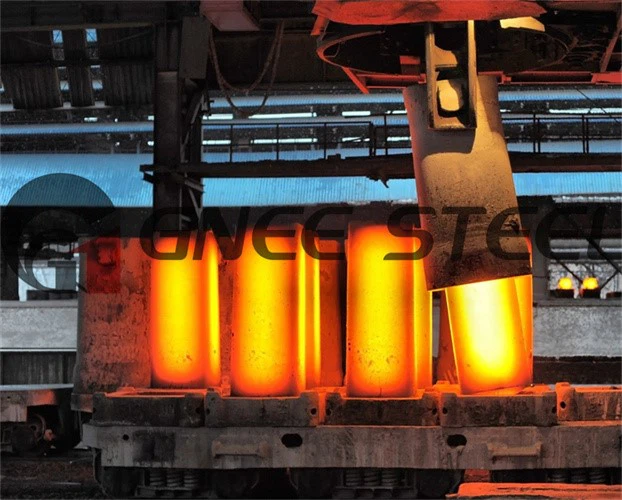
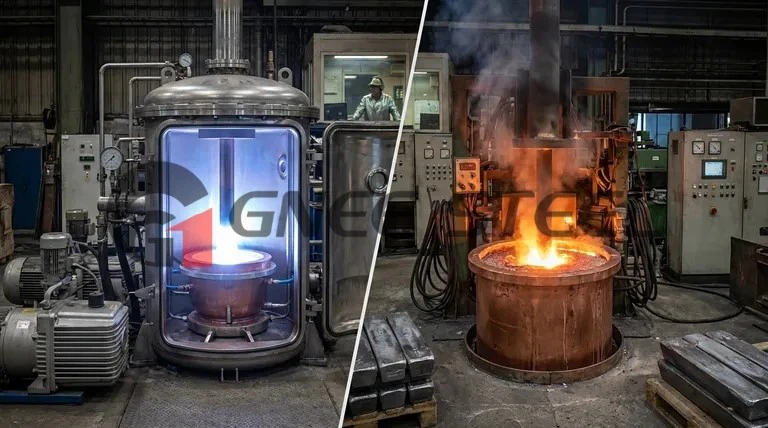
Gnee Alloy's Vacuum Induction Melting (VIM) + Electroslag Remelting (ESR) + Vacuum Arc Remelting (VAR) Process Technology
To achieve "zero-defect" quality, we employ a three-stage refining strategy far exceeding industry standards.

Vacuum Induction Melting (VIM) - Pure Base Material
Purpose: This is the main smelting step, carried out in a vacuum environment to prevent reaction with atmospheric oxygen and nitrogen.
Advantages: It allows for precise control of the content of volatile elements (aluminum, titanium) and the removal of gases (oxygen, nitrogen) and harmful trace impurities. It ensures that the chemical composition is within very tight tolerances.
Limitations: Vacuum forming (VIM) ingots often exhibit shrinkage cavities and segregation.
Electroslag Remelting (ESR) - Filtration
Objective: To refine vacuum electrophoretic ingots through slag barrier treatment to remove non-metallic inclusions.
Advantages: Effectively removes sulfur and oxide inclusions, significantly improving material cleanliness. Eliminates sponge-like shrinkage cavities generated during the vacuum electrophoresis process, resulting in a dense microstructure.
Limitations: May lead to macroscopic segregation in the center of large ingots.


Vacuum Arc Remelting (VAR) - Homogenization
Objective: To achieve the final refining step by utilizing vacuum high-temperature directional solidification of the ingot.
Advantages: Eliminates residual white spots and segregation from the electroslag remelting process, resulting in a dense, uniform ingot with excellent microstructure. This minimizes low-cycle fatigue (LCF) failure by reducing inclusion-induced fatigue.
4. Advantages of GH4169 alloy undergoing three-stage melting
Why pay for the extra process? The data speaks for itself.
| Quality Metric | Single Melt (EAF) | Double Melt (VIM+ESR) | Triple Melt (VIM+ESR+VAR) |
| Inclusion Level | High | Low | Ultra-Low (Clean Steel) |
| Segregation Risk | High | Moderate | Near-Zero (Freckle-Free) |
| Fatigue Resistance | Standard | +30% Improvement | +60% Maximum Life |
| Application | Construction | Industrial Pumps | Aero-Engine Rotating Parts |
| Compliance | GB/ASTM | ASTM / ASME | AMS 5662 / AS9100 |
5. Overview of Advantages in Aerospace Applications
Extremely high cleanliness: Removes oxides and gases, preventing fatigue cracking.
Microstructure uniformity: Ensures consistent mechanical properties in large components such as turbine disks.
Improved hot workability: Reduces defects in subsequent forging processes, increasing the yield of finished parts.
Reduced probability of defects: Minimizes the occurrence of metallurgical defects such as white spots, inclusions, and segregation.
6. Why choose to source triple-melted GH4169 from Gnee Alloy?
As a Tier-1 Supplier specializing in elite superalloys, we provide more than just raw material; we provide engineering security:
✅️Zero-Defect Quality: Every bar undergoes 100% Ultrasonic Testing (UT Class A) to ensure zero internal voids.
✅️MTC 3.1 & 3.2 Traceability: Full heat number tracking from VIM to the final product.
✅️Direct Factory Pricing: Save up to 15% by cutting out trading agents while securing Aerospace Grade quality.
✅️Wholesale Inventory: Large stock of triple-melted bars and forgings ready for Immediate Dispatch.

Gnee Steel GH4169(inconel 718) Certificate
📦 Packaging and Shipping
All Nickel Based Alloy products are packaged using the following methods:
Wooden pallets or crates
Moisture-proof packaging
Labels with furnace number, standard, and size labels
Shipped worldwide by sea, air, or express
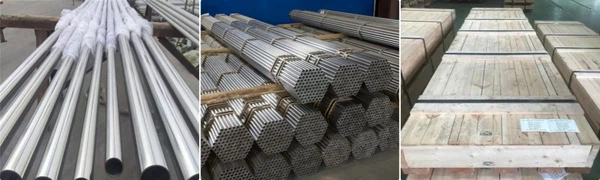
Gnee Steel GH4169 Product Packing
Contact us for the latest export price quote for GH4169 Alloy
FAQ
Q1: Is VIM+ESR+VAR always necessary for GH4169?
A: For rotating parts (shafts, discs) and flight-safety components, Yes. It is a mandatory requirement under AMS 5662. For static fasteners or low-stress furnace parts, a double-melted (VIM+VAR or VIM+ESR) material may be a more Cost-effective Solution.
Q2: Does the triple melting process affect the price per kg?
A: Yes, it is a premium process. However, the Material Life Cycle is significantly longer, and the risk of a multi-million dollar component failure is virtually eliminated.
Q3: Is your GH4169 interchangeable with US-made Inconel 718?
A: Absolutely. When produced via VIM+ESR+VAR, GH4169 is chemically and mechanically identical to Inconel 718 (UNS N07718). It is globally interchangeable in international aerospace blueprints.
Q4: Do you provide certification for the melting process?
A: Yes. Every Mill Test Certificate (MTC) explicitly states the melting route (e.g., "V+E+V") to ensure compliance with your engineering specifications.


