Dec 18, 2025 Leave a message

Inconel 625 vs Inconel 718: Material Comparison

When talking about high-performance alloys that are to be used in extreme environments, Inconel 625 and Inconel 718 very often emerge as the two most prominent names. The nickel-based superalloys get their reputation from being able to withstand very high and very low temperatures, having excellent strength and corrosion resistance, and being of great importance in areas such as aerospace, marine, and chemical processing. Yet, it is true that they have undergone some mutations. Each one of them is different and is therefore suited for a particular application and condition. This paper is a thorough investigation into the major differences between Inconel 625 and 718. It aims at enabling you to know their pros and cons and the scenarios in which it is best to use each of them. You do not have to be an engineer or a designer or be just curious about advanced materials to get the benefits of this comparison. The comparison will lead you to make the right project-related decisions.


Introduction to Inconel Alloys

Inconel alloys are a group of superalloys based on nickel which are recognized for their remarkable resistance to oxidization, corrosion and heat. These materials are intended particularly to withstand extreme environmental conditions, e.g., high temperatures and corrosive environments. Because of their remarkable properties, Inconel alloys find widespread applications among industries such as aerospace, chemical processing and marine applications. Their strength and longevity make them suitable for parts like turbines, heat exchangers and exhaust systems and thus reliability in performance is ensured even under the most challenging situations.


What are Inconel Alloys?

Inconel alloys are classified as nickel-chromium-based superalloys which are very much recognized for their great resistance against the high-temperature, corrosive and oxidizing environments and surely are the best among the materials used in such high-stress industrial applications.


Applications of Inconel Alloys

Aerospace

The aerospace sector utilizes Inconel alloys extensively as turbine blades, components of jet engines, and parts of exhaust systems. The extreme temperatures and high-pressure conditions are the areas where the alloys' strength and reliability come to play, thus ensuring safety during flights that go through such harsh conditions.


Chemical Processing

These alloys are very much resistant to the attack of corrosive agents and are therefore, very much applicable in the chemical processing industry as heat exchangers, reactors, and piping systems. Their longevity even in the face of strong acids and alkalis is the main reason for their widespread use in chemical processing.


Marine Applications

Inconel alloys have a remarkable ability to resist saltwater corrosion and thus are the best materials for marine hardware, submarine components, and offshore oil drilling equipment. This characteristic keeps the marine environment not only very corrosive but also very harsh to equipment.


Power Generation

Inconel alloys' main qualities of high heat and oxidation resistance are the reason for their use in gas turbines, nuclear reactors, and boiler tubes. They are able to withstand very high temperature cycling without any loss of mechanical integrity that, in turn, makes them reliable for the energy production sector.


Automotive Industry

Inconel alloys are mainly used in automotive applications where the performance of the vehicle is very high, hence, exhaust manifolds, turbochargers, and heat shields. Their strength, lightness, and ability to withstand very high and low temperatures make them the best for the engine and the whole vehicle.

Inconel 718 properties
Inconel 718 price
Inconel 718 supplier
Machining Inconel 718

Chemical Composition of Inconel 625

Inconel 625, a nickel-containing superalloy, is highly appreciated for its superior strength, fantastic corrosion resistance, and remarkable performance in harshest environments comprised of very high and chemically aggressive conditions. It is these unique properties that are responsible for its extensive use in aerospace, marine, and chemical processing industries. The chemical composition of Inconel 625 has been to a large extent altered in order to attain the corresponding high level of its superior properties.

Below is a weight percent breakdown of the commonly accepted chemical composition of Inconel 625:

Element Composition (Weight %)
Nickel (Ni) At least 58.0%
Chromium (Cr) 20.0–23.0%
Molybdenum (Mo) 8.0–10.0%
Iron (Fe) Up to 5.0%
Niobium (Nb) + Tantalum (Ta) 3.15–4.15%
Cobalt (Co) Maximum 1.0%
Manganese (Mn) Maximum 0.50%
Silicon (Si) Maximum 0.50%
Aluminum (Al) Maximum 0.40%
Titanium (Ti) Maximum 0.40%
Carbon (C) Maximum 0.10%
Phosphorus (P) Maximum 0.015%
Sulfur (S) Maximum 0.015%

With high content of Nickel and Chromium, the alloy is quite resistant to oxidation and corrosion even in very hostile chemical environments. Molybdenum and niobium enhance the strength of the alloy through solid-solution strengthening and by hindering grain boundary creep at higher temperatures. The content of the rest of the trace elements is kept at a low level in order to avoid difficulties in processing and performance, but without losing its mechanical properties.

The combination of Inconel 625 composition is such that it becomes a constantly chosen material for highly demanding applications like jet engine parts, deep-sea exploration tools, and chemical reactors, where both stamina and stability are vital.


Chemical Composition of Inconel 718

Inconel 718, a nickel-based superalloy, is characterized by its extraordinary strength, resistance to corrosion, and ability to remain functional in harsh conditions. Its chemical composition is precisely designed to assure mechanical properties and thermal stability, particularly at high temperatures and under considerable stress. The following is an exhaustive explanation of the major elements and their usual composition ranges in Inconel 718:

Nickel (Ni): 50.0–55.0%

Nickel is the principal base of the alloy, exhibiting great oxidation and corrosion resistance and at the same time imparting the alloy with its high-temperature strength.

Chromium (Cr): 17.0–21.0%

Chromium not only limits oxidation but also significantly improves, through its main chemical character, the alloy's chemical durability.

Iron (Fe): Balance

Iron is the main feature of the superalloy that is in part and largely responsible for the alloy's overall strength by mixing with nickel and other elements.

Molybdenum (Mo): 2.8–3.3%

Molybdenum is an alloying element that helps to prevent the corrosion forms of pitting and crevice which are particularly prevalent in chloride-containing environments.

Niobium (Nb) + Tantalum (Ta): 4.75–5.50%

The joint action of niobium and tantalum is a major factor in the precipitation hardening process that raises the alloy's strength and creep resistance.

Titanium (Ti): 0.65–1.15%

Titanium helps to create tough carbide and nitride phases which are one of the sources of the material's strength when it is exposed to high temperatures for a long time.

Aluminum (Al): 0.20–0.80%

Aluminum lowers material's oxidation susceptibility at extreme temperatures via the surface getting overlaid by a protective oxide layer.

Cobalt (Co): Max 1.0%

Cobalt provides an extra layer of support towards corrosion resistance, particularly in very oxidizing environments.

Carbon (C): Max 0.08%

Carbon aids when alloying with iron by developing strength through carbide formation, keeping the combination weldable.

Manganese (Mn): Max 0.35%

Manganese enhances the properties of the material and at the same time, through its action in the hot processing, lessens the risk of hot-cracking.

Silicon (Si): Max 0.35%

Silicon boosts oxidation resistance even more and together with the other mechanisms silicon may act as a ventilator contributing to better performance at high temperatures.

Phosphorus (P): Max 0.015%

The amount of phosphorus is closely observed as it can make the alloy brittle and thus ductility is of great importance.

Sulfur (S): Max 0.015%

The presence of sulfur is also limited in order to minimize the occurrence of hot-cracking and at the same time to guarantee the dependability of the material.


Comparison of Chemical Compositions

Inconel 718

Nickel (Ni): 50-55%

Chromium (Cr): 17-21%

Iron (Fe): Remainder (~Balance)

Molybdenum (Mo): 2.8-3.3%

Niobium (Nb): 4.75-5.5%


Hastelloy C-276

Nickel (Ni): Remainder (~Balance)

Molybdenum (Mo): 15-17%

Chromium (Cr): 14.5-16.5%

Iron (Fe): 4-7%

Tungsten (W): 3-4.5%


Monel 400

Nickel (Ni): 63% minimum

Copper (Cu): 28-34%

Iron (Fe): 2.5% maximum

Manganese (Mn): 2% maximum

Carbon (C): 0.3% maximum


Titanium Alloy (Ti-6Al-4V)

Titanium (Ti): Remainder (~Balance)

Aluminum (Al): 5.5-6.75%

Vanadium (V): 3.5-4.5%

Iron (Fe): 0.4% maximum

Oxygen (O): 0.2% maximum


Stainless Steel 316

Iron (Fe): Remainder (~Balance)

Chromium (Cr): 16-18%

Nickel (Ni): 10-14%

Molybdenum (Mo): 2-3%

Carbon (C): 0.08% maximum


Mechanical Properties of Inconel 625

Inconel 625, a nickel-based superalloy, is a material that is highly praised for its outstanding mechanical properties and resistance to extreme environments. Consequently, it is widely used in the aerospace, marine, chemical, and energy sectors. Here is a comprehensive of its most important mechanical characteristics:

Property Value
Tensile Strength ~120-160 ksi (827-1103 MPa)
Yield Strength ~60-90 ksi (414-621 MPa)
Elongation at Break ~30-60%
Hardness ~200-240 HV
Young's Modulus ~200 GPa (29 Msi)
Creep and Fatigue Resistance Excellent resistance to creep and fatigue during high-stress, high-temperature operations


Mechanical Properties of Inconel 718

Inconel 718 is a superalloy that is well known for its excellent properties of strength, toughness, and corrosion resistance. As a result, it can be employed in the most challenging applications such as aerospace, nuclear, and marine industries. Here are the mechanical properties of this alloy explained in detail:

High Tensile Strength

Inconel 718 has a tensile strength varying from 930 MPa to 1400 MPa (135 ksi to 203 ksi), based upon the heat treatment and application requirements. Its highly reliable performance is guaranteed in the most critical structural and high-pressure environments.

Yield Strength

In general, a yield strength characteristic of this alloy is about 550 to 1200 MPa (80 to 174 ksi), which means it can easily withstand heavy stresses with no change in shape.

Creep Resistance

The material can be used at a temperature limit of 700°C (1292°F) and still have a low probability of failure due to creeping, which is a very slow deformation of material under high temperature and pressure conditions. That is why the material is considered to be suitable for a turbine in an aircraft engine that operates at high temperature, where it is directly exposed to the hottest part of the engine.

Fatigue Strength

The material doesn't give up easily when it comes to resistance to fatigue. It withstands all the imposed mechanical oscillations and thus keeps the cycles of loading and unloading of the material going.

Hardness

The alloy has a hardness value that could be Rockwell C30 to C45 depending on the heat treatment it undergoes.

Impact Toughness

The cryogenic temperatures do not mean that Inconel 718 is no longer tough because the alloy still exhibits a significant amount of toughness; hence its versatility and reliability.


Differences in Mechanical Properties

The mechanical properties of materials are fully determined by their composition, processing, and application. The following are five significant differences in the mechanical properties of traditional materials, on the one hand, and Inconel 718, on the other hand:

Property Inconel 718 Comparison Materials
Tensile Strength Around 1240 MPa (180 ksi) in age-hardened condition Steel Alloys: 400-1000 MPa based on grade and treatment
Yield Strength High yield strength of about 1030 MPa (150 ksi) Titanium Alloys: Not exceeding 900 MPa despite good strength-to-weight ratios
Fatigue Resistance Superior resistance to cyclic loading, ideal for aerospace components under repetitive stress Aluminum Alloys: Less fatigue resistant, more likely to develop cracks under repeated loading
Creep Strength Can perfectly resist large deformations at 700°C (1292°F) Stainless Steel: Performance limited to 500°C (932°F) under high-temperature creep conditions
Impact Toughness Excellent toughness even at cryogenic temperatures due to nickel-based structure and precipitation hardening Carbon Steel: Can become brittle at low temperatures with significant reduction in toughness


Comparative Analysis of Corrosion Resistance

While assessing the resistance of materials to corrosion caused by harsh environmental conditions, it is a must to take into account various factors and data points. The defense against corrosion is very good, especially for stainless steels, titanium alloys, and Inconel 718, with the performance determined by the supply of the certain protection. Here are five major issues:

Corrosion Factor Stainless Steel Titanium Alloys Inconel 718
Resistance to Oxidation Moderate level, protection determined by chromium content Strong resistance due to stable oxide layer Outstanding resistance, excellent performance at high temperatures
Performance in Acidic Solutions Susceptible to pitting and crevice corrosion in strong acid environments Great resistance in oxidizing conditions Excellent resistance due to nickel-chromium-molybdenum composition
Saltwater Resistance Likely to corrode in high chloride content areas Excellent resistance, very suitable for marine applications Great performance in chloride environments, significantly reduces degradation
Temperature Stability Resists corrosion up to normal temperature levels Good stability across temperature range, especially in oxidizing environments Unbeatable stability and corrosion resistance across extended temperature range
Environmental Stress Cracking Less resistant, may crack under certain conditions Very unlikely to crack even in high stress situations Remarkably strong, provides resistant barrier against environmental stress-corrosion cracking


Our product range

Product Form Standard Specifications & Dimensions Common Alloys (Examples) Typical Standards
Bar & Rod Round Bar: Diameter: 3mm ~ 300mm
Hexagon Bar: Across Flats: 5mm ~ 100mm
Square Bar: Width: 5mm ~ 150mm
Length: Random, Cut-to-length, or Coils (small diameters)
Alloy 200/201
Monel 400/K-500
Inconel 600/601/625/718
Incoloy 800/800H/825
Hastelloy C-276/C-22/B-2/B-3
ASTM B160, B164, B166
EN/DIN 2.4066, 2.4816, 2.4851
ASME SB-166, SB-167
Wire Diameter: 0.1mm ~ 12mm
Form: Coils, spools, or straight lengths
Finish: Bright, pickled, annealed
Alloy 200/201
Inconel 600/625/X-750
Incoloy 825
ASTM B166, B167
EN/DIN 17752
Sheet & Plate Thickness (Sheet): 0.1mm ~ 5.0mm
Thickness (Plate): 5.0mm ~ 100mm+
Width: Up to 2000mm (depending on alloy/thickness)
Length: Up to 6000mm or as required
Alloy 200/201
Monel 400
Inconel 600/625/718
Incoloy 800H/825
Hastelloy C-276
ASTM B162, B168, B409
EN/DIN 17742, 17744
Strip & Foil Thickness (Strip): 0.05mm ~ 2.0mm
Thickness (Foil): 0.02mm ~ 0.05mm
Width: Up to 600mm
Condition: Cold rolled, annealed, tempered
Alloy 200/201
Inconel 600/625
Incoloy 825
ASTM B162, B168
Pipe & Tube Seamless Pipe (ASTM B161/B167):
- OD: 3/16" ~ 14" (6mm ~ 355mm)
- Schedule: SCH 5S to XXS
Welded Tube (ASTM B163/B516):
- OD: 6mm ~ 300mm
- Wall Thickness: 0.5mm ~ 10mm
Alloy 200/201
Monel 400
Inconel 600/625
Incoloy 800H/825
Hastelloy C-276
ASTM B161, B163, B167, B516
ASME SB-163, SB-167

Get the complete product catalog

Our factory and testing

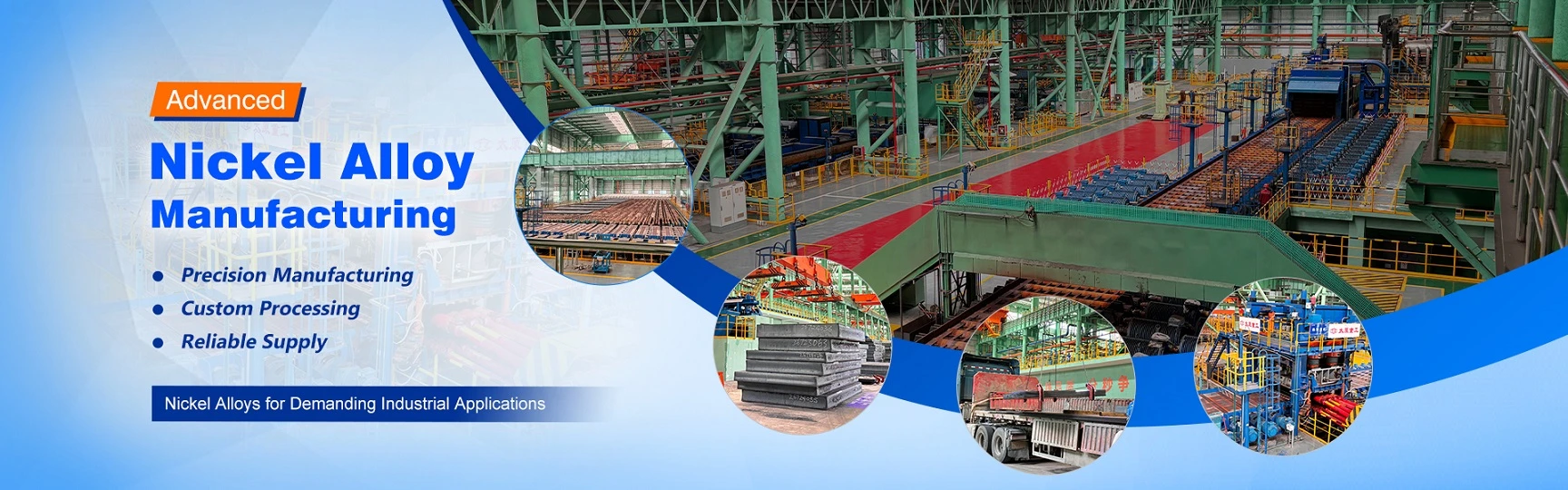
 Our core factory and collaborative production system are equipped with modern precision cutting, processing, and heat treatment equipment, focusing on transforming raw materials into semi-finished and finished products that meet stringent standards. To ensure that every batch of materials meets or exceeds specifications, we have established a comprehensive end-to-end quality inspection system. From material properties analysis (PMI) upon raw material warehousing to dimensional accuracy control during production, and finally to mechanical property testing (such as tensile strength and hardness) and non-destructive testing before final shipment, every step is rigorously controlled by our professional quality inspection team. We promise to provide an authoritative, online-verifiable original manufacturer's material certificate (MTC 3.1) for every order, and can arrange for third-party certification bodies (such as SGS, BV, and TUV) to conduct on-site inspections and issue certificates upon customer request.

Inconel 718 heat treatment


Send Inquiry

whatsapp

Phone

E-mail

Inquiry