

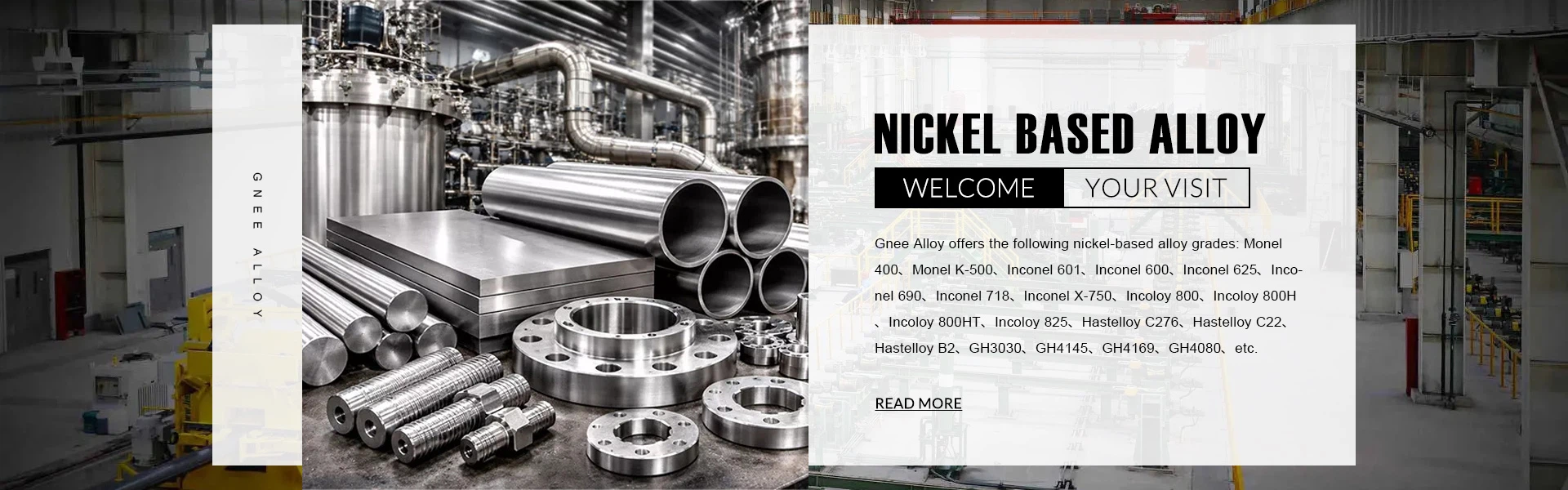
Inconel 625 is a nickel-based alloy known for its excellent corrosion and oxidation resistance. Thanks to its reliability and durability in a wide range of harsh environments, the alloy is widely used in industries such as aerospace, marine engineering, chemical processing, pollution control equipment, and nuclear reactors. Inconel 625 is designed to deliver high strength and outstanding resistance to fluid corrosion, making it an ideal material for manufacturing various complex components.
Click to get an Inconel 625 product quote
Inconel 625 Nickel Alloy: A Complete Guide to Properties and Applications
Gnee Alloy
Inconel 625 Nickel Alloy: A Complete Guide to Properties and Applications
请替换当前内容 We maintain a busy network of forestry and social development staff along with local facilitators in the areas we work.
We maintain a busy network of forestry and social development staff along with local facilitators in the areas we work.

Gnee Alloy
What are the characteristics of Inconel 625?
Inconel 625 (UNS NO6625) is a high-performance nickel-based superalloy, renowned for its exceptional tensile strength, resistance to extreme temperatures (down to 1093°C), and outstanding corrosion and oxidation resistance.

1. Inconel 625 Chemical Composition (%)
| Element | Value | |
|---|---|---|
|
|
Carbon (C) | ≤ 0.1% |
| Magnesium (Mg) | ≤ 0.5% | |
| Aluminum (Al) | ≤ 0.4% | |
| Silicon (Si) | ≤ 0.5% | |
| Phosphorus (P) | ≤ 0.015% | |
| Sulfur (S) | ≤ 0.015% | |
| Titanium (Ti) | ≤ 0.4% | |
| Chromium (Cr) | 20.0% – 23.0% | |
| Iron (Fe) | ≤ 5.0% | |
| Cobalt (Co) | ≤ 1.0% | |
| Nickel (Ni) | ≥ 58.0% | |
| Molybdenum (Mo) | 8.0% – 10.0% | |
| Niobium + Tantalum (Cb (Nb+Ta)) | 3.15% – 4.15% |

2. Inconel 625 Physical Properties
| Property | Value |
|---|---|
| Density | 8.44 g/cm³ |
| Specific Heat Capacity | 0.098 Kcal/kg·°C (21°C) |
| Melting Range | 1290°C – 1350°C |
| Modulus of Elasticity | 207.5 KN/mm² (21°C) |
| Electrical Resistivity | 129 μΩ·cm (21°C) |
| Coefficient of Thermal Expansion | 12.8 μm/m·°C (21°C – 93°C) |
| Thermal Conductivity | 9.8 W/m·°K (21°C) |
Click to download the Inconel 625 alloy PDF file now
3. Inconel 625 Performance Characteristics
Excellent Corrosion Resistance: Inconel 625 performs exceptionally well in a variety of corrosive environments, particularly in seawater where it offers outstanding resistance to pitting and crevice corrosion. It is highly resistant to chloride-induced stress corrosion cracking (SCC), making it suitable for marine engineering and chemical processing equipment.
High-Temperature Strength: Inconel 625 maintains high creep rupture strength and oxidation resistance at temperatures up to 1800°F (approximately 982°C), making it ideal for components operating in high-temperature environments.
Good Weldability: The alloy exhibits good weldability and is compatible with a variety of welding methods, including GTAW/TIG, GMAW/MIG, electron beam welding, and resistance welding.
Non-Magnetic: Inconel 625 is non-magnetic, making it suitable for applications where magnetic sensitivity is a concern.
4. Inconel 625 Alloy Application Areas
Aerospace: Used in components such as aircraft ducting systems, jet engine exhaust systems, and thrust reversers, ensuring reliable operation in high-temperature and corrosive environments.
Marine Engineering: Suitable for manufacturing specialized seawater equipment, such as pumps and valves, providing resistance against seawater corrosion.
Chemical Processing: Widely used in chemical processing equipment including piping, reactors, and storage tanks, offering resistance to various corrosive chemical media.
Pollution Control Equipment: Used in the manufacture of components for pollution control equipment, such as exhaust gas treatment systems and wastewater treatment facilities.
Nuclear Reactors: Suitable for structural components in nuclear reactors, ensuring long-term stability and safety in radioactive environments.


5. Inconel 625 Processing and Fabrication
Hot Working: Forging and hot working should be carried out within a strict temperature range, typically between 2100°F and 2150°F (approximately 1149°C to 1177°C). Processing in the 1400°F to 1000°F range (approximately 760°C to 538°C) should be avoided, as the alloy is prone to hot cracking in this temperature range.
Cold Working: Inconel 625 offers good cold workability and can be formed using conventional cold working methods. However, due to the alloy's tendency to work harden during cold working, intermediate annealing may be required for complex forming operations to restore ductility and relieve internal stress.
Welding: Filler materials matching the composition of the base metal should be selected to ensure the performance of the welded joint. The welding surface should be cleaned prior to welding to remove oil, paint, and other contaminants, preventing welding defects.
Machining: Inconel 625 can be machined using standard machining methods. Due to the alloy's high strength and toughness, work hardening tends to occur during machining. Therefore, high-rigidity machine tools and sharp cutting tools are recommended to reduce tool wear and improve machining efficiency. Water-based cutting fluids are recommended for cooling to reduce cutting temperatures and minimize tool wear.

Why Choose Gnee as Your Nickel-Based Alloy Supplier
✅ Over 18 years of export experience, products sold to more than 80 countries
✅ Certified by ISO, SGS, and BV
✅ Global inventory of Inconel, Hastelloy, Incoloy, and Monel alloy tubing, plates, and bars
✅ Custom processing services available – including cutting, polishing, CNC machining, and packaging
✅ Fast delivery within 7-15 days, supported by global logistics partners

Gnee Alloy inconel 625 Certificate
📦 Packaging and Shipping
All Nickel Based Alloy products are packaged using the following methods:
Wooden pallets or crates
Moisture-proof packaging
Labels with furnace number, standard, and size labels
Shipped worldwide by sea, air, or express

Gnee Alloy 625 Alloy Product Packing
Contact us for the latest export price quote for 625 Alloy
FAQ
Q:What are the benefits of using Inconel 625?
A:Inconel nickel-chromium alloy 625 (UNS N06625/W.Nr. 2.4856) is widely used due to its high strength, excellent machinability (including weldability), and superior corrosion resistance. Its operating temperature range is from low temperatures to 1800°F (982°C).
Q:Is Inconel 625 easy to weld?
A:Inconel welds are prone to cracking, making welding quite challenging. Therefore, some Inconel alloys are specifically designed for welding. For example, Inconel 625 is very easy to weld compared to other Inconel alloys. Inconel 718 is another alloy that is particularly easy to weld.
Q:Will Inconel 625 rust?
A:Nickel-based alloys, such as Inconel 625 and Inconel 718, are known for their high-temperature resistance, corrosion resistance, and oxidation resistance.
Q:Is Inconel 625 magnetic?
A:Inconel 625 is normally non-magnetic (paramagnetic) at room temperature. Its austenitic structure gives it strong resistance to magnetic fields, making it commonly used in precision electronic equipment, MRI scanners, and aerospace applications.


