

For engineers and furnace operators, the biggest challenge lies in the material's lifespan at extreme temperatures. You need to know:
Will it lose structural strength?
Will it undergo catastrophic oxidation (scaling)?
While many suppliers list only a temperature, the reality of high-temperature applications is far more complex. GH3030 reaches its physical limits at temperatures approaching 1000°C (1832°F). Understanding these limits is crucial to avoiding unexpected equipment failures and costly downtime.
At Gnee Steel, we've optimized GH3030 high-temperature tubing for industrial-grade durability, ensuring optimal performance in every thermal cycle.
GH3030 tube maximum service temperature guide

GH3030 tube maximum service temperature guide
GH3030 pipe (also known as Alloy 3030, XH78T, and sometimes classified as Ni-Cr-Fe solid solution strengthened alloy) is a nickel-based high-temperature alloy pipe designed to have excellent oxidation resistance and structural stability at high temperatures.
What is the yield strength of NIMONIC 75?
Yield strength: 152 MPa. Tensile strength: 286 MPa. Elongation: 75 %

GH3030 Pipe Maximum Operating Temperature Guidelines
Maximum Operating Temperature: Up to 1100°C (2012°F).
Optimal High Temperature Range: This alloy maintains good ductility and thermal strength, especially under lower loads, within a temperature range of 1000°C to 1100°C.
Long-Term Structural Load Limit: For components requiring higher load-bearing capacity (e.g., combustion chambers), the typical operating temperature is below 800°C to 900°C.
Recommended Annealing Temperature Range: Heat treatment (solution annealing) at 980°C to 1100°C followed by rapid cooling is recommended to ensure optimal oxidation resistance.
Contact our professionals to recommend alloys suitable for your project
1. Working conditions of GH3030 pipe
| Service Type | Max Temperature | Material Behavior |
| Continuous Service | 800°C (1472°F) | Excellent creep strength and a stable protective oxide layer. |
| Intermittent / Short-term | 1000°C (1832°F) | Strength Drop: The alloy softens significantly. Oxidation: The Cr2O3 layer begins to thicken and may spall during rapid cooling. |
| Melting Range | 1374°C - 1420°C | Complete loss of structural integrity. |
If your application requires a constant mechanical load above 850°C, we may recommend moving to GH3039 or Alloy 601. GH3030 is the most Cost-effective Solution for static parts strictly under the 800°C threshold.
2. Gas-affected temperature limit of GH3030 pipe
The "safe" temperature of GH3030 changes drastically based on the chemical atmosphere inside your furnace or reactor.
| Atmosphere Type | Recommended Max Temp | Potential Failure Mode |
| Oxidizing Air | 800°C - 900°C | Forms a dense, protective chromium-oxide scale. |
| Reducing Atmosphere | 750°C | Protective oxide layer cannot form effectively, leading to deep corrosion. |
| Sulfur-containing Gas | 600°C (Max) | Sulfidation: Rapid attack on grain boundaries, leading to embrittlement. |
| Vacuum | 950°C | Excellent performance; used widely in vacuum furnace internals. |
Download GH3030 Atmosphere & Corrosion Resistance Chart
3. Thermophysical properties of high-temperature alloy GH3030 tubes
For thermal expansion calculations, use the following Technical Datasheet values to prevent pipe buckling or joint failure.
| Temperature (℃) | Linear Expansion Coefficient (10⁻⁶/℃) | Thermal Conductivity (W/(m·K)) |
| 20 - 100 | 12.2 | 14.2 |
| 20 - 500 | 15.0 | 20.9 |
| 20 - 800 | 16.8 | 25.1 |
| 20 - 1000 | 18.2 | 28.0 |
Click to view Gnee Steel GH3030 inventory list
4. GH3030 Pipe Application Guide
Aerospace & Gas Turbines: Used in combustion chambers, afterburners, and exhaust systems, often operating in environments over 800°C, and up to 1000°C in lower-stress zones.
Industrial Furnace & Petrochemical: Suitable for radiant tubes, heating elements, and components needing oxidation resistance in both oxidizing and reducing atmospheres.
Fabrication & Welding: Good welding performance (TIG/MIG) and can be hot worked (1000–1200°C). It is recommended to avoid prolonged exposure to temperatures between 600–800°C to prevent embrittlement.


Why Source Our GH3030 Tubes for High-Heat Service?
✅️VIM+ESR Purity: Our melting process ensures a refined grain structure that resists Thermal Fatigue and grain growth at 800°C.
✅️Industrial Durability: We perform high-temperature tensile and creep tests to verify performance before shipping.
✅️MTC 3.1 Traceability: Full documentation for every batch, ensuring you receive Aerospace Grade quality.
✅️Wholesale Pricing: Benefit from Direct Factory Price with a massive In-Stock Inventory for Fast Shipping.

Gnee Steel GH3030 Certificate
📦 Packaging and Shipping
All Nickel Based Alloy products are packaged using the following methods:
Wooden pallets or crates
Moisture-proof packaging
Labels with furnace number, standard, and size labels
Shipped worldwide by sea, air, or express
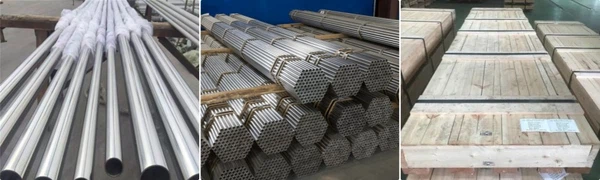
Gnee Steel GH3030 Product Packing
Contact us for the latest export price quote for GH3030 Alloy
FAQ
Q1: What exactly happens to GH3030 at 1000°C?
A: At 1000°C, the chromium in the alloy begins to react rapidly with oxygen. While it doesn't "melt," the Mechanical Load Capacity drops by over 80% compared to room temperature. It becomes "soft" and is prone to sagging under its own weight if not properly supported.
Q2: Can GH3030 be used for furnace heating elements?
A: Yes, it is a classic material for heating element support tubes and radiant tubes. Its Thermal Stability ensures the tube won't crack during the frequent on-off cycles of a furnace.
Q3: How do I prevent sulfidation if my gas contains trace sulfur?
A: If sulfur is present, we recommend keeping the operating temperature below 600°C or applying a specialized aluminized coating. Contact our technical team for a Custom Fabrication solution.
Q4: Is GH3030 equivalent to Nimonic 75 for high-temp service?
A: Yes. They are chemically and thermally equivalent. Our GH3030 meets the performance requirements of UNS N06075 and W.Nr. 2.4951.


