

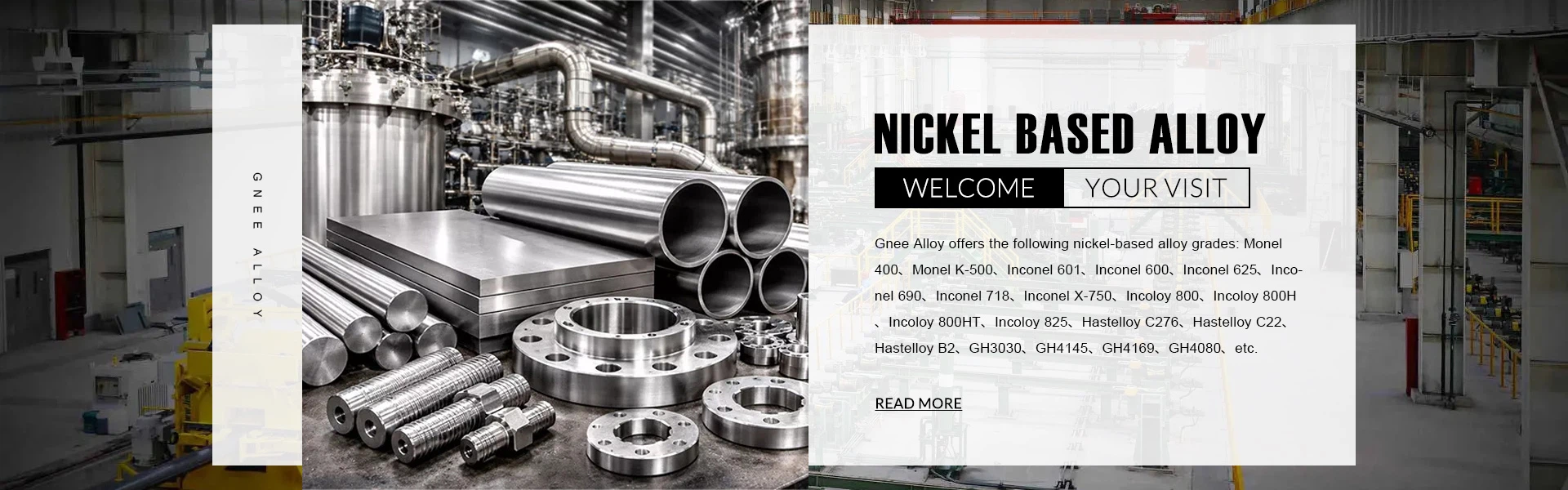

Inconel 625 UNS N06625 | ASTM B443 / ASME SB-443 is the preferred alloy for pressure vessel linings (welded overlays or weld cladding). By forming a protective layer on an economical substrate such as carbon steel, it provides excellent corrosion resistance and high-temperature mechanical properties in strong acid, chloride, and high-frequency cyclic stress environments.
This alloy is virtually immune to chloride-induced stress corrosion cracking (SCC), making it particularly suitable for marine engineering, deep-sea oil production, and chemical processing. Its high molybdenum (8-10%) and high chromium (20-23%) content gives it excellent resistance to pitting and crevice corrosion, remaining stable even in highly corrosive acids such as wet-process phosphoric acid.
In terms of high-temperature performance, Inconel 625 maintains structural integrity and oxidation resistance below 982°C (1800°F), ensuring durability under high-temperature reaction or shutdown conditions.
Click to apply for professional technical selection review of pressure vessel lining
Challenges in Using Inconel 625 Pressure Vessel Liners
Before evaluating any alloy, it's crucial to understand the extreme operating conditions the vessel liner must withstand-typically exceeding a design life of 15-30 years:
Highly Corrosive Media: Strong inorganic/organic acids, high chloride concentrations, acidic fluids containing hydrogen sulfide/carbon dioxide, and alternating oxidation/reduction environments.
High Pressure and Temperature: Operating temperatures typically range from 150°C to 900°C, with internal pressures reaching tens to hundreds of bar.
Thermal Cycling Fatigue: Repeated heating and cooling cycles generate thermal stress and accelerate crack initiation at welds.
Weld Heat-Affected Zone (HHAZ) Vulnerability: The HHAZ is the most common failure point for liners, prone to intergranular corrosion and sensitization.
Strict Compliance Requirements: Vessels must comply with ASME Boiler and Pressure Vessel Codes, NACE Codes, and Area Pressure Equipment Directives.
Ease of Maintenance: Once installed, liner inspection or replacement is difficult and costly; therefore, long-term reliability is paramount.
This is why standard austenitic stainless steel, and even most duplex stainless steels, cannot meet the required service life. This is also why Inconel 625 has become the default material for critical vessel lining applications.
Overview of Inconel 625 Pressure Vessel Liner Plate Selection
| Parameter | ASTM B443 (Inconel 625) | ASME SB-443 (Pressure Vessel Supplement) |
|---|---|---|
| Specification Type | Nickel Alloy Plate, Sheet & Strip Standard | ASME Boiler & Pressure Vessel Code Section VIII |
| Material | Inconel 625 (UNS N06625 / W.Nr. 2.4856) | Same – with ASME "SA" marking |
| Product Form | Plate, sheet, and strip (hot-rolled or cold-rolled) | Same – for pressure vessel fabrication |
| Grade / Condition | Grade 1 (Annealed) or Grade 2 (Solution Annealed) | Grade 1 preferred for lining; Grade 2 for high-temperature service |
| Typical Lining Applications | Flue gas desulfurization (FGD) absorbers, chemical reactor linings, seawater heat exchanger plates, chimney linings, sour gas vessel cladding | Pressure vessel internal cladding, corrosion-resistant barrier layers, weld overlay backing |
| Key Strengthening Mechanism | Solid-solution strengthening (Mo + Nb) – no precipitation hardening required | Same |
| Melting Process | VIM + ESR (typical) or VIM + VAR (specified) | VIM + VAR recommended for critical service |
| Certification | EN 10204 Type 3.1 or 3.2 | EN 10204 Type 3.2 + ASME data report |
| ASME Section VIII Compliance | When specified as SB-443 | Mandatory for stamped pressure vessels |
UNS N06625 Pressure Vessel Plate Chemical Composition (wt%)
| Element | Standard Range | Function in Lining Performance | |
|---|---|---|---|
|
|
Nickel (Ni) | ≥ 58.0 (balance) | Stable austenitic matrix; SCC resistance |
| Chromium (Cr) | 20.0 – 23.0 | Oxidation & general corrosion resistance | |
| Molybdenum (Mo) | 8.0 – 10.0 | Pitting & crevice corrosion resistance | |
| Niobium + Tantalum (Nb+Ta) | 3.15 – 4.15 | HAZ stabilization; intergranular corrosion resistance | |
| Iron (Fe) | ≤ 5.0 | - | |
| Carbon (C) | ≤ 0.10 | Controlled for weldability | |
| Phosphorus / Sulfur | ≤ 0.015 each | Minimized for corrosion and toughness |


Gnee Alloy Nickel-Based Alloy Inventory Product PMI Testing
ASTM B443 Inconel 625 Pressure Vessel Lining Plate Mechanical Properties
| Product Form | Tensile Strength (Min) | 0.2% Yield Strength (Min) | Elongation (Min) |
|---|---|---|---|
| Sheet / Thin Lining Plate (≤4.76mm) | 690 MPa | 275 MPa | 30% |
| Heavy Lining / Cladding Plate (>4.76mm) | 690 MPa | 414 MPa | 30% |
Click to download the Inconel 625 alloy PDF file now
Inconel 625 Pressure Vessel Liner Melting and Manufacturing Requirements

Inconel 625 Pressure Vessel Liner Melting and Manufacturing Requirements
| Parameter | ASTM B443 (Standard) | Pressure Vessel Supplement |
|---|---|---|
| Melting Process | VIM + ESR (typical) | VIM + VAR (for critical service) |
| Product Form | Hot-rolled plate (> 4.76 mm), cold-rolled sheet (≤ 4.76 mm), and strip | Same – with tighter dimensional control |
| Heat Treatment | Solution annealed at 980–1150°C, rapid cool | Same – documented time/temperature record |
| Surface Finish | Pickled, blasted, bright annealed, or as-rolled | Pickled or bright annealed – for weld overlay bonding |
| Edge Condition | Sheared, slit, or rolled edges | Sheared or machined edges – for butt welding |
| Dimensional Tolerances | ASTM B906 – includes thickness, width, length, flatness | Same – plus plate flatness verification (critical for lining adhesion) |
Contact us to learn about our Inconel 625 manufacturing process information
ASME SB-443 Inconel 625 Pressure Vessel Lining Plates – Standard Dimensional Data
| Dimension Parameter | Recommended Range / Data | Details & Application Notes |
|---|---|---|
| Thickness | 4.8mm (3/16") to 50mm (2") | • 3.0mm – 8.0mm (Thin Gauge): Commonly used for large-area, complex-shaped linings. Easy to form and weld. • 12.7mm (1/2") – 25.4mm (1") (Medium Gauge): The classic choice for pressure vessel linings. Offers balanced strength and fabricability. • ≥50mm (2") (Heavy Gauge): Used for extremely high-pressure or severe erosion/wear services, such as reactor bottoms or heavy-duty vessel heads. |
| Width | 1000mm (1m) to 2500mm (2.5m) | • Standard Master Sheet Sizes: Commonly available as 1000×2000mm, 1220×2440mm (4'×8'), 1500×3000mm, etc. • Maximum Width: Up to 2500mm (subject to mill capability). |
| Length | 2000mm to 6000mm (6m) | • Standard Length Range: Typically supplied in 2m to 6m lengths. • Cut-to-Size Service (Value-Added): A key concern for engineers. We offer custom cutting per vessel inner wall development dimensions to minimize on-site welding and fabrication time. |
| Dimensional Tolerances | Per ASME SB-443 / ASTM B443 | • Thickness, width, and length tolerances conform to ASME SB-443 / ASTM B443 specifications. • Tighter tolerances available upon request. |
| Surface Finish | Hot-rolled, pickled, ground, or polished | • Standard finish: Hot-rolled & pickled (for welding and lining installation). • Polished or ground finish available for special applications (e.g., hygienic or high-cleanliness services). |
| Cutting Methods | Shearing, plasma cutting, abrasive cutting, or inert arc cutting | • Shearing for thin gauges. • Plasma / Abrasive / Inert Arc for thicker plates or custom shapes. • All cutting methods preserve the corrosion-resistant properties of Inconel 625. |
Contact us to customize Inconel 625 products to fit your project dimensions
Inconel 625 Pressure Vessel Plate Non-Destructive Testing (NDT) Requirements
| Parameter | ASTM B443 (Standard) | Pressure Vessel Supplement |
|---|---|---|
| Ultrasonic Testing (UT) | As specified | 100% mandatory on plates for pressure vessel cladding |
| Liquid Penetrant Testing (PT) | As specified | 100% mandatory on weld overlay surfaces |
| Visual Inspection | 100% | 100% – with magnification as required |
| Hardness Testing | Per lot | Per plate – documented in MTR |
| Corrosion Testing | As specified (ASTM G28) | Mandatory – intergranular corrosion test for lining material |
Note: For pressure vessel lining applications, 100% UT is standard to ensure no internal defects that could compromise the corrosion barrier


Inconel 625 Pressure Vessel Plate Quality Certifications (MTR Requirements)
| Document | ASTM B443 (Standard) | Pressure Vessel Supplement |
|---|---|---|
| Heat Number | Full traceability | Full traceability |
| Melting Process | VIM + ESR (or as specified) | VIM + VAR certification (if required) |
| Chemical Composition | Full analysis | Full analysis + optional trace elements |
| Mechanical Properties | UTS, YS, Elongation | UTS, YS, Elongation, Hardness |
| Corrosion Testing | As specified | ASTM G28 Method A – mandatory for chemical service |
| UT Results | As specified | 100% UT report – with defect map |
| Heat Treatment Record | Time + temperature + cooling | Time + temperature + cooling + quench method |
| Certification Type | EN 10204 Type 3.1 or 3.2 | EN 10204 Type 3.2 + ASME data report |
Click to contact us to view our comprehensive certifications
Inconel 625 compared to other alloy lining materials
| Comparison Parameter | Inconel 625 (UNS N06625) | Alloy C-276 (UNS N10276) | Inconel 825 (UNS N08825) | Super Duplex S32750 (UNS S32750) | Titanium Gr. 2 (UNS R50400) |
|---|---|---|---|---|---|
| Alloy Type | Ni-Cr-Mo-Nb (Solid Solution Strengthened) | Ni-Cr-Mo-W (Solid Solution Strengthened) | Ni-Fe-Cr-Mo (Ti-stabilized) | Duplex Stainless Steel (Austenitic-Ferritic) | Commercially Pure Titanium (Alpha Alloy) |
| Key Strengthening Mechanism | Nb + Mo solid solution & precipitation | W + Mo solid solution | Mo + Ti stabilization (no precipitation) | Nitrogen + Duplex microstructure | Pure metal (work hardening only) |
| Tensile Strength, min. (MPa) | 827 (Annealed) | 690 | 586 | 795 | 345 |
| Yield Strength 0.2%, min. (MPa) | 414 (Annealed) | 283 | 241 | 550 | 275 |
| Elongation, min. (%) | 30 | 40 | 30 | 15 | 20 |
| Pitting Resistance Equivalent (PRE) | ~55 | ~67 | ~34 | ~42 | N/A (Not applicable) |
| Matching Filler Metal | ERNiCrMo-3 | ERNiCrMo-4 | ERNiCrMo-3 or ERNiFeCr-1 | ER2594 | ERTi-2 |
| Relative Cost Index (625=100) | 100 | ~150-180 | ~65-75 | ~25-30 | ~70-90 (varies by thickness) |
| Typical Max. Service Temp. (°C) | ~870 (ASME limit) | ~540 (limited by thermal stability) | ~540 | ~250 (due to embrittlement) | ~315 |
| Availability in Plate Form | Widely available (ASME SB-443) | Available (ASME SB-575) | Available (ASME SB-424) | Available (ASME SA-240) | Available (ASME SB-265) |
| Primary Risk/Failure Mode | Stress relaxation at high temp. (w/out aging) | Susceptible to intergranular corrosion (if improperly welded) | Pitting in high-chloride, H₂S environments | 475°C embrittlement, hydrogen embrittlement | Galvanic corrosion with carbon steel |
Contact our professionals to recommend the right alloy for your project
Why Choose Gnee as Your Nickel-Based Alloy Supplier
✅️Direct Factory Pricing: Eliminate the 15-20% trading house markups and secure wholesale rates for large-scale vessel overhauls.
✅️MTC 3.1 & 3.2 Traceability: Full EN 10204 documentation provided, documenting exact PREN values and high-temp mechanical properties.
✅️Wholesale Inventory: Massive stock of 0.5mm to 10mm sheets ready for Fast Global Shipping.
✅️AS9100 & ISO 9001 Certified: Manufactured under the world's most rigorous quality management protocols.

Gnee Alloy inconel 625 Certificate
📦 Packaging and Shipping
All Nickel Based Alloy products are packaged using the following methods:
Wooden pallets or crates
Moisture-proof packaging
Labels with furnace number, standard, and size labels
Shipped worldwide by sea, air, or express

Gnee Alloy 625 Alloy Plate Packing
Contact us for the latest export price quote for 625 Alloy
Customer feedback on Gnee Alloy products

Real customer feedback on Gnee Alloy products
FAQ
Q1: Why choose Inconel 625 over 316L for phosphoric acid reactors?
A: Phosphoric acid often contains chloride impurities. While 316L will suffer rapid wall thinning and pitting, Inconel 625 provides an impenetrable barrier, extending your Material Life Cycle by up to 500% and preventing costly emergency shutdowns.
Q2: Can Inconel 625 be used as a "Weld-Overlay" on carbon steel?
A: Absolutely. Alloy 625 is the premier choice for cladding and overlay. Its high ductility handles the dilution from the base carbon steel while maintaining a Corrosion-Resistant Shield at the surface.
Q3: Is your material NACE MR0175 compliant for sour gas vessels?
A: Yes. Our materials are specifically processed and verified to meet the hardness and microstructural limits required by NACE MR0175 / ISO 15156, making them the definitive choice for offshore HP/HT vessels.
Q4: Do you offer trial coupons for site corrosion testing?
A: Yes. We support R&D and pilot plants by providing small GH3625 (625 equivalent) coupons for material validation before you commit to a full project order.


