

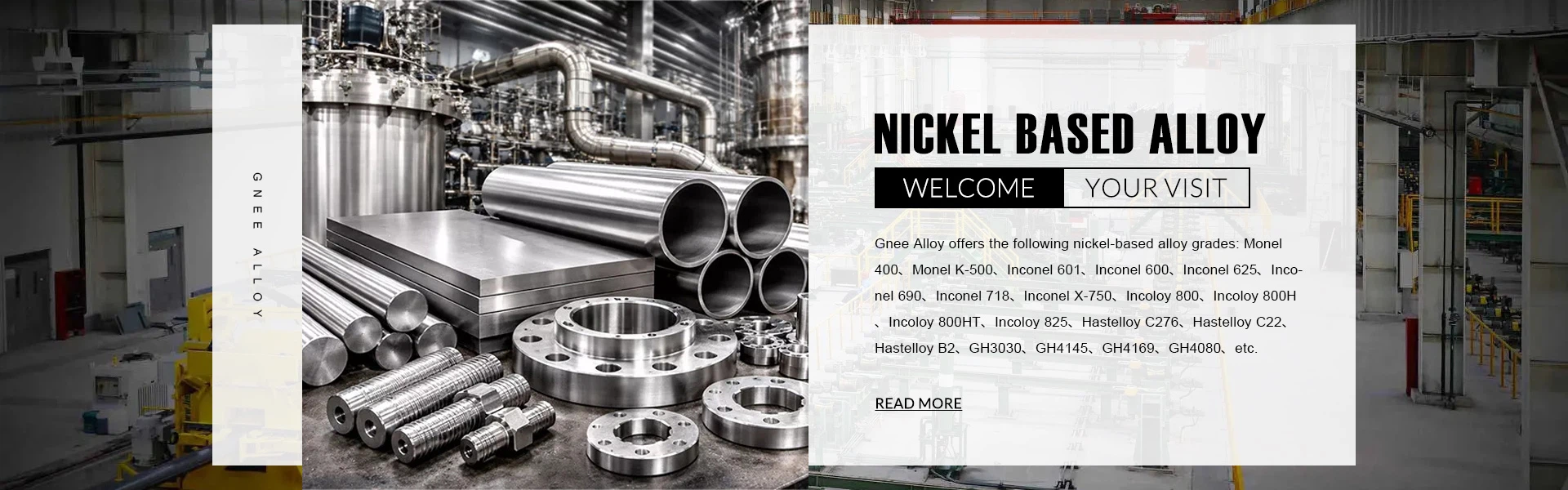
Nickel-based corrosion-resistant alloy
corrosion-resisting nickelbase alloys
Alloys that use nickel as a base and can resist corrosion in some media are called nickel-based corrosion-resistant alloys. In addition, corrosion-resistant alloys containing more than 30% nickel and more than 50% nickel plus iron are customarily called iron-nickel-based corrosion-resistant alloys (see stainless acid-resistant steel).
Nickel-based corrosion-resistant alloys mostly have an austenitic structure. In the solid solution and aging treatment state, there are intermetallic phases and metal carbonitrides on the austenite matrix and grain boundaries of the alloy. Various corrosion-resistant alloys are classified according to their composition and their characteristics are as follows:
The corrosion resistance of Ni-Cu alloy is better than that of nickel in reducing media, and its corrosion resistance is better than copper in oxidizing media. It is resistant to high temperature fluorine gas, hydrogen fluoride and hydrogen fluoride in the absence of oxygen and oxidant. The best material for acids (see Metal Corrosion).


Ni-Cr alloy is mainly used under oxidizing media conditions. Resistant to high temperature oxidation and corrosion from gases containing sulfur, vanadium and other gases, its corrosion resistance increases with the increase in chromium content. This type of alloy also has good resistance to hydroxide (such as NaOH, KOH) corrosion and stress corrosion resistance.
Ni-Mo alloy is mainly used under conditions of reducing medium corrosion. It is the best alloy to resist hydrochloric acid corrosion, but in the presence of oxygen and oxidants, the corrosion resistance will decrease significantly.
Ni-Cr-Mo(W) alloy has the properties of the above-mentioned Ni-Cr alloy and Ni-Mo alloy. Mainly used under oxidation-reduction mixed media conditions. This type of alloy has good corrosion resistance in high-temperature hydrogen fluoride gas, in hydrochloric acid and hydrofluoric acid solutions containing oxygen and oxidants, and in wet chlorine gas at room temperature.
Ni-Cr-Mo-Cu alloy is resistant to both nitric acid and sulfuric acid corrosion, and also has good corrosion resistance in some oxidation-reduction mixed acids.
Depending on the chemical composition of the alloy, especially the content of C, S, P, Si and other elements and the purity requirements, it can be smelted in an electric arc furnace, a vacuum induction furnace, or a secondary refining process. In order to make the corrosion-resistant alloy have good thermoplasticity, the deoxidation process must be strictly controlled during smelting. Some alloys need to add an appropriate amount of Al, Ca, Mg, rare earth, etc. as final deoxidizer. The thermoplasticity of some alloys can be significantly improved by the electroslag remelting process.
Nickel-based corrosion-resistant alloys easily combine with sulfur in the furnace gas during the heating process to form nickel sulfide with a low melting point, which cracks during processing. Therefore, electric furnaces, protective gas heating furnaces or low-sulfur fuels should be used for heating. Heating furnace. The temperature range of thermal processing is shown in Table 1. This type of alloy usually has better cold working properties. After each solution or annealing treatment, the allowable cold working deformation is generally between 20 and 80%.


