

Both Inconel 686 vs Inconel 625 alloys are nickel-based superalloys, renowned for their high-temperature strength, corrosion resistance, and fabricability. However, despite their similarities, there are crucial differences between the Inconel 686 and Inconel 625 that must be taken into account when selecting the right alloy for a given task.
Inconel 686 vs 625 – What's the Difference?
Inconel 686 vs 625 – Composition
Let's start with a brief overview of their compositions. Inconel 625, as we know, is primarily composed of nickel, chromium, and molybdenum. This composition gives it excellent resistance to oxidation and corrosion, even in highly oxidizing environments. On the other hand, Inconel 686 has a slightly different composition, with additional alloying elements such as titanium and aluminum, which contribute to its unique properties.
Inconel 686 vs 625 – Microstructure
One of the key differences between these two alloys lies in their microstructure. Inconel 625 exhibits a stable austenitic structure, which maintains its ductility and toughness even at elevated temperatures. This allows it to retain its mechanical properties over a wide range of operating conditions. In contrast, Inconel 686 undergoes a precipitation-hardening process, where titanium and aluminum form gamma prime precipitates that significantly enhance its strength and creep resistance at high temperatures.
The precipitation-hardening mechanism in Inconel 686 results in superior creep resistance compared to Inconel 625. Creep is a time-dependent deformation that occurs at high temperatures and stresses, and it can be a significant issue in components operating under extreme conditions. The gamma prime precipitates in Inconel 686 effectively obstruct the movement of grain boundaries and dislocations, thereby reducing creep rates and enhancing the alloy's durability.


Inconel 686 vs 625 – Corrosion Resistance
In terms of corrosion resistance, both alloys offer excellent performance in most environments. However, Inconel 625 tends to have slightly better corrosion resistance in oxidizing acids, while Inconel 686 may perform better in reducing environments. This difference is due to the specific composition and microstructure of each alloy, which affects their response to various corrosive agents.
Inconel 686 vs 625 – Fabrication Characteristics
Fabrication characteristics are also worth considering. Both Inconel 625 and Inconel 686 can be welded, forged, and machined using standard metallurgical practices. However, due to the presence of gamma prime precipitates in Inconel 686, it may require slightly different welding parameters and post-weld heat treatment to ensure optimal performance. Additionally, the hardness and strength of Inconel 686 may require the use of more robust machining tools and techniques.
Inconel 686 vs 625 – Applications
Finally, the choice between Inconel 686 and Inconel 625 often depends on the specific application requirements. Inconel 625 is widely used in aerospace, oil and gas, and chemical processing industries due to its balance of strength, corrosion resistance, and fabricability. Its ability to retain mechanical properties at high temperatures makes it suitable for turbine blades, exhaust systems, and other critical components.
On the other hand, Inconel 686 is often preferred in applications that demand superior creep resistance and strength at even higher temperatures. This alloy finds its way into advanced turbine engines, power generation equipment, and other high-performance systems where creep deformation can be a limiting factor.
Conclusion
In conclusion, while Inconel 686 and Inconel 625 are both exceptional nickel-based superalloys, their differences in composition, microstructure, and properties make them suitable for different applications.
Our product range
| Product Form | Standard Specifications & Dimensions | Common Alloys (Examples) | Typical Standards |
|---|---|---|---|
| Bar & Rod | Round Bar: Diameter: 3mm ~ 300mm Hexagon Bar: Across Flats: 5mm ~ 100mm Square Bar: Width: 5mm ~ 150mm Length: Random, Cut-to-length, or Coils (small diameters) |
Alloy 200/201 Monel 400/K-500 Inconel 600/601/625/718 Incoloy 800/800H/825 Hastelloy C-276/C-22/B-2/B-3 |
ASTM B160, B164, B166 EN/DIN 2.4066, 2.4816, 2.4851 ASME SB-166, SB-167 |
| Wire | Diameter: 0.1mm ~ 12mm Form: Coils, spools, or straight lengths Finish: Bright, pickled, annealed |
Alloy 200/201 Inconel 600/625/X-750 Incoloy 825 |
ASTM B166, B167 EN/DIN 17752 |
| Sheet & Plate | Thickness (Sheet): 0.1mm ~ 5.0mm Thickness (Plate): 5.0mm ~ 100mm+ Width: Up to 2000mm (depending on alloy/thickness) Length: Up to 6000mm or as required |
Alloy 200/201 Monel 400 Inconel 600/625/718 Incoloy 800H/825 Hastelloy C-276 |
ASTM B162, B168, B409 EN/DIN 17742, 17744 |
| Strip & Foil | Thickness (Strip): 0.05mm ~ 2.0mm Thickness (Foil): 0.02mm ~ 0.05mm Width: Up to 600mm Condition: Cold rolled, annealed, tempered |
Alloy 200/201 Inconel 600/625 Incoloy 825 |
ASTM B162, B168 |
| Pipe & Tube | Seamless Pipe (ASTM B161/B167): - OD: 3/16" ~ 14" (6mm ~ 355mm) - Schedule: SCH 5S to XXS Welded Tube (ASTM B163/B516): - OD: 6mm ~ 300mm - Wall Thickness: 0.5mm ~ 10mm |
Alloy 200/201 Monel 400 Inconel 600/625 Incoloy 800H/825 Hastelloy C-276 |
ASTM B161, B163, B167, B516 ASME SB-163, SB-167 |
Get the complete product catalog
Our factory and testing
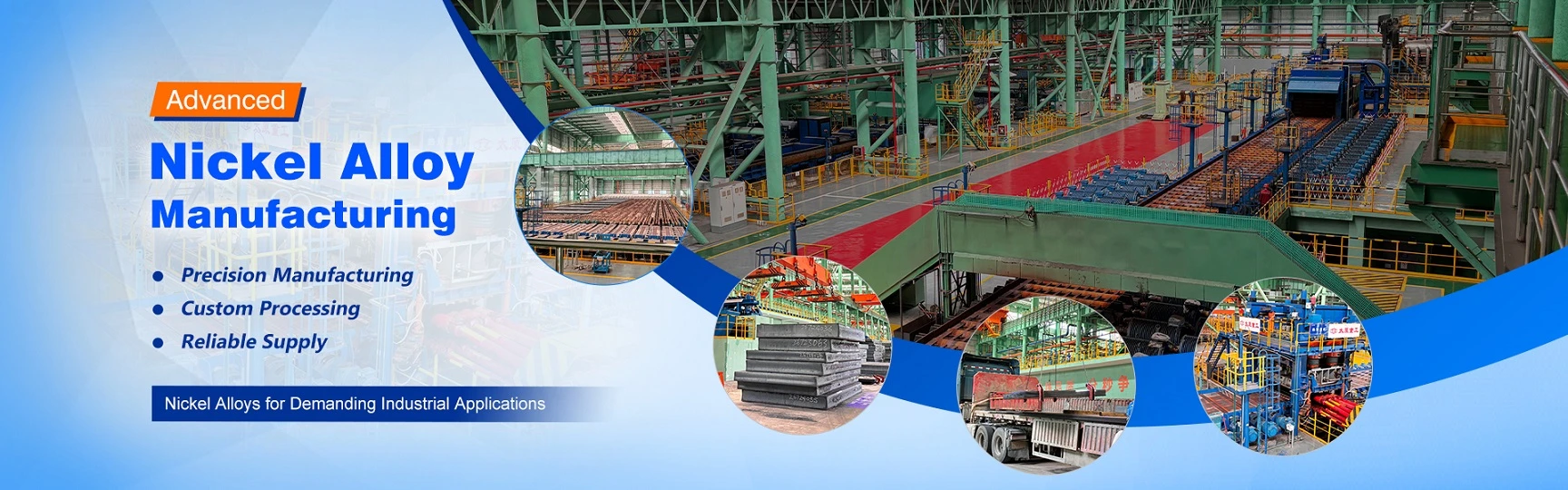
Our core factory and collaborative production system are equipped with modern precision cutting, processing, and heat treatment equipment, focusing on transforming raw materials into semi-finished and finished products that meet stringent standards. To ensure that every batch of materials meets or exceeds specifications, we have established a comprehensive end-to-end quality inspection system. From material properties analysis (PMI) upon raw material warehousing to dimensional accuracy control during production, and finally to mechanical property testing (such as tensile strength and hardness) and non-destructive testing before final shipment, every step is rigorously controlled by our professional quality inspection team. We promise to provide an authoritative, online-verifiable original manufacturer's material certificate (MTC 3.1) for every order, and can arrange for third-party certification bodies (such as SGS, BV, and TUV) to conduct on-site inspections and issue certificates upon customer request.


