

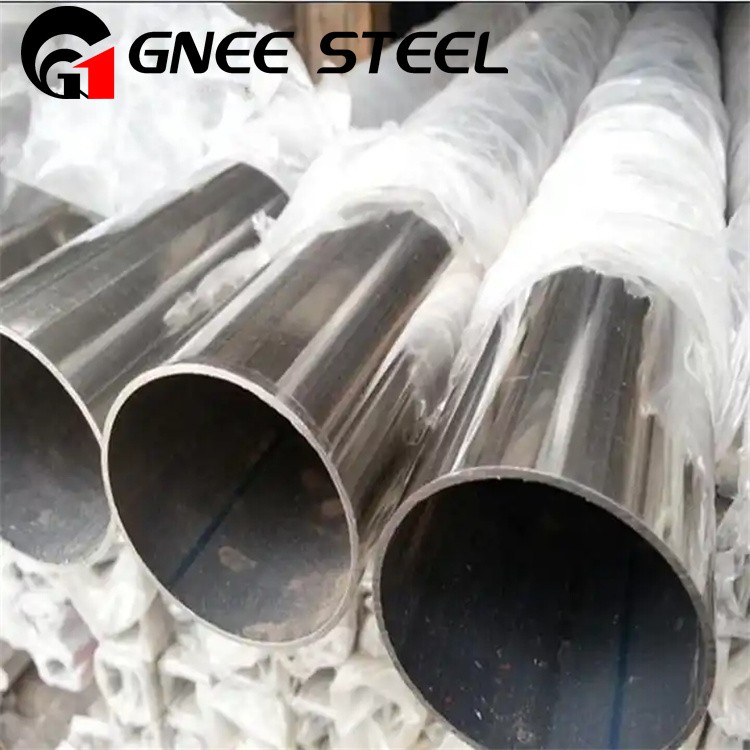
253MA is a heat-resistant austenitic stainless steel
253Ma alloy has the following characteristics:
253MA is a heat-resistant austenitic stainless steel designed for applications requiring high creep strength and good corrosion resistance. Its operating temperature range is 850~1100 ℃.
The chemical composition of 253MA is balanced, making the steel have suitable properties in the temperature range of 850℃-1100℃, with a scale onset temperature as high as 1150℃; excellent creep deformation resistance and creep rupture strength; in large It has good resistance to high temperature corrosion and balanced brush corrosion in most gas media; it has high yield strength and tensile strength at high temperatures; it has good formability and weldability, and sufficient machinability.
In addition to the alloying elements chromium and nickel, 253MA stainless steel also contains a small amount of rare earth metals (REM), which significantly improves its capabilities. Nitrogen is added to improve creep properties and make this steel austenitic. Despite its relatively low chromium and nickel content, this stainless steel has in many cases the same high-temperature properties as highly alloyed alloy steels and nickel-based alloys.

253Ma Application Scope Application fields: 253MA is widely used in sintering equipment, blast furnace equipment, steel melting, furnaces and continuous casting equipment, rolling mills (heating furnaces), heat treatment furnaces and accessories, mineral equipment and cement production equipment, etc.
Nickel Ni balance
Nickel is a hard, ductile, ferromagnetic metal that is highly polishable and resistant to corrosion. Nickel is an iron-loving element. The earth's core is mainly composed of iron and nickel elements.
Carbon is a non-metallic element with the chemical symbol C. It is stable at room temperature, not easy to react, and has extremely low toxicity to the human body. It can even be safely ingested in the form of graphite or activated carbon. It is located at the third place in the periodic table of elements. Two-cycle IVA family.
Chromium, chemical symbol Cr, is a steel-gray metal. The element's name comes from Greek, and its original meaning is "color" because chromium compounds have colors. In 1797, French chemist L.N. Vauquelin discovered a new mineral in Siberian red lead ore (chromite), which was obtained by reducing it with carbon the following year.
Tungsten is a metal element with the element symbol W. It has high hardness, high melting point, and is not corroded by air at room temperature. It is mainly used for manufacturing filaments and high-speed cutting alloy steel, super-hard molds, and is also used in optical instruments and chemical instruments.
Molybdenum is a transition element that can easily change its oxidation state and plays a role in transferring electrons during redox reactions in the body. In its oxidized form, molybdenum is most likely in the +6 valence state.
Aluminum is a metallic element with the element symbol Al. It is a silver-white light metal. It is malleable. Products are often made into rods, sheets, foils, powders, ribbons and filaments. In humid air, an oxide film can be formed to prevent metal corrosion.
Titanium is a metallic chemical element with chemical symbol Ti and atomic number 22. It is located in period 4 and group IVB of the periodic table of chemical elements. It is a silver-white transition metal characterized by light weight, high strength, metallic luster, and resistance to moisture chlorine corrosion.
Iron is a metallic element with an atomic number of 26, its elemental chemical formula: Fe, and its average relative atomic mass of 55.845.
Manganese, chemical element, element symbol Mn, atomic number 25, is a gray-white, hard, brittle, shiny transition metal. Pure metallic manganese is a metal slightly softer than iron. Manganese containing a small amount of impurities is hard and brittle and will oxidize in moist places.
Silicon is also a very common element. However, it rarely appears in nature in a simple form. Instead, it exists in rocks, gravel, and dust in the form of complex silicates or silica.
Phosphorus is the 15th chemical element with the symbol P. It is in the third period of the periodic table of elements and group VA.
Sulfur is a non-metallic element with chemical symbol S and atomic number 16. Sulfur is one of the oxygen group elements (Group VIA) and is located in the third period of the periodic table of elements.


